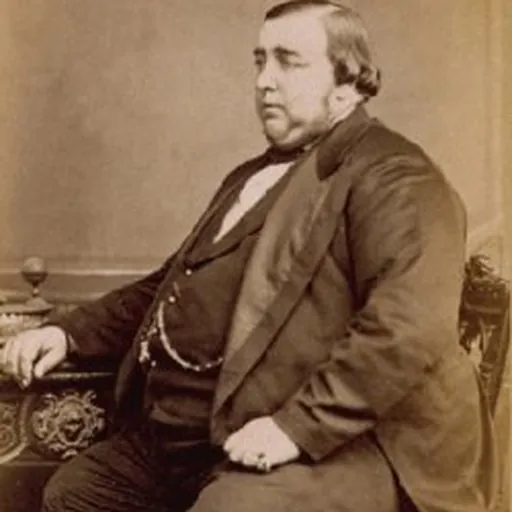
Arthur Orton
English imposter
About Arthur Orton
Lived 1834 – 1898 (aged 64). Arthur Orton was a British butcher, known for Tichborne Case.
Arthur Orton (20 March 1834 – 1 April 1898) was an English man who has generally been identified by legal historians and commentators as the "Tichborne Claimant", who in two celebrated court cases both fascinated and shocked Victorian society in the 1860s and 1870s.
The son of a London butcher, Orton went to sea as a boy, spent a year in Chile, and worked as a butcher and stockman for squatters in Australia in the middle-to-late 1850s. In 1866 Thomas Castro, a butcher from Wagga Wagga in Australia, claimed to be Roger Tichborne, the heir to the Tichborne estates and baronetcy who had been declared lost at sea in 1854. During the protracted court proceedings that followed Castro's claim, evidence was produced that Castro might in fact be Arthur Orton, attempting to secure the Tichborne fortunes by imposture.
The verdict of the jury in Regina versus Castro (1873–74) was that Castro was not Roger Tichborne, and that he was Arthur Orton. He was sentenced to fourteen years imprisonment for perjury. After his release he lived in great poverty, still insisting that he was Tichborne. In 1895 he confessed to being Orton, but about one year later he retracted his confession. He died in 1898; the Tichborne family allowed a coffin plate bearing the names "Sir Roger Charles Doughty Tichborne" to be placed on the coffin, not because his claim had been conceded, but because "o legal means of preventing such an outrage existed".
In November 1852 he sailed for Tasmania aboard the Middleton In October 1855, Orton appeared on a charge of obtaining money under false pretences brought by Frederick Dight, after Orton had been a witness against Dight in an earlier Supreme Court trial, but the case was dismissed. Contemporary view of Port Albert, Gippsland. Arthur Orton landed there as a passenger on the schooner 'Eclipse' after leaving Tasmania for mainland Australia in 1855. From 1855 to the mid-1860s there is little detail about his life, but he appears to have pursued gold prospecting, mail-running and pastoral station-hand work, with a suggestion of bushranging and even murder. He worked for some time on squatters 'runs' in the district.
In May 1856, he appears in a subscription list, donating £2, for 'the Patriotic Fund from the Upper District of Gippsland' as a stockman and 'one of the men' of 'Mewburn Park'. In April 1859, a letter to the editor of the 'Gippsland Guardian' mentions Orton, 'who was in charge of the Dargo station', and recounts Orton's testimony in relation to 'the mysterious disappearance of William Henry Clare alias Ballaarat Harry, and Thomas Took'.
Orton's letters to England while he was in Hobart showed he was fond of dogs and children and affectionate towards his girlfriend in Wapping.
Tichborne claimant
In August 1865 advertisements appeared in Australian newspapers asking for information about the fate of Roger Charles Tichborne (born 1829), who had been on a vessel, Bella, which had disappeared at sea off the coast of South America in 1854. This advertisement had been inserted by Lady Tichborne, the missing man's mother, who believed her son was still alive. Roger Tichborne had, however, been presumed dead by the courts and his younger brother had thus succeeded to the Tichborne baronetcy and the family's estates.
In 1866, through his solicitor William Gibbes, a butcher in Wagga Wagga known as "Thomas Castro" came forward, claiming to be the missing Sir Roger. He appeared to have some knowledge of the missing man's background and family history, although many of his assertions were inaccurate or false. However, at Gibbes's prompting he wrote to Lady Tichborne and was invited to come to England to be recognised.
Whilst living in England, he stayed at Essex Lodge in Thornton Heath with Lady Tichborne. According to author Bernard Falk, her religious sensibilities were offended by the great usage he and his invited guests made of alcohol and tobacco, so she moved out.
Recognition, doubt and legal process
The Scotland Yard detective Jack Whicher discovered that immediately on his arrival in England in December 1866 the Claimant visited Wapping and made enquiries about the Orton family. When this visit was made public during the legal processes, it was presented as strong evidence that the Claimant was indeed Arthur Orton. However, Lady Tichborne recognised him as her son with complete certainty; he was likewise accepted as Roger by numerous family servants and professional advisers. In his analysis of the affair, Rohan McWilliam considers the extent of recognition remarkable, given the physical bulk and unrefined manners of the Claimant, as compared with the Roger Tichborne of 1854. Almost all the rest of the Tichborne family considered the Claimant an imposter. He died on 1 April 1898 in impoverished circumstances, and was given a pauper's burial in Paddington Cemetery. In "an act of extraordinary generosity", the Tichborne family allowed a card bearing the name "Sir Roger Charles Doughty Tichborne" to be placed on the coffin before its interment. This "generosity" is disputed by author Bernard Falk, who stated that "No legal means existed to prevent" a named coffin plate claiming the Baronet's title being attached. Orton's cause continued to be upheld during the 20th century by his eldest daughter - one of four children borne him by his wife - who lived until 1926.
Orton was portrayed by actors Hugh Keays-Byrne in The Tichborne Affair and Robert Pugh in The Tichborne Claimant, dramas about the case.
Zadie Smith's 2023 novel The Fraud features the Tichborne trial and the circumstances around it.
Don’t just read it —
keep it.
Full-length biographies made to live with: read them, listen on the way to work, watch them tonight.
- E-book
- Audio
- Video
Instant download · yours to keep · every purchase keeps this site free
Important facts
People in Arthur Orton's life
Named in this biography and alive at the same time


Related people
Same field, nearest in time

Contemporaries
People whose lives overlapped Arthur Orton's





Frequently asked questions
Who was Arthur Orton?
English imposter
When was Arthur Orton born?
Arthur Orton was born on 20 March 1834 in Wapping.
When did Arthur Orton die?
Arthur Orton died on 1 April 1898 in Marylebone.
What was Arthur Orton's occupation?
Arthur Orton was a butcher.
What was Arthur Orton known for?
Arthur Orton was known for Tichborne Case.
What nationality was Arthur Orton?
Arthur Orton was British.
Sources & further reading
Cite this page
APA: Biography.guide. (2026). Arthur Orton. https://biography.guide/arthur-orton/
MLA: "Arthur Orton." Biography.guide, https://biography.guide/arthur-orton/.
Chicago: "Arthur Orton." Biography.guide. https://biography.guide/arthur-orton/.
Data last updated: 2026-09-22 · Spot an error? Report a correction.
Portrait: Wikimedia Commons · author & licence
Page generated 2026-09-27 05:02 UTC