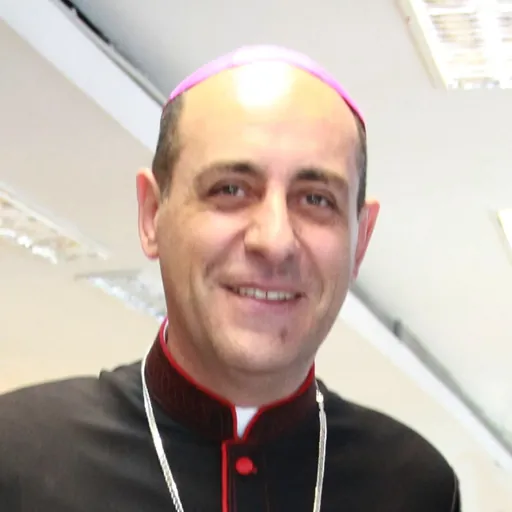
Víctor Manuel Fernández
Cardinal Prefect of the Dicastery for the Doctrine of the Faith
About Víctor Manuel Fernández
Born 1962. Víctor Manuel Fernández is an Argentine university teacher, catholic priest, catholic deacon, archbishop, catholic theologian and writer.
Víctor Manuel Fernández (born 18 July 1962) is an Argentine prelate of the Catholic Church and a theologian. He is currently the head of the Dicastery for the Doctrine of the Faith.
Fernández served as rector of the Pontifical Catholic University of Argentina from December 2009 to April 2018. He was named Archbishop of La Plata on 2 June 2018. On 1 July 2023, Pope Francis named Fernández prefect of the Dicastery for the Doctrine of the Faith as of mid-September. Pope Francis made Fernández a cardinal on 30 September 2023. After his ordination, he went to Rome where he studied Biblical theology at the Pontifical Gregorian University, graduating with a Licentiate of Sacred Theology (STL) in 1988. He returned to Argentina to undertake a doctorate in the Faculty of Theology of the Catholic University of Argentina, which he completed in 1990. He served as formator and director of studies at the seminary of Río Cuarto from 1988 to 1993 and from 2000 to 2007.
Theologian and educator In the late 1990s, Fernández followed the recommendation of the Archbishop of Buenos Aires Jorge Bergoglio and declined an invitation to head a theological institute in Bogotá.
He headed the Faculty of Theology at the Pontifical Catholic University of Argentina (CUA) when Cardinal Bergoglio nominated him to serve as its rector on 15 December 2009. when his designation received confirmation from the Congregation for Catholic Education, which had withheld its assent while Fernandez responded to objections to his appointment from the Congregation for the Doctrine of the Faith (CDF).
Two months after Cardinal Bergoglio became Pope Francis, he named Fernández titular archbishop of Tiburnia on 13 May 2013, and he received his episcopal consecration on 15 June 2013 Fernández wore a pectoral cross Francis sent him from Rome. He was the first rector of the University to be made an archbishop. As Francis' first Argentine episcopal appointment, it was seen as a rebuke to the Roman Curia with which Francis as Archbishop of Buenos Aires had an occasionally antagonistic relationship, especially with the attempt of some in Rome to block Fernández' appointment as rector of UCA in 2011.
Francis named him a member of the Fourteenth Ordinary General Assembly of the Synod of Bishops in October 2015 and appointed him to the drafting committee for the final report to be submitted to the synod participants for their votes.
On 17 December 2016, he was named a consultor to the Congregation for Catholic Education.
He ended his tenure as rector of the CUA on 25 April 2018, after completing the maximum two terms in that post. Pope Francis named him Archbishop of La Plata on 2 June 2018 to succeed Héctor Rubén Aguer, who had been in poor health for several years, had submitted his resignation as required on his 75th birthday just a week earlier, and was long identified as an opponent of Bergoglio within the Argentine Episcopal Conference. He was enthroned in his archdiocese on the following 16 June.
As archbishop in 2019, he was accused of supporting a La Plata priest Father Eduardo Lorenzo in the face of five sex abuse allegations. Fernandez was accused of supporting Lorenzo even after an arrest warrant was issued and the priest committed suicide.
Dicastery for the Doctrine of the Faith On 1 July 2023, Pope Francis appointed him to succeed Cardinal Luis Ladaria Ferrer as prefect of the Dicastery for the Doctrine of the Faith (DDF) in mid-September. He became the first Argentine named by Pope Francis to a senior position in the Roman Curia. letter written in Spanish from Pope Francis to Fernández was published alongside the announcement of his appointment. It defined his mission, saying: "The dicastery over which you will preside in other times came to use immoral methods. Those were times when, rather than promoting theological knowledge, possible doctrinal errors were pursued. What I expect from you is certainly something very different".
In a letter to the faithful of his archdiocese, Fernández said he initially declined the appointment because he did not feel "qualified or trained" to lead the dicastery's section responsible for child abuse, and relented when assured that the specialists in that section were capable of working independently.
In an interview after his appointment, Fernandez said he opposed same-sex blessings but stated that those that did not create confusion should be affirmed.
On 9 July 2023, Pope Francis announced plans to make him a cardinal at a consistory scheduled for 30 September. At that consistory he was created Cardinal-Deacon of Santi Urbano e Lorenzo a Prima Porta. He participated as a cardinal elector in the 2025 papal conclave that elected Pope Leo XIV.
On his creation as a cardinal, the Survivors Network of those Abused by Priests (SNAP) and Ending Clergy Abuse (ECA) groups issued a joint statement calling on Pope Francis to remove Fernández as head of the DDF and to rescind his elevation as a cardinal. In their statement, SNAP and ECA said that in their view, by tapping Fernández to lead the DDF, “Pope Francis demonstrates not only poor judgment, but also gross disrespect to Catholic victims around the world.”
On 18 December 2023, Pope Francis approved a DDF ruling allowing priests to bless unmarried and same-sex couples. The Declaration Fiducia supplicans allowed the blessing of same-sex couples but without any type of ritualization or offering the impression of a marriage. This document sparked worldwide opposition, especially from Africa, with at least 25 episcopal conferences, 46 cardinals and bishops, and various organizations criticizing or voicing concerns about the document, including Cardinals Müller, Sarah, Napier, Kutwa and Sturla.
On 8 April 2024, Pope Francis approved the declaration Dignitas Infinita, which condemned violations of human dignity, including gender theory, as well as abortion and discrimination against women.
Relationship with Pope Francis His relationship with Pope Francis dates to his work for the Argentine Bishops' Conference, where he demonstrated his ability to incorporate different viewpoints in drafting group statements. As head of the drafting committee for the Aparecida Conference of CELAM in 2007, Francis relied on Fernandez' skill. He wrote or "contributed in significant ways" to the encyclical Laudato Si'.
Called Francis' "trusted theologian", he is said to have been the principal author of Amoris Laetitia, the apostolic exhortation issued by Francis in 2016 following the two sessions of the Synod of Bishops on the Family. In his own extended defense of Amoris, Fernandez argued for greater latitude when deciding giving Communion to the divorced and remarried. He wrote that "one cannot maintain those [sexual] acts in each and every case are gravely dishonest in a subjective sense. In the complexity of particular situations is where, according to St. Thomas Aquinas, 'the indetermination increases'". as well as his close collaborator. Francis cited his essay "The Good Things of Living in This Time" in a talk to the clergy of Rome in February 2018.
Works Fernandez's book Heal Me With Your Mouth: The Art of Kissing was published in 1995; it contains a theological analysis on the art of kissing. The book resurfaced in 2023 following Fernandez's appointment to the DDF; he defended it, denying that it contained heresy or heterodox teachings, but stated that he would not write it today and that its republishing had already been discontinued.
In 1998 published in Mexico the book Mystical Passion: Spirituality and Sensuality that includes graphic descriptions of human sexual relations and discussion of what the Argentinian theologian describes as "mystical orgasm". It depicts in detail an imaginary erotic encounter with Jesus Christ on the shores of Galilee. The book's final section focuses on the human orgasm and its connection to divine intimacy. Fernández's description of "an experience of love, a passionate encounter with Jesus, that a sixteen-year-old-teenager [girl] told me about", is in the book's sixth chapter. Fernandez later described the work as "a book of my youth that I certainly would not write now" and that "could be misinterpreted"; he argued that he dismissed it soon after his publishing and ordered it not to be re-printed and later wrote "more serious works" on mysticism. Some clerical sex abuse survivors described themselves as "deeply troubled" by Fernandez's works, while the John Paul II Academy for Human Life and Family urged Pope Francis to dismiss Fernandez from his post.
In Il progetto di Francesco. Dove vuole portare la Chiesa (The Francis Project: Where He Wants to Take the Church), a book-length interview Fernandez gave to the journalist Paolo Rodari from the Italian daily La Repubblica, he describes the broad themes of Francis' papacy, the need to view moral issues in context rather than assert them as non-negotiable, to "set hearts on fire" rather than reiterate dated "philosophical or natural law-related" arguments. He said: "For example, it is no good opposing same-sex marriage because people tend to see us as a group of resentful, cruel, insensitive, over-the-top even, individuals. It is an entirely different thing to talk about the beauty of marriage and the harmony of differences that form part of an alliance between a man and woman. This positive context speaks for itself when it comes to showing that the use of the same term 'marriage' to describe same-sex unions, is unsuitable."
Don’t just read it —
keep it.
Full-length biographies made to live with: read them, listen on the way to work, watch them tonight.
- E-book
- Audio
- Video
Instant download · yours to keep · every purchase keeps this site free
Important facts
People in Víctor Manuel Fernández's life
Named in this biography and alive at the same time




Related people
Same field, nearest in time



Contemporaries
People whose lives overlapped Víctor Manuel Fernández's




Frequently asked questions
Who is Víctor Manuel Fernández?
Cardinal Prefect of the Dicastery for the Doctrine of the Faith
When was Víctor Manuel Fernández born?
Víctor Manuel Fernández was born on 18 July 1962 in Río Cuarto Department.
What is Víctor Manuel Fernández's occupation?
Víctor Manuel Fernández is a university teacher, catholic priest, catholic deacon, archbishop, catholic theologian and writer.
What nationality is Víctor Manuel Fernández?
Víctor Manuel Fernández is Argentine.
Sources & further reading
· Wikipedia: Víctor Manuel Fernández
· DBpedia: Víctor Manuel Fernández
Cite this page
APA: Biography.guide. (2026). Víctor Manuel Fernández. https://biography.guide/victor-manuel-fernandez/
MLA: "Víctor Manuel Fernández." Biography.guide, https://biography.guide/victor-manuel-fernandez/.
Chicago: "Víctor Manuel Fernández." Biography.guide. https://biography.guide/victor-manuel-fernandez/.
Data last updated: 2026-09-20 · Spot an error? Report a correction.
Page generated 2026-09-27 05:09 UTC