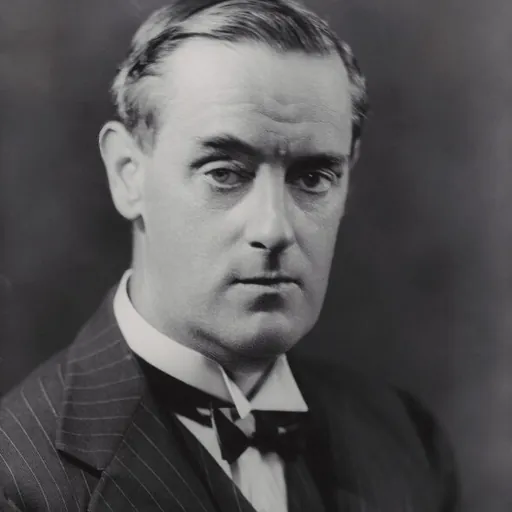
Victor Hope, 2nd Marquess of Linlithgow
British politician, agriculturalist and colonial administrator
About Victor Hope, 2nd Marquess of Linlithgow
Lived 1887 – 1952 (aged 64). Victor Hope, 2nd Marquess of Linlithgow was an Indian politician.
Victor Alexander John Hope, 2nd Marquess of Linlithgow, (24 September 1887 – 5 January 1952) was a British Unionist politician and statesman, agriculturalist, and colonial administrator. He served as Governor-General and Viceroy of India from 1936 to 1943. He also served as vice president of the Royal Society of Edinburgh, Chancellor of the University of Edinburgh and Lord High Commissioner to the General Assembly of the Church of Scotland. He was usually referred to as Lord Linlithgow, or simply Linlithgow.
Early life and family Hope was born at Hopetoun House, South Queensferry, Linlithgowshire, Scotland, on 24 September 1887. His godmother was Queen Victoria.
He was educated at Ludgrove School and Eton College and on 29 February 1908 succeeded his father as 2nd Marquess of Linlithgow.
Early career Linlithgow served as an officer on the Western Front during the First World War. Transferred from Lothians and Border Horse, he commanded a battalion of the Royal Scots. Influenced by submissions to the Royal Commission, "a decade later, when (he) became Viceroy of India he showed a personal interest in nutrition, pushing it to the top of the research agenda". The reason for sending a Commission on Agriculture under Linlithgow was 'because constitutional reform without economic and educational reform will do nothing to ameliorate the condition of life of the mass of the population of India, and this is what matters most.'
From April 1933 to November 1934 he was chairman of the Parliamentary Joint Select Committee on Indian constitutional reform, drawn up to consider the proposals for Indian self-government contained in the government's March 1933 White Paper. He agreed to take the job after Lord Salisbury declined it (although he agreed to serve on the committee) and Sidney Peel, the second choice, fell ill with phlebitis. Linlithgow told the Joint Select Committee that he would show no favouritism between the Indian factions (Hindus, Muslims and Princely States) and would be neutral just as he was between his own five children. The committee's proposals became the Government of India Act 1935.
Viceroy
Having previously declined both the governorship of Madras and the governor-generalship of Australia (his father was the first Governor-General of Australia), he became the Viceroy of India, Linlithgow implemented the plans for local self-government embodied in the Government of India Act 1935, which led to provincial governments led by the Congress Party in five of the eleven provinces of British India, but the recalcitrance of the princes prevented the establishment of elected governments in most of the princely states.
With the outbreak of the Second World War, Linlithgow's rejection of the request by the Congress for a declaration that India would be given the chance to determine its own future after the war led to the resignation of the Congress ministries. He declared India to be at war with Germany in September 1939, without consulting Indian politicians. On 8 August 1940 Lord Linlithgow made a statement on behalf of the British government. It was known as the August Offer and offered greater rights in the governance of India to the Indian people. The proposal was rejected by most Indian politicians, including the Congress Party and the Muslim League. Disputes between the British administration and Congress ultimately led to massive Indian civil disobedience in the Quit India Movement. Linlithgow suppressed the disturbances and arrested the Congress leaders. Some historians have partly blamed Linlithgow for the Bengal famine of 1943 which resulted in three million deaths.
Retirement
His seven-year tenure as viceroy, the longest in the history of the Raj, ended on 1 October 1943, succeeded by Field Marshal Lord Wavell who had been Commander-in-Chief, India since January 1942.
Indians were not kind in their assessments of his career. V. P. Menon in The Transfer of Power in India stated: "His 7½ year regime – longer than that of any other Viceroy – was conspicuous by its lack of positive achievement. When he left India, famine stalked portions of the countryside. There was economic distress due to the rising cost of living and the shortage of essential commodities. On the political side, Sir Tej Bahadur Sapru expressed the general feeling thus: 'Today, I say, after seven years of Lord Linlithgow's administration the country is much more divided than it was when he came here'."
A sincere Presbyterian, he served as Lord High Commissioner to the Church of Scotland in 1944 and 1945. He died in 1952.
Honours
Ribbon Description
Don’t just read it —
keep it.
Full-length biographies made to live with: read them, listen on the way to work, watch them tonight.
- E-book
- Audio
- Video
Instant download · yours to keep · every purchase keeps this site free
Important facts
Family & relationships
People in Victor Hope, 2nd Marquess of Linlithgow's life
Named in this biography and alive at the same time



Related people
Same field, nearest in time





Contemporaries
People whose lives overlapped Victor Hope, 2nd Marquess of Linlithgow's





Frequently asked questions
Who was Victor Hope, 2nd Marquess of Linlithgow?
British politician, agriculturalist and colonial administrator (1887-1952)
When was Victor Hope, 2nd Marquess of Linlithgow born?
Victor Hope, 2nd Marquess of Linlithgow was born on 24 September 1887 in South Queensferry.
When did Victor Hope, 2nd Marquess of Linlithgow die?
Victor Hope, 2nd Marquess of Linlithgow died on 5 January 1952 in South Queensferry.
What was Victor Hope, 2nd Marquess of Linlithgow's occupation?
Victor Hope, 2nd Marquess of Linlithgow was a politician.
What nationality was Victor Hope, 2nd Marquess of Linlithgow?
Victor Hope, 2nd Marquess of Linlithgow was Indian.
Sources & further reading
· Wikipedia: Victor Hope, 2nd Marquess of Linlithgow
· DBpedia: Victor Hope, 2nd Marquess of Linlithgow
Cite this page
APA: Biography.guide. (2026). Victor Hope, 2nd Marquess of Linlithgow. https://biography.guide/victor-hope-2nd-marquess-of-linlithgow/
MLA: "Victor Hope, 2nd Marquess of Linlithgow." Biography.guide, https://biography.guide/victor-hope-2nd-marquess-of-linlithgow/.
Chicago: "Victor Hope, 2nd Marquess of Linlithgow." Biography.guide. https://biography.guide/victor-hope-2nd-marquess-of-linlithgow/.
Data last updated: 2026-09-20 · Spot an error? Report a correction.
Portrait: Wikimedia Commons · author & licence
Page generated 2026-09-27 04:58 UTC