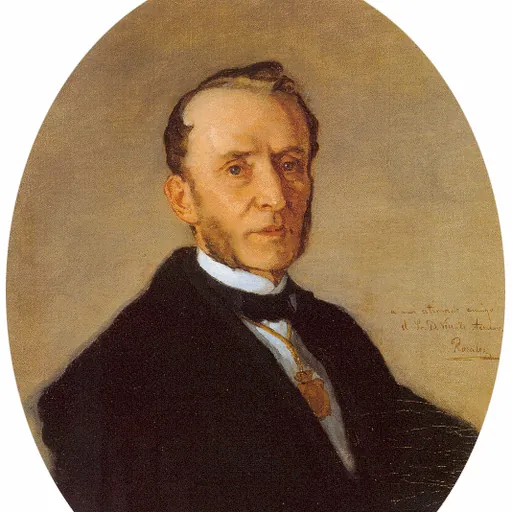
About Vicente Asuero y Cortázar
Lived 1806 – 1873 (aged 66). Vicente Asuero y Cortázar was a Spanish physician and senior lecturer.
Vicente Casto Asuero y Sáez de Cortázar ( – February 23, 1873) was a Spanish medical doctor, professor at the Central University and court physician to Isabella II of Spain. He was also a member of the Consejo de Sanidad de España and of several scientific societies, such as the Royal National Academy of Medicine, of which he was elected president, although he resigned a few days later. Known for his lectures against homeopathy and his contributions to medical hydrology, he has been described as "the foremost Spanish physician of his time", and attended the for two courses, where he learned Humanities and Philosophy. During 1818 and 1819 he resided intermittently in Alcalá de Henares with his brother Cosme and combined his studies at the Escuelas Pías with the Royal Academy of Fine Arts of San Fernando, which he attended at night. The following years he studied at the along with other illustrious men of his time such as Mariano José de Larra, Juan Eugenio Hartzenbusch, Segundo Sierra Pambley or Salustiano Olózaga.
Due to the political tendencies of his family, he moved with his brothers Zenón and Cosme, both military, to Seville and Cádiz, where the constitutional government had moved at the end of the Liberal Triennium, and temporarily interrupted his studies. He returned to the capital in 1823 and settled in the house of an elderly lady, since his relatives had to go into exile to La Rioja. He then learned Physics and Mathematics at the Estudios de San Isidro and obtained the bachelor's degree in Philosophy on 3 October 1825. The following year he studied Botany at the Real Jardín Botánico, In his home up to ten people lived, as he took in the children of his brothers José and Zenón when they died and also Bárbara, a widowed sister of his, and her daughter. Engraving of Asuero y Cortázar, work of , published in La Ilustración Española y Americana (1873). He joined as a full member of the Royal Academy of Exact, Physical and Natural Sciences on 16 November 1838 According to Enrique Salcedo Ginestal, at the request of Pedro Mata y Fontanet the Minister of the Interior, Fermín Caballero, granted Asuero the position of professor of Medical Morals, History and Bibliography at the University of Madrid on 20 October 1843, a position in which was also interested. A few days after taking the chair he exchanged it for that of general and descriptive anatomy. Three years later, on 1 June 1846, he obtained the title of doctor. During his twenty-five years as a professor he taught two courses of Anatomy; one of Physiology; another of a new subject, created in 1867, called "Extension to therapeutics, pharmacology and medical hydrology", and the rest of Therapeutics.
During the 1840s, homeopathy gained popularity in Spain to the point that in 1850 a royal order provided for the creation of a provisional chair for the teaching of this pseudoscience, although it ultimately did not take effect. Some publications and university professors, including Pedro Mata and , Marquis of San Gregorio, opposed the new doctrine. In this context, Asuero, then professor of Therapeutics, gave nine lectures impugning homeopathy between 4 and 12 April 1850 which he later tried to publish reducing the number to five under the title Lecciones sobre los fundamentos de la terapéutica sustitutiva u homeopática. Only the first was printed, in 1850.
He was a member of the Consejo de Sanidad del Reino from 1847 to 1855, in addition to holding the same position between 1849 and 1852 in the Junta Provincial de Beneficencia of Madrid, for which he prepared various reports and the project, report and budget for the establishment of the . On the other hand, on 10 January 1856 he began working at the Hospital de San Pedro de los Naturales in Madrid to fill the vacancy due to the death of Sebastián Olea, his brother-in-law and former companion at the Colegio de San Carlos. Years later he was replaced by his son Vicente in this position. On 1 January 1862, Asuero was appointed consulting physician to the Royal Chamber through the intercession of Corral y Oña, who was the first court physician and sought to surround himself with people hostile to homeopathy to undermine its influence in the palace. He received 30,000 Spanish reals annually and once attended the consort king, Francisco de Asís de Borbón, in addition to having been present at the birth of Infanta Eulalia. l'Hôpital spring in Vichy (France), city to which Asuero traveled on several occasions. Asuero requested his retirement as a professor shortly before the Revolution of 1868 to the Minister of Development , but it was not granted until 10 April 1869 by the provisional government, with an allocation of 16,800 reales. Later, he was elected president of the Royal National Academy of Medicine by twenty-two votes against two on 14 January 1871; however, he submitted his resignation for health reasons at the next meeting, on 1 February, and it became effective on the 6th. In addition to the first class cross of the Order of Civil Beneficence, which was awarded to him on 5 October 1856 for his services against cholera, in April 1872 he was granted the grand cross of the , which Asuero initially rejected out of loyalty to Isabella II of Spain and finally requested again a week before his death, once the reign of Amadeo I of Spain had ended, because according to Fermín Caballero "he did not want his name to appear among those who had shown him slights or disdain [to Queen Maria Victoria]". He died at the age of sixty-six on 23 February 1873
Works Engraving by and José Fernández Cuevas published in El Anfiteatro Anatómico Español (1873). Fermín Caballero said that "the writings attributable to the pen of Doctor Asuero are not many nor long" and that "like most Spanish physicians, he wrote little". In addition to the first of the Lecciones sobre los fundamentos de la terapéutica sustitutiva u homeopática (1850), he has three other works published during his lifetime called Discurso pronunciado en la solemne apertura de las sesiones del año 1854 en la Real Academia de Medicina de Madrid (1854), with the motto ¡Qué de cosas en una ley!; Discurso pronunciado en la solemne inauguracion del año académico de 1855 á 1856 en la Universidad Central (1855), on the theme Aptitud para el estudio de las ciencias y artes, and Programa de ampliacion de la Terapéutica é hidrologia médica (1868), of which only the part corresponding to the extension of Therapeutics was published.
In addition, a Discurso sobre el garrotillo and another Discurso sobre el cólera that he delivered at the Real Academia de Medicina were stenographically recorded and published in the magazine . He also left some manuscript works entitled Memoria sobre la Frenología, in which he defends that pseudoscience; Memoria sobre el cáncer; Memoria sobre los instintos; Devanadera de Asuero para la madeja de Moron, on the supposed madness of ; Historia de la última enfermedad del general D. Ramón María Narváez, Duke of Valencia; El doctor Manrique enfermo, asistido por el Doctor Asuero; Bases de la Terapéutica, of which Caballero says that it is a prologue or preparation to the Memoria sobre los instintos, and Estudio del hierro y de los medicamentos alterantes.
On the other hand, Asuero made a map of bathhouses of the Iberian Peninsula and the French Pyrenees in which he noted the name, water temperature and classification according to medical hydrology of each one. The correspondence he maintained with Gertrudis Gómez de Avellaneda and that both he and his wife exchanged with Concepción Arenal is also preserved.
Don’t just read it —
keep it.
Full-length biographies made to live with: read them, listen on the way to work, watch them tonight.
- E-book
- Audio
- Video
Instant download · yours to keep · every purchase keeps this site free
Important facts
People in Vicente Asuero y Cortázar's life
Named in this biography and alive at the same time




Related people
Same field, nearest in time



Contemporaries
People whose lives overlapped Vicente Asuero y Cortázar's






Frequently asked questions
Who was Vicente Asuero y Cortázar?
Spanish physician
When was Vicente Asuero y Cortázar born?
Vicente Asuero y Cortázar was born on 27 October 1806 in Nájera.
When did Vicente Asuero y Cortázar die?
Vicente Asuero y Cortázar died on 23 February 1873 in Madrid.
What was Vicente Asuero y Cortázar's occupation?
Vicente Asuero y Cortázar was a physician and senior lecturer.
What nationality was Vicente Asuero y Cortázar?
Vicente Asuero y Cortázar was Spanish.
Sources & further reading
· Wikipedia: Vicente Asuero y Cortázar
· DBpedia: Vicente Asuero y Cortázar
Cite this page
APA: Biography.guide. (2026). Vicente Asuero y Cortázar. https://biography.guide/vicente-asuero-y-cortazar/
MLA: "Vicente Asuero y Cortázar." Biography.guide, https://biography.guide/vicente-asuero-y-cortazar/.
Chicago: "Vicente Asuero y Cortázar." Biography.guide. https://biography.guide/vicente-asuero-y-cortazar/.
Data last updated: 2026-09-20 · Spot an error? Report a correction.
Portrait: Wikimedia Commons · author & licence
Page generated 2026-09-27 04:58 UTC