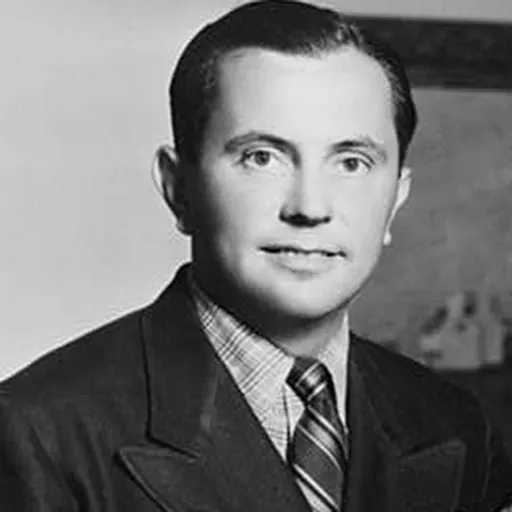
About Vernon Duke
Lived 1903 – 1969 (aged 65). Vernon Duke was an American and Russian composer, poet, lyricist and songwriter.
Vernon Duke ( 16 January 1969) was a Russian and American composer and songwriter, who also wrote under his birth name, Vladimir Dukelsky. He is best known for "Taking a Chance on Love," with lyrics by Ted Fetter and John Latouche; "I Can't Get Started," with lyrics by Ira Gershwin (1936); "April in Paris," with lyrics by E. Y. ("Yip") Harburg (1932), and "What Is There To Say," for the Ziegfeld Follies of 1934, also with Harburg.
Duke wrote the words and music for "Autumn in New York" (1934) for the revue Thumbs Up! In his book American Popular Song, The Great Innovators 1900–1950, composer Alec Wilder praises this song, writing: "The verse may be the most ambitious I've ever seen."
Duke also collaborated with lyricists Johnny Mercer, Ogden Nash, and Sammy Cahn.
Early life Vladimir Aleksandrovich Dukelsky was born on in the village of Parfyanovka, then part of Pskov Governorate in the Russian Empire.
At the time, his mother "happened to be traveling by train". His family descended from the West Russian (Belarusian) nobility. They belonged to the small gentry class; the 1954 Grove's Dictionary of Music and Musicians referred to his paternal grandmother, Princess Tumanishvili, as having been "directly descended from the kings of Georgia". According to Duke, his mother also had some Austrian and Spanish ancestry. The Jewish Standard lists him among Jewish musicians, for reasons unknown; composer Jack Gottlieb denies this claim.
The Dukelskys resided in Kiev, and Vladimir's only visit to Saint Petersburg and Moscow occurred in the summer of 1915. The impressions of that summer were later echoed in Dukelsky's oratorio The End of St. Petersburg (1931–37). The title is a reference to the film The End of St. Petersburg, directed by Vsevolod Pudovkin. Eventually, the family was forced to leave Russia and spent a year and a half among other refugees in Constantinople. In 1921, they obtained American visas and sailed steerage class on the SS King Alexander to New York.
He underwent his immigration inspection at Ellis Island. On the passenger list, the purser of the King Alexander recorded his name as Vladimir Doukelsky, in the French fashion. In 1922 in New York, George Gershwin befriended the young immigrant. Gershwin (born Jacob Gershwine) suggested that Dukelsky truncate and Americanize his surname, taking Vernon as his given name; Duke later explained that this was necessary because his then-publisher Serge Koussevitzsky would not accept use of the "Dukelsky" name on the composer's "commercial" creations. Dukelsky's first songs published under his pen name were conceived that year, but he continued to write classical music and Russian poetry under his birth name until 1955. Dukelsky's first theatrical production, Zephyr and Flora, was staged in the 1925 season of Ballets Russes, with choreography by Léonide Massine and scenography by Georges Braque, to great critical acclaim. In a review of musical novelties of the season, Sergei Prokofiev described it as full of "superior melodies, very well designed, harmonically beautiful and not too 'modernist'." Prokofiev was as impressed with the young talent as Diaghilev was, and soon the composers became close friends. They frequently saw each other until Prokofiev returned to the Soviet Union in 1938; they continued to correspond until 1946. Dukelsky's First Symphony was premiered by Serge Koussevitzky and his orchestra in 1928 in Paris on the same bill as excerpts from Prokofiev's The Fiery Angel. Some of Dukelsky's and Prokofiev's compositions of the 1930s bear evidence of their musical dialogue.
In the late 1920s, Dukelsky divided his time between Paris, where his more classical works were performed, and London, where he composed numbers for musical comedies under his pen name Vernon Duke. His harmonies, however, were highly original. As a songwriter and author of theatrical and film music, his work was close to that of George Gershwin and Harold Arlen, but he developed an idiosyncratic voice of his own. He also published Listen Here! a Critical Essay on Music Depreciation in 1963.
Death Duke died in Santa Monica, California on 16 January 1969, during surgery for lung cancer. His numerous papers—musical and literary manuscripts and correspondence in English, French, and Russian—are stored in the Musical Division of the Library of Congress.
Works
As Vladimir Dukelsky Zéphyr et Flore 1925; Ode Epitaphe 1931 poems by Osip Mandelstam in memorial to Diaghilev. Sung in Russian Ilma Achmadeeva (soprano), Netherlands Theatre Choir, Residentie Orchestra of the Hague. Gennady Rozhdestvensky Chandos, 1999. Violin Concerto ca. 1941–43. Chloë Hanslip, Singapore Symphony Orchestra, cond. Andrew Litton. Chandos, 2025. Cello Concerto 1946; Samuel Magill, Cello. Piano Concerto Orchestrated by Scott Dunn. Scott Dunn, Piano. Dmitri Yablonsky, Conductor. Russian Philharmonic. Naxos, 2007.
As Vernon Duke
1931 – Tarnished Lady 1932 – Walk A Little Faster (lyrics by E.Y. "Yip" Harburg) "April in Paris" "A Penny for Your Thoughts" "Off Again, On Again" "Speaking of Love" "Where Have We Met Before?" 1934 – Ziegfeld Follies of 1934 (music also by others – Duke lyrics by E.Y. Harburg) "I Like the Likes of You" "What Is There To Say?" 1934 – Thumbs Up! (music also by others – Duke lyrics by Vernon Duke) "Autumn in New York" "Words Without Music" (lyrics by Ira Gershwin) 1936 – Ziegfeld Follies of 1936 (lyrics by Ira Gershwin) "I Can't Get Started" "He Hasn't a Thing Except Me" "Words Without Music" "Island in the West Indies" 1938 – Spring Again (lyrics by Ira Gershwin) 1940 – Cabin in the Sky (lyrics by John Latouche) "Taking a Chance on Love" "Cabin in the Sky" "Honey in the Honeycomb" "Love Me Tomorrow" 1941 – Banjo Eyes (lyrics by John Latouche and Harold Adamson) "We're Having a Baby" "Who Started the Rhumba?" "A Nickel to My Name" 1942 – The Lady Comes Across (lyrics by John Latouche) "Summer Is A-Commin' In" "You Took Me By Surprise" "This Is Where I Came In" "Lady" 1944 – Jackpot (lyrics by Howard Dietz) "What Happened" "Sugarfoot" "I've Got a One-Track Mind" "I Kissed My Girl Goodbye" 1944 – Sadie Thompson (lyrics by Howard Dietz) "The Love I Long For" "Poor as a Church Mouse" "When You Live on an Island" 1946 – Sweet Bye and Bye (lyrics by Ogden Nash; book by S. J. Perelman and Al Hirschfeld) 1949 – "Ogden Nash's Musical Zoo", for voice and piano 1952 – Two's Company (lyrics by Ogden Nash and Sammy Cahn) "It Just Occurred to Me" "Roundabout" "Out of the Clear Blue Sky" "Haunted Hot Spot" "Just Like a Man" 1956 – The Littlest Revue (music also by others – Duke lyrics by Ogden Nash) "I Want to Fly Now (and Pay Later)" "Summer Is A-Comin' In" "Good Little Girls" "Love Is Still in Town" "You're Far from Wonderful" "Madly in Love" 1963 – Zenda (lyrics by Lenny Adelson, Sid Kuller, and Martin Charnin)
Don’t just read it —
keep it.
Full-length biographies made to live with: read them, listen on the way to work, watch them tonight.
- E-book
- Audio
- Video
Instant download · yours to keep · every purchase keeps this site free
Important facts
People in Vernon Duke's life
Named in this biography and alive at the same time





Related people
Same field, nearest in time



Contemporaries
People whose lives overlapped Vernon Duke's

Frequently asked questions
Who was Vernon Duke?
American composer (1903-1969)
When was Vernon Duke born?
Vernon Duke was born on 10 October 1903 in Parafjanava.
When did Vernon Duke die?
Vernon Duke died on 16 January 1969 in Santa Monica.
What was Vernon Duke's occupation?
Vernon Duke was a composer, poet, lyricist and songwriter.
What nationality was Vernon Duke?
Vernon Duke was American and Russian.
Sources & further reading
Cite this page
APA: Biography.guide. (2026). Vernon Duke. https://biography.guide/vernon-duke/
MLA: "Vernon Duke." Biography.guide, https://biography.guide/vernon-duke/.
Chicago: "Vernon Duke." Biography.guide. https://biography.guide/vernon-duke/.
Data last updated: 2026-09-21 · Spot an error? Report a correction.
Portrait: Wikimedia Commons · author & licence
Page generated 2026-09-27 05:00 UTC