
About Valery Bykovsky
Lived 1934 – 2019 (aged 84). Valery Bykovsky was a Russian aircraft pilot, astronaut, military personnel, military officer, engineer and aviator.
Valery Fyodorovich Bykovsky (; 2 August 1934 – 27 March 2019) was a Soviet cosmonaut who flew on three space flights: Vostok 5, Soyuz 22, and Soyuz 31. He was also backup for Vostok 3 and Soyuz 37.
Early life and career Born in Pavlovsky Posad, Russia, on 2 August 1934, Bykovsky was the son of Fyodor Fyodorovich Bykovsky and Klavdia Ivanova. He had an older sister named Margrita, born three years earlier. When he was four years old, World War II began, forcing the family to move to Kuybyshev, and later again to Syzran, before moving back to near Moscow. By the age of 14, Bykovsky wanted to attend naval school; however, his father was not a proponent of this idea and encouraged him to stay at his school. A few days later, Bykovsky attended a lecture on the Soviet Air Force Club which inspired him to pursue his dream of becoming a pilot. He began flight theory lessons when he was 16 at the Moscow City Aviation Club.
He graduated from the academy at 21 years old and received the rank of lieutenant. By the time he began his cosmonaut training, he had done over 72 parachute jumps. His first assignment was as the backup pilot to the Vostok 3 mission.
He launched on the Vostok 5 mission from Baikonur Cosmodrome in Kazakhstan on 14 June 1963. During the flight he conducted experiments, such as photographing the Earth's horizon and documenting the growth of peas. He also floated about in the cabin and adjusted the spacecraft orientation numerous times. Bykovsky set a space endurance record of five days in orbit where his call-sign was "Hawk" (Russian: Ястреб). Although this duration has been surpassed by multi-crew flights, it remains the record for a solo spaceflight.
He was given his nation's highest honour, "Hero of The Soviet Union" for his contribution to Soviet spaceflight.
On June 25, 1963, Bykovsky and Tereshkova went to Moscow University for a press conference
He flew the Soyuz 22 mission with Vladimir Aksyonov. The mission launched on 15 September 1976. The capsule was originally a backup for the Apollo–Soyuz Test Project (ASTP). The main purpose of the mission was studying and practising Earth observation techniques.
Valery Bykovsky and East German astronaut Sigmund Jähn after the Soyuz 31 missionHe flew the Soyuz 31 mission to the Salyut 6 space station with the East German Sigmund Jähn. It was launched on 26 August 1978. They joined two other cosmonauts on the space station that had arrived on Soyuz 29. The four conducted biological experiments on themselves during their stay. Bykovsky and Jähn undocked from the station in the Soyuz 29 capsule on 3 September and landed back on Earth later that day.
Post-cosmonaut career
Much of his later career was devoted to promoting the Intercosmos programme amongst the world's socialist nations. Due to his age, he was moved from active duty to the reserves in 1988. He became the director of the Centre of Soviet Science and Culture in East Berlin after the Soyuz 31 mission. He retired sometime in 1990.
Valery Bykovsky established the Russian Federation of Cosmonautics (RFC) in 1998 with the objective of advancing the development of space exploration and science in Russia. The RFC's main goals included increasing public interest in space exploration, providing educational opportunities for young people, and supporting research and development initiatives in the space sector. Bykovsky was the president of the RFC until his death in 2019.
Personal life Bykovsky was a keen sportsman:
Bykovsky was a proficient aesthete and photographer who evinced a particular penchant for the art of painting.
He was married to Valentina Mikhailovna Sukhova; they had two sons.
Honours and awards
Twice Hero of the Soviet Union (22 June 1963 and 28 September 1976) Order of Lenin (1963, Pilot-Cosmonaut of the USSR (1963) Gold Medal. Tsiolkovsky Academy of Sciences
Don’t just read it —
keep it.
Full-length biographies made to live with: read them, listen on the way to work, watch them tonight.
- E-book
- Audio
- Video
Instant download · yours to keep · every purchase keeps this site free
Important facts
People in Valery Bykovsky's life
Named in this biography and alive at the same time
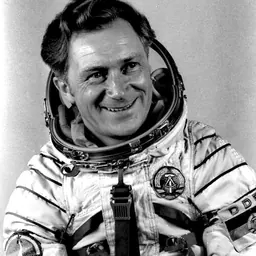

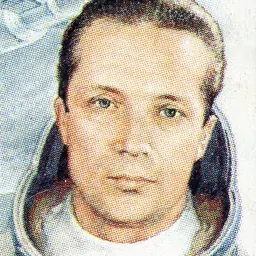

Related people
Same field, nearest in time
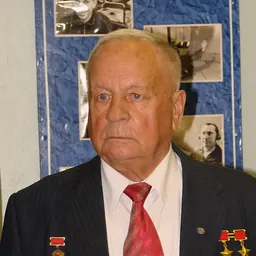
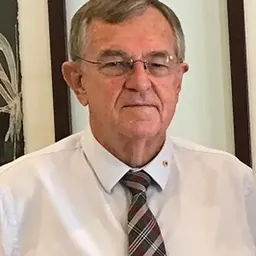

Contemporaries
People whose lives overlapped Valery Bykovsky's




Frequently asked questions
Who was Valery Bykovsky?
Soviet cosmonaut (1934-2019)
When was Valery Bykovsky born?
Valery Bykovsky was born on 2 August 1934 in Pavlovsky Posad.
When did Valery Bykovsky die?
Valery Bykovsky died on 27 March 2019 in Leonikha.
What was Valery Bykovsky's occupation?
Valery Bykovsky was an aircraft pilot, astronaut, military personnel, military officer, engineer and aviator.
What nationality was Valery Bykovsky?
Valery Bykovsky was Russian.
Sources & further reading
Cite this page
APA: Biography.guide. (2026). Valery Bykovsky. https://biography.guide/valery-bykovsky/
MLA: "Valery Bykovsky." Biography.guide, https://biography.guide/valery-bykovsky/.
Chicago: "Valery Bykovsky." Biography.guide. https://biography.guide/valery-bykovsky/.
Data last updated: 2026-09-20 · Spot an error? Report a correction.
Page generated 2026-09-27 05:25 UTC