
Valentine Bargmann
German-American physicist
About Valentine Bargmann
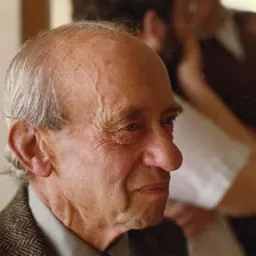
Lived 1908 – 1989 (aged 81). Valentine Bargmann was an American mathematician, theoretical physicist, university teacher and physicist.
Valentine "Valya" Bargmann (April 6, 1908 – July 20, 1989) was a German-American mathematician and theoretical physicist.
Biography Born in Berlin, Germany, to a German Jewish family, Bargmann studied there from 1925 to 1933. After the National Socialist Machtergreifung, he moved to Switzerland to the University of Zürich where he received his Ph.D. under Gregor Wentzel.
He emigrated to the U.S., barely managing immigration acceptance, as his German passport was to be revoked with only two days of validity left.
At the Institute for Advanced Study in Princeton (1937–1946) he worked as an assistant to Albert Einstein, publishing with him and Peter Bergmann on classical five-dimensional Kaluza–Klein theory (1941). He taught at Princeton University from 1946 for the rest of his career.
He pioneered understanding of the irreducible unitary representations of SL2(R) and the Lorentz group (1947). He further formulated the Bargmann–Wigner equations with Eugene Wigner (1948), for particles of arbitrary spin, building up on work of several theorists who pioneered quantum mechanics.
Bargmann's theorem (1954) on projective unitary representations of Lie groups gives a condition for when a projective unitary representation of a Lie group comes from an ordinary unitary representation of its universal cover.
Bargmann further discovered the Bargmann–Michel–Telegdi equation (1959) describing relativistic precession; Bargmann's limit of the maximum number of QM bound states of a potential (1952); the notion of Bargmann potentials for the radial Schrödinger equations with bound states but no non-trivial scattering, which play a basic role in the theory of Solitons, and the holomorphic representation in the Segal–Bargmann space (1961), including the Bargmann kernel.
Bargmann was elected a Fellow of the American Academy of Arts and Sciences in 1968. In 1978, he received the Wigner Medal, together with Wigner himself, in the founding year of the prize. In 1979, Bargmann was elected to the US National Academy of Sciences. In 1988, he received the Max Planck Medal of the German Physical Society.
He was also a talented pianist.
He died in Princeton in 1989.
Don’t just read it —
keep it.
Full-length biographies made to live with: read them, listen on the way to work, watch them tonight.
- E-book
- Audio
- Video
Instant download · yours to keep · every purchase keeps this site free
Important facts
People in Valentine Bargmann's life
Named in this biography and alive at the same time



Related people
Same field, nearest in time



Contemporaries
People whose lives overlapped Valentine Bargmann's


Frequently asked questions
Who was Valentine Bargmann?
German-American physicist
When was Valentine Bargmann born?
Valentine Bargmann was born on 6 April 1908 in Berlin.
When did Valentine Bargmann die?
Valentine Bargmann died on 20 July 1989 in Princeton.
What was Valentine Bargmann's occupation?
Valentine Bargmann was a mathematician, theoretical physicist, university teacher and physicist.
What nationality was Valentine Bargmann?
Valentine Bargmann was American.
Sources & further reading
· Wikipedia: Valentine Bargmann
Cite this page
APA: Biography.guide. (2026). Valentine Bargmann. https://biography.guide/valentine-bargmann/
MLA: "Valentine Bargmann." Biography.guide, https://biography.guide/valentine-bargmann/.
Chicago: "Valentine Bargmann." Biography.guide. https://biography.guide/valentine-bargmann/.
Data last updated: 2026-09-20 · Spot an error? Report a correction.
Page generated 2026-09-27 05:31 UTC