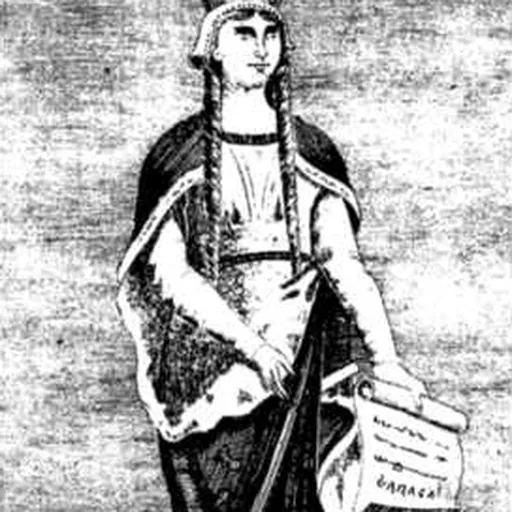
About Urraca of Zamora
Lived 1033 – 1101 (aged 67–68). Urraca of Zamora was an aristocrat.
Urraca of Zamora (1033/34 – 1101/03) was a Leonese infanta, one of the five children of Ferdinand I the Great, who received the city of Zamora as her inheritance and exercised palatine authority in it. Her story was romanticized in the cantar de gesta called the Cantar de Mio Cid, and Robert Southey's Chronicle of the Cid. Urraca's mother was Sancha of León.
Succession dispute Born in 1033/34, Urraca was the daughter of Ferdinand I of León and Sancha of León. Before his death in 1065, Ferdinand divided his widespread conquests in central Spain between his five children, charging them to live at peace with one another. Ferdinand's oldest son, Sancho II, received Castile and the tribute from Zaragoza; Alfonso VI received León and the tribute from Toledo; and García II received Galicia. His daughters, Elvira and Urraca, received Toro and Zamora, respectively.
Sancho, however, resolved to rule over his father's entire kingdom and made war on his siblings. By 1072, Sancho had overthrown his youngest brother Garcia, and forced his other brother Alfonso to flee to his Moorish vassal city of Toledo. Toro, the city of Sancho's sister Elvira, fell easily. But in a siege of Urraca's better-defended city of Zamora, King Sancho was stalled, and was then mysteriously assassinated on 7 October 1072. It was widely suspected that the assassination was a result of a pact between Alfonso and Urraca. The Chronicle of the Cid, purportedly written by one of the Cid's followers, states that the assassin was a nobleman of Zamora, who then received sanctuary in the city. The chronicle is careful not to place any direct blame on Alfonso or Urraca, just as it takes pains to stress that the participation of the Cid at the siege of Zamora was involuntary and supposedly forced on him by King Sancho.
Alfonso's reign The twelfth-century Chalice of Doña Urraca, donated by Urraca to St. Isidore's Basilica, León. According to the chronicle, the guilt of Zamora was decided by a trial by combat, which proved inconclusive. Urraca sent summons to the nobles of Sancho's dominions, and Alfonso was grudgingly acknowledged as heir to both Castile and León. Led by the Cid and a dozen "oath-helpers", the nobles forced Alfonso to swear to his innocence publicly.
Burial Urraca is buried in St. Isidore's Basilica, León.
Don’t just read it —
keep it.
Full-length biographies made to live with: read them, listen on the way to work, watch them tonight.
- E-book
- Audio
- Video
Instant download · yours to keep · every purchase keeps this site free
Important facts
People in Urraca of Zamora's life
Named in this biography and alive at the same time
Related people
Same field, nearest in time

Contemporaries
People whose lives overlapped Urraca of Zamora's



Frequently asked questions
Who was Urraca of Zamora?
Leonese infanta
When was Urraca of Zamora born?
Urraca of Zamora was born in 1033 in León.
When did Urraca of Zamora die?
Urraca of Zamora died in 1101 in León.
What was Urraca of Zamora's occupation?
Urraca of Zamora was an aristocrat.
What nationality was Urraca of Zamora?
Urraca of Zamora's recorded nationality: Kingdom of Leon.
Sources & further reading
Cite this page
APA: Biography.guide. (2026). Urraca of Zamora. https://biography.guide/urraca-of-zamora/
MLA: "Urraca of Zamora." Biography.guide, https://biography.guide/urraca-of-zamora/.
Chicago: "Urraca of Zamora." Biography.guide. https://biography.guide/urraca-of-zamora/.
Data last updated: 2026-09-22 · Spot an error? Report a correction.
Portrait: Wikimedia Commons · author & licence
Page generated 2026-09-27 05:02 UTC