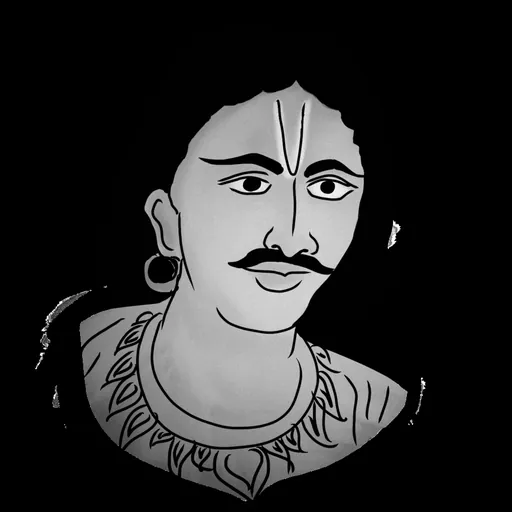
About Upendra Bhanja
Lived 1670 – 1740 (aged 69–70). Upendra Bhanja was a poet and writer.
Kabi Samrata Upendra Bhanja, ) was a 17th-century Odia poet and a composer of classical Odissi music. He is most known for his Odissi songs and kabyas written in the Odia language, primarily Baidehisa Bilasa, Labanyabati & Koti Brahmanda Sundari.
He was born during 1670 (opinions differ between 1670 and 1688) in Kulagarh, Ghumusar Zamindari, present day Kulada near Bhanjanagar, 80 kms from the Silk City Brahmapur, Odisha and died during 1740 (again opinions vary).
His first wife was the sister of the king of Nayagarh and the daughter of the king of Banapur was his second wife, who was an erudite princess and gave Upendra Bhanja poetical inspiration in an abundant measure. His grandfather King Dhananjaya Bhanja was a great poet and wrote Raghunatha Bilasa (The Ramayana), Ratna Manjari (a poetical romance) etc., which provided models to the prince for writing. But unlike his grandfather, he preferred his entire life to poetry rather than to ruling over a kingdom. He had a thorough training in Sanskrit classical literature and mastered Sanskrit dictionaries such as Amara Kosha, Trikanda Kosha and Medini Kosha. He even wrote a dictionary Geetabhidhana in Odia for helping poets. The town of Bhanjanagar is named after him. The music of Upendra Bhanja is central to Odissi music, the traditional classical music of the state of Odisha and Bhanja is widely respected as one of the greatest Odissi composers of all time.
Kabyas Upendra Bhanja wrote some 52 books of which only 22 are available now. Due to the absence of a printing press, a number of the hand-copied books have been lost. Some of his eminent kabyas are Baidehisha Bilasa (with "Ba" initial for each line), Rasalila, Brajaleela, Subhadra Parinaya(with "Sa" initial for every line), Labanyabati, Premasudhanidhi, Rasika Harabali, Subhadra Parinaya and Chitrakabya Bandodhya, Labanyabati, Koti Brahmanda Sundari, Kala Koutuka (with "Ka" initial for every line), Satisha Bilasa" (with initial 'Sa' initial every line), "Damayanti Bilasa" (with 'Da' initial each line) and "Padmabati Parinaya" (starts with 'Pa') etc. Bhanja belonged to a family that was rooted in literature and music of the times, and his grandfather Dhananjaya Bhanja was an eminent composer of Odissi songs and the writer of a Ramayana kabya.
Style Upendra Bhanja wrote in the last decade of seventeenth and the early decades of eighteenth century and championed a style of poetry called 'Reeti' and 'Deena' in Sanskrit poetics. Though a number of poets in the seventeenth and eighteenth centuries wrote in reeti style, Upendra Bhanja is deemed to be the greatest of them all. Upendra Bhanja was a poet of unsurpassed rhetorical excellence, whether it be shringara, viraha, bhakti or karuna rasa. Upendra Bhanja had practiced his great poetic talents in using "upama", "alankara" and "rasas" in all his kabyas.
The greatness of Upendra Bhanja was in his "Alankara" use such as: Anuprasa, Jamak, etc. The style of presenting facts with comparable factors (upama) is distinguishable in his
“Baidehisha Bilasa” is the pioneer work of Upendra Bhanja as declared by the poet."Rasika Harabali" was written on the basis of his own experience at the early part of his young life.His contemporary poet of Bhakta Kabi, Dina Krushna Das as described in his work “Kala Koutuka”. The socio-cultural way of contemporary Odias are vividly described in his literature .Upendra Bhanja is not only eminent poet of Odisha but also his writings will be explained through all classical contemporary music systems of India
Don’t just read it —
keep it.
Full-length biographies made to live with: read them, listen on the way to work, watch them tonight.
- E-book
- Audio
- Video
Instant download · yours to keep · every purchase keeps this site free
Important facts
Related people
Same field, nearest in time



Contemporaries
People whose lives overlapped Upendra Bhanja's




Frequently asked questions
Who was Upendra Bhanja?
Medieval Odia poet & Odissi musician
When was Upendra Bhanja born?
Upendra Bhanja was born in 1670 in Ganjam district.
When did Upendra Bhanja die?
Upendra Bhanja died in 1740.
What was Upendra Bhanja's occupation?
Upendra Bhanja was a poet and writer.
Sources & further reading
Cite this page
APA: Biography.guide. (2026). Upendra Bhanja. https://biography.guide/upendra-bhanja/
MLA: "Upendra Bhanja." Biography.guide, https://biography.guide/upendra-bhanja/.
Chicago: "Upendra Bhanja." Biography.guide. https://biography.guide/upendra-bhanja/.
Data last updated: 2026-09-20 · Spot an error? Report a correction.
Portrait: Wikimedia Commons · author & licence
Page generated 2026-09-27 04:58 UTC