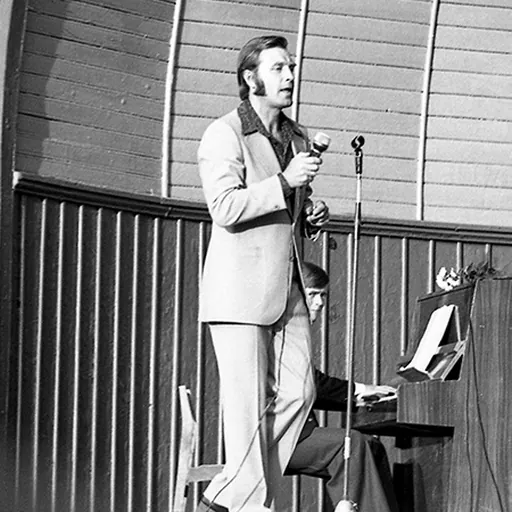
About Uno Loop
Lived 1930 – 2021 (aged 91). Uno Loop was an Estonian music educator, singer, boxer, sportsperson, music teacher and guitarist.
Uno Loop (31 May 1930 – 8 September 2021) was an Estonian singer, musician, athlete, actor, and educator. Loop's career as a musician and singer began in the early 1950s. He performed with various ensembles and as a popular soloist beginning in the 1960s. In his youth, he trained as a boxer, and became the 1947–48 light-middleweight two-time Estonian Junior Champion. Later, he trained as a triathlete. Between the late 1950s and the early 1990s, he taught music, voice and guitar. Loop also worked as an actor, and appeared in several films beginning in the 1960s and in several roles in Estonian television series.
Early life, education, and sport Uno Loop was born in Tallinn to Eduard and Amilde Hildegard Loop (née Vesiloik) and grew up in Tallinn and the village of Nabala in Harju County. In his youth, Loop was also interested in athletics, particularly boxing, and began training and competing in matches in his early teens. At the age of 17, he became the 1947–48 light-middleweight two-time Estonian Junior Champion.
Career Musician and educator While performing with the ensemble Swing Club, Loop also began teaching music and guitar at his alma mater, the Tallinn Higher Music School in 1959. In the late 1950s, he also performed with the Tallinn-based ensemble Sinilind and the jazz group Metronoom, which included Uno Naissoo and other notable singers, composers, and musicians such as Kalju Terasmaa, Eri Klas, Tiit Varts, and Hillar Kareva. In 1960, he performed as a singer and guitarist with the Estonian Radio Male Quartet with Eri Klas, Kalju Terasmaa and Arved Haug, leaving to join the Estonian Radio Estrada (Variety) Orchestra. The quartet recorded several songs with noted Estonian baritone Georg Ots. From 1961 until 1965, he performed as a soloist singer for the National Philharmonic of the Estonian SSR.
During the 1960s, Loop became a popular soloist singer, performing Estonian language light pop, jazz, and estrada music, and was frequently seen on Eesti Televisioon (ETV).
In 1964, Uno Loop wrote the first Estonian language guitar textbook, Kitarrimängu õpik, published by Eesti Riiklik Kirjastus and illustrated by Olev Subbi. It remained the only Estonian language guitar textbook until 1991.
Loop's last public performance was a concert held at the Nokia (Alexela) Concert Hall in Tallinn on 30 December 2010, and he retired shortly afterwards. This was followed by a few smaller roles in the early 1970s, mostly performing musical numbers. In 1969, he appeared in the Tõnis Kask-directed Russian language drama film Chyornyy, kak ya, based on the 1961 book Black Like Me by American journalist John Howard Griffin. In the intervening years, he could often be seen on television as a musical performer. In 2010, he made two guest appearances as the character Erlend Rüütli on the TV3 comedy-crime series Kättemaksukontor.
Personal life and death Uno Loop married Aino Pere in 1949. The couple had two children. He also had a daughter from a previous relationship. The couple lived at their summer home in Laulasmaa in Harju County following Loop's retirement. In June 2019, they celebrated their 70th wedding anniversary. In his later years, he had given up most sports, including cycling, swimming, and jogging, but continued to exercise. His funeral took place on 17 September at Keila church. Notable attendees included Prime Minister of Estonia Kaja Kallas, as well as singers and musicians Ivo Linna, Katrin Karisma, Urmas Lattikas, Erich Krieger, Jaan Elgula, and Tanel Padar. He was interred at Rahumäe Cemetery in Tallinn.
Legacy In 2009, journalist and author Enno Tammer wrote a biography of Loop titled Uno Loop: läbi elu ("Uno Loop: Through Life"), published by Tammerraamat in Tallinn.
On 14 February 2014, the Peep Pedmanson-penned and Hardi Volmer-directed musical play Uno Bossa ehk Uno Loobi seitse elu ("Uno Bossa, or The Seven Lives of Uno Loop") premiered at the Rakvere Theatre, which chronicled Loop's long musical career, with actor Margus Grosnõi playing the part of Loop.
Awards and honors Meritorious Artist of the Estonian SSR (1981)
Don’t just read it —
keep it.
Full-length biographies made to live with: read them, listen on the way to work, watch them tonight.
- E-book
- Audio
- Video
Instant download · yours to keep · every purchase keeps this site free
Important facts
People in Uno Loop's life
Named in this biography and alive at the same time





Related people
Same field, nearest in time



Contemporaries
People whose lives overlapped Uno Loop's

Frequently asked questions
Who was Uno Loop?
Estonian singer, boxer and sportsperson (1930-2021)
When was Uno Loop born?
Uno Loop was born on 31 May 1930 in Tallinn.
When did Uno Loop die?
Uno Loop died on 8 September 2021 in Harju County, Keila.
What was Uno Loop's occupation?
Uno Loop was a music educator, singer, boxer, sportsperson, music teacher and guitarist.
What nationality was Uno Loop?
Uno Loop was Estonian.
Sources & further reading
Cite this page
APA: Biography.guide. (2026). Uno Loop. https://biography.guide/uno-loop/
MLA: "Uno Loop." Biography.guide, https://biography.guide/uno-loop/.
Chicago: "Uno Loop." Biography.guide. https://biography.guide/uno-loop/.
Data last updated: 2026-09-23 · Spot an error? Report a correction.
Portrait: Wikimedia Commons · author & licence
Page generated 2026-09-27 05:06 UTC