About Ulrich Molitor
Lived 1442 – 1507 (aged 64–65). Ulrich Molitor was a German jurist, notary and writer.
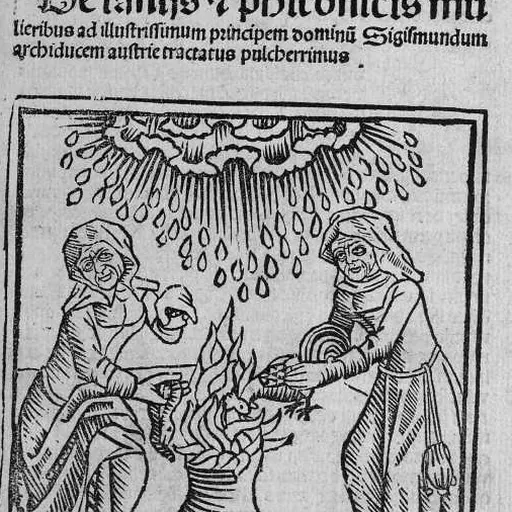
Ulrich Molitor (also Molitoris) (c. 1442 – before 23 December 1507) was a lawyer who wrote a treatise offering qualified support, joined to clarifications and methodological critiques derived Canon Law, to the recent witch-phobic efforts by Heinrich Kramer represented in Krämer's then-recently-published manual for the interrogation and prosecution of witchcraft Malleus Maleficarum.
Molitor maintains the tradition held in the Canon Episcopi that attendance of black masses in which Satan is adored and sexually worshipped are hallucinated episodes or dreams, but does not otherwise oppose or refute the existence of witchcraft. He counsels against the admission of confessions extracted by torture in court since this sort of testimony is often false. Molitor's work, De Lamiis et Pythonicis Mulieribus, was first published in 1489, three years after the first edition of Kramer's work, Malleus Maleficarum, and both books were reprinted frequently throughout the 1490s. Moliter was likely to have personally witnessed the inquisitions led by Heinrick Kramer in the diocese of Brixen and the diocese of Constance.
Molitor's work is written in the form of a dialogue with Molitor's position that of a skeptic in opposition to a witch-phobic fanatic (likely meant to represent Kramer). A third figure, Archduke Sigismund, acts as a wise arbiter. Molitor's position is that of the ancient and long-held traditional Catholic law, the Canon Episcopi (906), that considered witchcraft an illusion. Molitor quotes the Bible, Church Fathers and poets and focusses on the devil's ability to deceive. Sigismund in the dialogue is quick to dismiss evidence that was produced through the use of torture: "For the fear of punishments incites men to say what is contrary to the nature of the facts". Sigismund had also experienced an inquisition led by Kramer in Innsbruck in 1485 and may have played a decisive role in shutting it down, thereby preventing seven accused women from being executed.
The density of illustrations, along with the conceit of a dramatic dialogue included in the work indicate that it was intended for popular consumption and not solely as a work of legal or juridical criticism.
Don’t just read it —
keep it.
Full-length biographies made to live with: read them, listen on the way to work, watch them tonight.
- E-book
- Audio
- Video
Instant download · yours to keep · every purchase keeps this site free
Important facts
People in Ulrich Molitor's life
Named in this biography and alive at the same time

Related people
Same field, nearest in time



Contemporaries
People whose lives overlapped Ulrich Molitor's
Frequently asked questions
Who was Ulrich Molitor?
German witch hunter
When was Ulrich Molitor born?
Ulrich Molitor was born in 1442 in Constance.
When did Ulrich Molitor die?
Ulrich Molitor died in 1507 in Constance.
What was Ulrich Molitor's occupation?
Ulrich Molitor was a jurist, notary and writer.
What nationality was Ulrich Molitor?
Ulrich Molitor was German.
Sources & further reading
Cite this page
APA: Biography.guide. (2026). Ulrich Molitor. https://biography.guide/ulrich-molitor/
MLA: "Ulrich Molitor." Biography.guide, https://biography.guide/ulrich-molitor/.
Chicago: "Ulrich Molitor." Biography.guide. https://biography.guide/ulrich-molitor/.
Data last updated: 2026-09-20 · Spot an error? Report a correction.
Portrait: Wikimedia Commons · author & licence
Page generated 2026-09-27 04:58 UTC