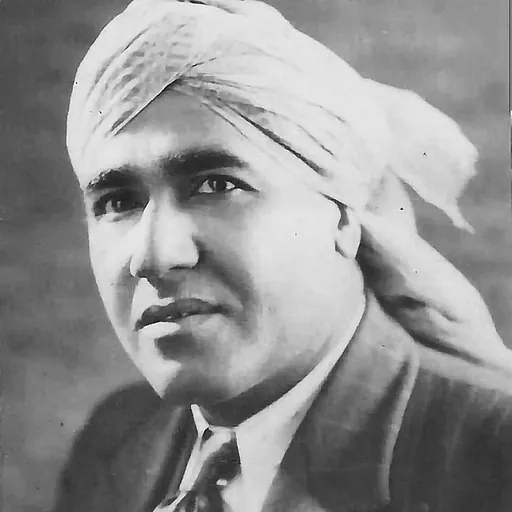
About Udham Singh
Lived 1899 – 1940 (aged 40). Udham Singh was an Indian revolutionary.
Udham Singh (born Sher Singh; 26 December 1899 – 31 July 1940) was an Indian revolutionary belonging to Ghadar Party and HSRA, best known for assassinating Michael O'Dwyer, the former lieutenant governor of the Punjab in British India, on 13 March 1940. The assassination was done in revenge for the Jallianwala Bagh massacre in Amritsar in 1919, for which O'Dwyer was responsible and of which Singh himself was a survivor. Singh was subsequently tried and convicted of murder and hanged in July 1940. While in custody, he used the name Ram Mohammad Singh Azad, which represents the three major religions in India and his anti-colonial sentiment. A district (Udham Singh Nagar) was named after him as a homage by the Mayawati government in October 1995.
Early life Udham Singh was born Sher Singh into a Sikh family on 26 December 1899 in the neighbourhood of Pilbad in Sunam, around 130 miles south of Lahore, British India, to Tehal Singh, a Kamboj, low-skilled low-paid manual labourer and his wife Narain Kaur. He was their youngest, with a two-year difference between him and his elder brother, Sadhu. At the orphanage he was affectionately referred to as "Ude".
Shortly thereafter, despite being below the official age of enrolment, Udham Singh persuaded authorities to allow him to serve in the British Indian Army during the First World War. On 13 April, over twenty thousand unarmed people were assembled in Jallianwala Bagh, Amritsar to celebrate the important Sikh festival of Baisakhi, and to peacefully protest the arrests. Singh and his friends from the orphanage were serving water to the crowd. Troops under the command of Colonel Reginald Dyer opened fire on the crowd, killing several hundred; this became known variously as the Amritsar Massacre or the Jallianwala Bagh massacre.
Singh became involved in revolutionary politics and was deeply influenced by Bhagat Singh and his revolutionary group. In 1924, Singh became involved with the Ghadar Party, organising Indians overseas towards overthrowing colonial rule. In 1927, he returned to India on orders from Bhagat Singh, bringing 25 associates as well as revolvers and ammunition. Soon after, he was arrested for possession of unlicensed arms. Revolvers, ammunition, and copies of a prohibited Ghadar Party paper called "Ghadr-di-Gunj" ("Voice of Revolt") were confiscated. He was prosecuted and sentenced to five years in prison.
Upon his release from prison in 1931, Singh's movements were under constant surveillance by the Punjab Police. He made his way to Kashmir, where he was able to evade the police and escape to Germany. In 1934, he reached London, where he found employment. Privately, he formed plans to assassinate Michael O'Dwyer. In Singh's diaries for 1939 and 1940, he occasionally misspells O'Dwyer's surname as "O'Dyer", leaving a possibility he may have confused O'Dwyer with General Dyer. However, General Dyer had died in 1927, even before Udham Singh had planned the revenge. In England, Singh was affiliated to the Indian Workers' Association in Coventry and attended their meetings.
Shooting at Caxton Hall On 13 March 1940, Michael O'Dwyer was scheduled to speak at a joint meeting of the East India Association and the Central Asian Society (now Royal Society for Asian Affairs) at Caxton Hall, London. Singh had entered the event with a ticket in his wife's name. Singh concealed a revolver inside a book, which had pages cut in the shape of a revolver. This revolver was purchased by him from a soldier in a pub. Then he entered the hall and found an empty seat. As the meeting concluded, Singh shot O'Dwyer twice as he moved towards the speaking platform. One of these bullets passed through O'Dwyer's heart and right lung, killing him almost instantly. and Charles Cochrane-Baillie, 2nd Baron Lamington. Singh was arrested immediately after the shooting and the pistol seized as evidence (it was later transferred to the Crime Museum, where it remains).
Personal life Singh married a Mexican woman, Lupe Hernandez, in the 1920s, by whom he fathered two sons. In 1927 he left the United States, leaving Hernandez and their two sons behind. Many other Indian men in the States took Hispanic wives due to the Johnson-Reed (Immigration) Act of 1924, as they would otherwise have been expelled. According to some of his relatives, Singh later took an English wife as well. It is not known if he had children with her too.
Murder, trial, and execution
On 1 April 1940, Singh was formally charged with the murder of Michael O'Dwyer, and remanded in custody at Brixton Prison. Initially asked to explain his motivations, Singh stated:"I did it because I had a grudge against him. He deserved it. I don't belong to society or anything else. I don't care. I don't mind dying. What is the use of waiting until you get old? ... Is Zetland dead? He ought to be. I put two into him. I bought the revolver from a soldier in a public house. My parents died when I was three or four. Only one dead? I thought I could get more." While in custody, he called himself Ram Mohammad Singh Azad: the first three words of the name reflect the three major religious communities of Punjab (Hindu, Muslim, and Sikh); the last word azad (literally "free") reflects his anti-colonial sentiment.
While awaiting his trial, Singh went on a 42-day hunger strike, before finally being force fed. On 4 June 1940, his trial commenced at the Central Criminal Court, Old Bailey, before Justice Cyril Atkinson, with V.K. Krishna Menon and St John Hutchinson representing him. G. B. McClure was the prosecuting barrister. When asked about his motivation, Singh explained: I did it because I had a grudge against him. He deserved it. He was the real culprit. He wanted to crush the spirit of my people, so I have crushed him. For full 21 years, I have been trying to seek vengeance. I am happy that I have done the job. I am not scared of death. I am dying for my country. I have seen my people starving in India under the British rule. I have protested against this, it was my duty.
Singh was convicted of murder and sentenced to death. On 31 July 1940, Singh was hanged at Pentonville Prison by Stanley Cross. His remains are preserved at the Jallianwala Bagh in Amritsar, Punjab. On every 31 July, marches are held in Sunam (Singh's hometown) by various organisations and every statue of Singh in the city is paid tribute with flower garlands.
Singh's speech Following his conviction, he made a speech which the judge directed should not be released to the press. The Punjab section of Congress in the Punjab Assembly led by Dewan Chaman Lal refused to vote for the Premier's motion to condemn the assassination. In April 1940, at the Annual Session of the All India Congress Committee held in commemoration of 21st anniversary of the Jallianwala Bagh Massacre, the youth wing of the Indian National Congress Party displayed revolutionary slogans in support of Singh, applauding his action as patriotic and heroic.
Singh had some support from the international press. The Times of London called him a "fighter for freedom", his actions "an expression of the pent-up fury of the downtrodden Indian people." Bergeret from Rome praised Singh's action as courageous. In March 1940, Indian National Congress leader Jawaharlal Nehru, condemned the action of Singh as senseless, however, in 1962, Nehru reversed his stance and applauded Singh with the following published statement: "I salute Shaheed-i-Azam Udham Singh with reverence who had kissed the noose so that we may be free." The casket was received by Indira Gandhi, Shankar Dayal Sharma and Zail Singh. On 2 August 1974 his ashes were divided into seven urns and distributed; one each to Haridwar, Kiratpur Sahib, Rauza Sharif, Sunam and the museum at Jallianwala Bagh, and two urns to the library of the Shaheed Udham Singh Arts College in Sunam.
A museum dedicated to Singh is located in Amritsar, near Jallianwala Bagh. Singh's ancestral house, in Sunam, has been converted into a museum. 30 letters and other objects are on display in the museum. The official name of his ancestral town Sunam was changed to 'Sunam Udham Singh Wala'. Singh has been the subject of a number of films: Jallian Wala Bagh, Sarfarosh: The Story of Shaheed Uddham Singh (1976), Shaheed Uddham Singh (film) (1999) and Sardar Udham (2021). Udham Singh himself acted in two British films while staying in the UK to complete his mission. Elephant Boy (1937) and The Four Feathers (1939). Udham Singh Nagar district in Uttarakhand is named after Singh. Singh is the subject of the 1998 track "Assassin" by Asian Dub Foundation. "Frank Brazil", is named after an Alias of Singh, is a track by The Ska Vengers. Shaheed Udham Singh Chowk in Anupgarh was named for him. The day of his death is a public holiday in Punjab and Haryana. A statue of him was installed by International Sarav Kamboj Samaj at the main entrance of Jallianwala Bagh, Amritsar on 13 March 2018. The statue was unveiled by Union Home Minister Rajnath Singh.
Don’t just read it —
keep it.
Full-length biographies made to live with: read them, listen on the way to work, watch them tonight.
- E-book
- Audio
- Video
Instant download · yours to keep · every purchase keeps this site free
Important facts
People in Udham Singh's life
Named in this biography and alive at the same time



Related people
Same field, nearest in time



Contemporaries
People whose lives overlapped Udham Singh's





Frequently asked questions
Who was Udham Singh?
Indian revolutionary (1899-1940)
When was Udham Singh born?
Udham Singh was born on 26 December 1899 in Sunam.
When did Udham Singh die?
Udham Singh died on 31 July 1940 in HM Prison Pentonville.
What was Udham Singh's occupation?
Udham Singh was a revolutionary.
What nationality was Udham Singh?
Udham Singh was Indian.
Sources & further reading
Cite this page
APA: Biography.guide. (2026). Udham Singh. https://biography.guide/udham-singh-revolutionary/
MLA: "Udham Singh." Biography.guide, https://biography.guide/udham-singh-revolutionary/.
Chicago: "Udham Singh." Biography.guide. https://biography.guide/udham-singh-revolutionary/.
Data last updated: 2026-09-20 · Spot an error? Report a correction.
Page generated 2026-09-27 05:10 UTC