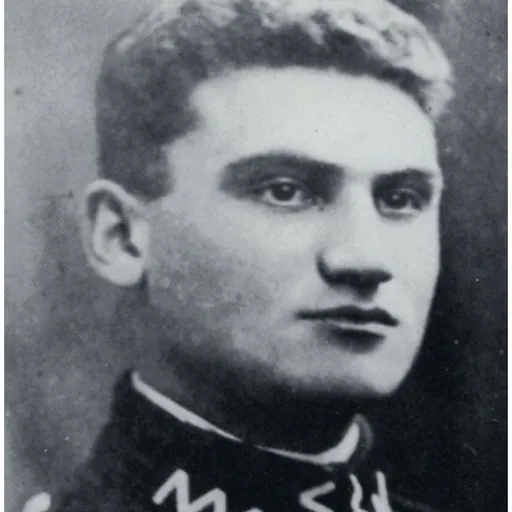
About Tuvia Bielski
Lived 1906 – 1987 (aged 81). Tuvia Bielski was a Russian and Polish partisan, known for Bielski partisans.
Tuvia Bielski (May 8, 1906 – June 12, 1987) was a Polish Jewish militant who was leader of the Bielski group, a group of Jewish partisans who set up refugee camps for Jews fleeing the Holocaust during World War II. Their camp was situated in the Naliboki forest, which was part of Poland between World War I and World War II, and which is now in western Belarus.
Biography Bielski grew up in the only Jewish family in Stankiewicze. The small village in Eastern Poland (now Western Belarus) is located between the towns of Lida and Navahrudak, both of which housed Jewish ghettos during World War II.
Tuvia was the son of David and Beila Bielski, who had 12 children: 10 boys and two girls. Tuvia was the third eldest. His brothers Asael, Alexander ("Zus") and Aron were later to become members of his partisan group.
In 1927, Bielski was recruited into the Polish Army, where he eventually became a corporal in the 30th Infantry Battalion. After completing his military service, Bielski returned home. In an effort to add to his family's income, he rented another mill. This income was still inadequate, so in 1929, at the age of 23, he married an older woman named Rifka who owned a general store and a large house. The couple lived in the nearby small town of Subotniki.
During the Soviet occupation in 1939, Bielski feared that he would be arrested by the NKVD due to his "bourgeois capitalist" occupation, so he moved to Lida. and married Sonia, though they were not yet "officially" married due to wartime conditions. Sonia was killed while taking shelter with others in a peasant home. In 1943, Tuvia married Lila "Lilka" Tiktin, who was only 17 at the time. They knew each other before the war and stayed married until his death 44 years later.
World War II
When Operation Barbarossa began, Tuvia, Zus, and Asael were called up by their army units to fight against the Nazi German occupiers. Tuvia recalls: "Suddenly about 50 planes (Luftwaffe) flew over the town dropping incendiary bombs. In a few minutes the entire place was on fire. The commander called us in, ordered us to leave the burning town and regroup in a forest about five kilometers from there. We were to continue working. We carried out his command but soon after we began our job in the forest another wave of planes flew over the area and set the woods on fire. The commander called us in and said: 'Friends, you are on your own!'" After the units disbanded, the Bielski brothers fled to Stankiewicze, where their parents lived. In early July 1941, a German army unit arrived in Stankiewicze and Jewish residents were moved to a ghetto in Nowogródek. The four Bielski brothers managed to flee to the nearby forest. Their parents, two of their brothers and other family members, including Rifka and Zus' wife and child, were killed in the ghetto on December 8, 1941.
In 1944, Asael Bielski was conscripted into the Soviet Army and killed in battle in Germany.
When Tuvia died in 1987, he was nearly penniless. He was initially buried on Long Island; one year after his death, his remains were exhumed and taken to Jerusalem, where he was given a state funeral with full military honors in 1988. The exact grave is at Har Tamir, a part of Har HaMenuchot. The following location is in Hebrew using Latin letters: Gush taf-bet, Chelka daled, Shura 19, kever 11 (block 402, section 4, row 19, grave 11). The Naliboki massacre was the subject of an official inquiry by the Polish Institute of National Remembrance's Commission for the Prosecution of Crimes against the Polish Nation. The investigation ultimately did not find conclusive evidence linking the Bielski partisans to the crime.
Bielski's memoirs, a manuscript written in Yiddish, were discovered in 2009 in Bielski's estate at the YIVO in New York. It was planned to be translated into English and published in 2012.
Don’t just read it —
keep it.
Full-length biographies made to live with: read them, listen on the way to work, watch them tonight.
- E-book
- Audio
- Video
Instant download · yours to keep · every purchase keeps this site free
Important facts
People in Tuvia Bielski's life
Named in this biography and alive at the same time

Related people
Same field, nearest in time


Contemporaries
People whose lives overlapped Tuvia Bielski's



Frequently asked questions
Who was Tuvia Bielski?
Polish resistance member (1906–1987)
When was Tuvia Bielski born?
Tuvia Bielski was born on 8 May 1906 in Stankiewicze.
When did Tuvia Bielski die?
Tuvia Bielski died on 12 June 1987 in Brooklyn.
What was Tuvia Bielski's occupation?
Tuvia Bielski was a partisan.
What was Tuvia Bielski known for?
Tuvia Bielski was known for Bielski partisans.
What nationality was Tuvia Bielski?
Tuvia Bielski was Russian and Polish.
Sources & further reading
Cite this page
APA: Biography.guide. (2026). Tuvia Bielski. https://biography.guide/tuvia-bielski/
MLA: "Tuvia Bielski." Biography.guide, https://biography.guide/tuvia-bielski/.
Chicago: "Tuvia Bielski." Biography.guide. https://biography.guide/tuvia-bielski/.
Data last updated: 2026-09-22 · Spot an error? Report a correction.
Portrait: Wikimedia Commons · author & licence
Page generated 2026-09-27 05:02 UTC