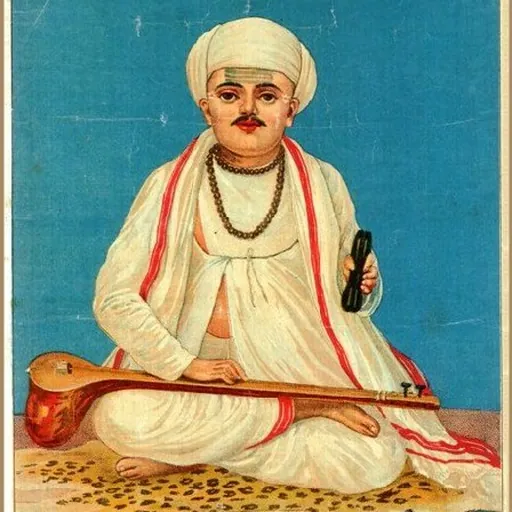
About Tukaram
Lived 1608 – 1650 (aged 41–42). Tukaram was a poet, translator and writer.
Tukaram (Marathi pronunciation: [t̪ukaːɾam]), also known as Tuka, Tukobaraya, and Tukoba, was a Hindu Marathi saint of the Varkari Sampradaya who lived in the 17th century. deal with social reform.
Biography
Early life Tukaram was born in the modern-day Maharashtra state of India. His name at birth was Tukaram Bolhoba Ambile.
Tukaram is said to have left for Vaikuntha, abode of Vishnu (identified with Vithoba) at the end of his earthly life. He spent most of his later years in devotional worship, community kirtan (group prayers with singing) and composing abhanga poetry. Tukaram pointed out social injustices, caste hierarchy, and the misconduct of certain religious leaders through his and . As a result, he faced opposition from various sections of society. One of his main detractors was Mambaji Gosavi, who ran a matha (monastic establishment) in Dehu and had several followers. Eleanor Zelliot notes that poets from the Bhakti movement, including Tukaram, significantly influenced Shivaji’s rise to power.
Late 20th-century scholarship of Tukaram, and translations of his abhanga poem, affirm his pantheistic Vedantic view. Tukaram's abhanga 2877, as translated by Ramchandra Dattatreya Ranade of Nimbal states, for example, "The Vedanta has said that the whole universe is filled by God. All sciences have proclaimed that God has filled the whole world. The Puranas have unmistakably taught the universal immanence of God. The sants have told us that the world is filled by God. Tuka indeed is playing in the world uncontaminated by it like the Sun which stands absolutely transcendent".
Scholars note the often discussed controversy, particularly among Marathi people, whether Tukaram subscribed to the monistic Vedanta philosophy of Adi Shankara. Bhandarkar notes that abhanga 300, 1992 and 2482 attributed to Tukaram are in style and philosophy of Adi Shankara:
Kirtan Tukaram encouraged kirtan as a music imbued, community-oriented group singing and dancing form of bhakti.
Social reforms
Tukaram accepted disciples and devotees without discriminating on the basis of gender. One of his celebrated devotees was Bahinabai, a Brahmin woman, who faced anger and abuse of her husband when she chose the bhakti path and Tukaram as her guru.
Tukaram taught, states Ranade, that "pride of caste never made any man holy", "the Vedas and Shastras have said that for the service of God, castes do not matter", "castes do not matter, it is God's name that matters", and "an outcast who loves the Name of God is verily a Brahmin; in him have tranquility, forbearance, compassion and courage made their home". However, early 20th century scholars questioned whether Tukaram himself observed caste when his daughters from his second wife married men of their own caste.
David Lorenzen states that the acceptance, efforts and reform role of Tukaram in the Varkari tradition follows the diverse caste and gender distributions found in Bhakti movements across India.
Literary works Gatha temple in Dehu, near Pune Maharashtra, is one of two local temples that mark the legacy of Tukaram. His poetry is carved on its wall.
Tukaram composed abhang poetry, a Marathi genre of literature which is metrical (traditionally the ovi meter), simple, direct, and it fuses folk stories with deeper spiritual themes.
Tukaram's work is known for informal verses of rapturous abandon in folksy style, composed in vernacular language, in contrast to his predecessors such as Dnyaneshwar or Namdev known for combining similar depth of thought with a grace of style. Also called Abhanga Gatha, tradition believes it includes some 4,500 abhangas. The poems considered authentic cover a wide range of human emotions and life experiences, some autobiographical, and places them in a spiritual context. The 1869 edition noted, "some of the [as received] manuscripts on which the compilation relied, had been 'corrected', 'further corrected' and 'arranged'."
A translation of about 3,700 poems from the Tukaram Gatha in English was published, in three volumes, between 1909 and 1915, by Fraser and Marathe. In 1922, Fraser and Edwards published his biography and religious ideas incorporating some translations of Tukaram's poems, and included a comparison of Tukaram's philosophy and theology with those of Christianity. Deleury, in 1956, published a metric French translation of a selection of Tukaram's poem along with an introduction to the religious heritage of Tukaram (Deleury spells him as Toukaram).
Arun Kolatkar published, in 1966, six volumes of avant-garde translations of Tukaram poems.
Chandrakant Kaluram Mhatre has translated selected poems of Tukaram, published as One Hundred Poems of Tukaram.
Legacy
Maharashtra society Tukaram's abhangas are very popular in Maharashtra. It became part of the culture of the state. Varkaris, poets and peoples study his poems. His poems are popular in rural Maharashtra and their popularity is increasing. Tukaram was a devotee of Vithoba (Vitthala), an avatar of Vishnu, but with regional style and features.
According to Richard Eaton, from early 14th-century when Maharashtra region came under the rule of the Delhi Sultanate, down to the 17th century, the legacy of Tukaram and his poet-predecessors, "gave voice to a deep-rooted collective identity among Marathi-speakers". Dilip Chitre summarizes the legacy of Tukaram and Bhakti movement sants, during this period of Hindu-Muslim wars, as transforming "language of shared religion, and religion a shared language. It is they who helped to bind the Marathas together against the Mughals on the basis not of any religious ideology but of a territorial cultural identity".
Mahatma Gandhi Mahatma Gandhi, in early 20th century, while under arrest in Yerawada Central Jail by the British colonial government for his non-violent movement, read and translated Tukaram's poetry along with Upanishads, Bhagavad Gita and poems by other Bhakti movement poet-saints.
Saintliness is not to be purchased in shops, nor is it to be had for wandering, nor in cupboards, nor in deserts, nor in forests It is not obtainable for a heap of riches. It is not in the heavens above, nor in the entrails of the earth below. Tuka says: It is a life's bargain, and if you will not give your life to possess it, better be silent.
The essence of the endless Vedas is this: Seek the shelter of God and repeat His name with all thy heart. The result of the cogitations of all the Shastras is also the same. Tuka says: The burden of the eighteen Puranas is also identical.
Merit consists in doing good to others, sin in doing harm to others. There is no other pair comparable to this. Truth is the only freedom; untruth is bondage, there is no secret like this. God's name on one's lips is itself salvation, disregarding the name is perdition. Companionship of the good is the only heaven, indifference is hell. Tuka says: It is thus clear what is good and what is injurious, let people choose what they will. Tukaram|Translated by Mahatma Gandhi
Places associated with Tukaram Places associated with Tukaram in Dehu that exist today are: Tukaram Maharaj Janm Sthan Temple, Dehu – place where Tukaramji was born, around which a temple was built later Sant Tukaram Vaikunthstan Temple, Dehu – from where Tukaram ascended to Vaikuntha (Abode of God) in his mortal form; there is a beautiful ghat behind this temple along the Indrayani River Sant Tukaram Maharaj Gatha Mandir, Dehu – modern structure; massive building housing a big statue of Tukaram; In the Gatha temple, about 4,000 abhangas (verses) created by Tukaram were carved on the walls.
Movies and popular culture
A number of Indian films have been made about the saint in different languages. These include: Tukaram (1921) silent film by Shinde. Sant Tukaram (1921) silent film by Kalanidhi Pictures. Sant Tukaram (1936) – this movie on Tukaram was screened open-air for a year, to packed audiences in Mumbai, and numerous rural people would walk very long distances to see it. Thukkaram (1938) in Tamil by B. N. Rao. Santha Thukaram (1963) in Kannada Sant Tukaram (1965) in Hindi Bhakta Tukaram (1973) in Telugu Tukaram (2012) in Marathi Sant Tukaram (2025) in Hindi abhanga Tukaram (2025) in Marathi
Tukaram's life was the subject of the 68th issue of Amar Chitra Katha, India's largest comic book series.
Balbharti has included a poem of Tukaram in a Marathi school textbook
The government of India had issued a 100 rupee Silver commemorative coin in 2002.
Don’t just read it —
keep it.
Full-length biographies made to live with: read them, listen on the way to work, watch them tonight.
- E-book
- Audio
- Video
Instant download · yours to keep · every purchase keeps this site free
Important facts
People in Tukaram's life
Named in this biography and alive at the same time

Related people
Same field, nearest in time



Contemporaries
People whose lives overlapped Tukaram's




Frequently asked questions
Who was Tukaram?
Bhakti sant-poet
When was Tukaram born?
Tukaram was born in 1608 in Dehu.
When did Tukaram die?
Tukaram died in 1650 in Indrayani.
What was Tukaram's occupation?
Tukaram was a poet, translator and writer.
Sources & further reading
Cite this page
APA: Biography.guide. (2026). Tukaram. https://biography.guide/tukaram/
MLA: "Tukaram." Biography.guide, https://biography.guide/tukaram/.
Chicago: "Tukaram." Biography.guide. https://biography.guide/tukaram/.
Data last updated: 2026-09-20 · Spot an error? Report a correction.
Page generated 2026-09-27 05:09 UTC