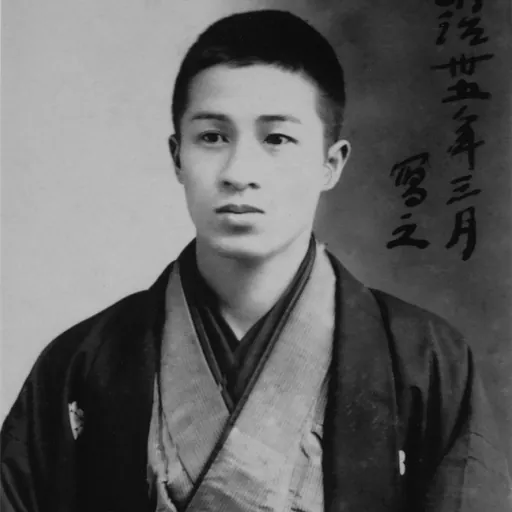
About Tsuchiya Kōitsu
Lived 1870 – 1949 (aged 79). Tsuchiya Kōitsu was a Japanese printmaker, ukiyo-e artist, painter, xylographer, woodcut draftsperson and draftsperson.
Tsuchiya Kōitsu was a Japanese artist in the Shin-hanga movement. He trained under the ukiyo-e master Kobayashi Kiyochika for 19 years, and initially focused on works depicting scenes from the First Sino-Japanese War. In 1931, at the age of 60, he began work for Shōzaburō Watanabe and his art publishing establishment which also published the work of artists like Kawase Hasui and Yoshida Hiroshi. His later work incorporated light effects to increase the emotional impact of his art.
Biography Tsuchiya Koitsu was born on September 23, 1870, in Hamamatsu, Shizuoka, Japan. His birth name was either Koichi or Sahei. He moved to Tokyo at age 15. He first attempted to become an apprentice at a Buddhist temple, but soon after, on a priest's recommendation, took up an apprenticeship at the Matsuzaki Shumeidō engraving studio, closely associated as an engraver with Kiyochika Kobayashi, to whom he was soon introduced and under whom he then studied. He worked for Kiyochika for 19 years and lived in his house, improving his skills in woodblock printing, lithography and illustration, and developing his own kosenga technique for landscapes.
Koitsu published through the Watanabe publishing house after Watanabe and Koitsu met at an exhibition commemorating the 17th anniversary of Kiyochika's death. His first design for Watanabe, Gion no Yozakura, initiated a series of about ten prints specialising in fūkeiga, in a style recalling both Kiyochika's work and that of fellow shin-hanga artists Kawase Hasui and Hiroshi Yoshida; as was typical of shin-hanga, Koitsu made intensive use of light effects to evoke mood and emotion, revealing his mastery of form and colour. In Gion no Yozakura this skill is visible in the glow of lanterns reflected on the pale pink cherry blossoms of Kyoto's Gion Shrine: foreground figures are lit by a rectangular lantern bearing the shrine's name, while small distant figures catch further lamplight, giving the print a delightful impression of leisure in the old capital as Koitsu saw it. He also produced prints for publishers Doi Sadaichi, Kawaguchi, Baba Nobuhiko, Tanaka Shobido, and Takemura. He worked mainly for Doi Hangaten, which continues to reprint his designs from the original blocks, and occasionally for Kawaguchi, for the Kyoto hanmoto Baba Nobuhiko, for Tanaka Shobido and for Takemura, remaining a productive designer of shin-hanga landscapes through the 1930s and 1940s. Two prints from this period stand out: Morigasaki Kaigan, made for Kawaguchi in 1932, depicts three silhouetted figures in a fishing boat in the early evening, its varied blues setting off the yellow moonlight and the orange glow of a lantern; and Yotsuya Araki Yokochō, published by Doi Sadaichi in 1935 as part of the series Tōkyō Fūkei (published between January 1931 and November 1935), shows two elegantly dressed geisha at the entrance of a teahouse and a third in silhouette at a second-floor window, its saturated, glossy colours bordering on the slightly garish and its firm key-block lines occasionally omitted, as for trees shown in mist or at dusk.
With the outbreak of the Second World War, both of Koitsu's main sources of income, kakemono exported to China and woodblock prints sold directly in the West, suffered heavily from his dependence on the export market. After the war he continued to paint until his death from complications of pneumonia on November 13, 1949, but produced no further shin-hanga.
Gallery
Don’t just read it —
keep it.
Full-length biographies made to live with: read them, listen on the way to work, watch them tonight.
- E-book
- Audio
- Video
Instant download · yours to keep · every purchase keeps this site free
Important facts
People in Tsuchiya Kōitsu's life
Named in this biography and alive at the same time


Related people
Same field, nearest in time



Contemporaries
People whose lives overlapped Tsuchiya Kōitsu's




Frequently asked questions
Who was Tsuchiya Kōitsu?
Japanese artist (1870-1949)
When was Tsuchiya Kōitsu born?
Tsuchiya Kōitsu was born on 23 September 1870 in Sunpu Domain, Hamamatsu.
When did Tsuchiya Kōitsu die?
Tsuchiya Kōitsu died on 13 November 1949 in Chigasaki.
What was Tsuchiya Kōitsu's occupation?
Tsuchiya Kōitsu was a printmaker, ukiyo-e artist, painter, xylographer, woodcut draftsperson and draftsperson.
What nationality was Tsuchiya Kōitsu?
Tsuchiya Kōitsu was Japanese.
Sources & further reading
Cite this page
APA: Biography.guide. (2026). Tsuchiya Kōitsu. https://biography.guide/tsuchiya-koitsu/
MLA: "Tsuchiya Kōitsu." Biography.guide, https://biography.guide/tsuchiya-koitsu/.
Chicago: "Tsuchiya Kōitsu." Biography.guide. https://biography.guide/tsuchiya-koitsu/.
Data last updated: 2026-09-23 · Spot an error? Report a correction.
Portrait: Wikimedia Commons · author & licence
Page generated 2026-09-27 05:05 UTC