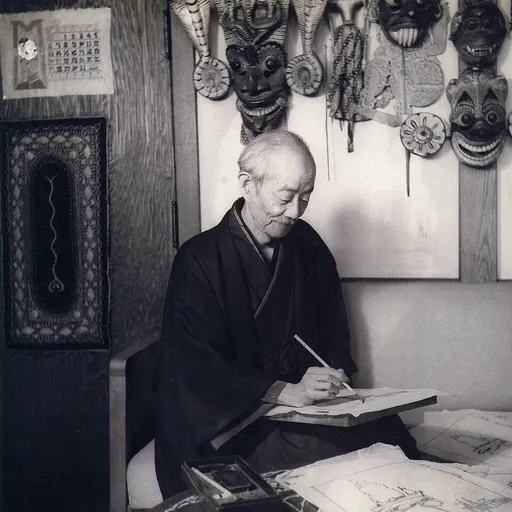
About Hiroshi Yoshida
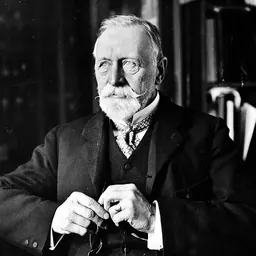
Lived 1876 – 1950 (aged 73). Hiroshi Yoshida was a Japanese printmaker and painter.
was a 20th-century Japanese painter and woodblock printmaker. Along with Hasui Kawase, he is regarded as one of the greatest artists of the shin-hanga style, and is noted especially for his landscape prints. Yoshida made numerous trips around the world, with the aim of getting to know different artistic expressions and making works of different landscapes. He traveled widely, and was particularly known for his images of non-Japanese subjects done in traditional Japanese woodblock style, including the Taj Mahal, the Swiss Alps, the Grand Canyon, and other National Parks in the United States.
He was known as a in Japan and spent about half of the year on sketching travels. He was particularly fond of mountain landscapes and painted many of them, founding the Nihon Sangakugaka Kyōkai (Japan Mountain Painting Society, 日本山岳画家協会) in his later years. As a mountaineer, he climbed the mountains of the Japanese Alps every summer and created his large paintings and woodblock prints after returning home.
Biography
View from Komagatake, 1928. From the series Southern Japan Alps
Hiroshi Yoshida (born Hiroshi Ueda) was born in the city of Kurume, Fukuoka, in Kyushu, on September 19, 1876. Hos father, Ueda Tsukane, taught painting in public schools and came from a samurai family; Hiroshi showed an early gift for art that his father encouraged. At the age of 15, he was adopted by the Yoshida family after his talent for painting was discovered by Kasaburo Yoshida, a junior high school art teacher, and studied with the Kyoto Tamura Sōryū and Miyake Kokki. He moved to Tokyo at the age of 17 and entered the Fudōsha (不同舎), a painting school sponsored by the yōga-ka Koyama Shōtarō, and became a member of the Meiji Bijutsukai (Meiji Art Society, 明治美術会), the first Western-style art organization in Japan.
In 1920, at the age of 44, Yoshida presented his first woodcut at the Watanabe Print Workshop, organized by Shōzaburō Watanabe (1885–1962), publisher and advocate of the shin-hanga movement. His first work was a print depicting the Meiji Shrine. In 1921, he produced seven prints, including a series of sailing ships. However, Yoshida's collaboration with Watanabe was short partly due to Watanabe's shop burning down because of the Great Kanto earthquake on September 1, 1923.
In 1923, Yoshida made a third travel to the U.S. to sell the few works left after the earthquake. His prints were well received in the U.S. and he held exhibitions all over the country from his base in Boston.
In 1925, he hired a group of professional carvers and printers, and established his own studio. Prints were made under his close supervision. Yoshida combined the ukiyo-e collaborative system with the sōsaku-hanga principle of "artist's prints", and formed a third school, separating himself from the shin-hanga and sōsaku-hanga movement.
In 1925, he started the series Europe and the series The United States and published works like The Grand Canyon. In that year, he started the series Seto Inland Sea, of which Glittering Sea was published in the same year. He also published the series Twelve Scenes in the Japan Alps and three prints from the series Ten Views of Mount Fuji in the same year. In 1928, he published the series Southern Japan Alps and the remaining seven works from the series Ten Views of Mount Fuji.
In 1938 Yoshida made the first of three trips to China as an official war artist.
At the age of 73, Yoshida took his last sketching trip to Izu and Nagaoka and painted his last works The Sea of Western Izu and The Mountains of Izu. He became sick on the trip and returned to Tokyo where he died on April 5, 1950, at his home. From 1930 until his death in 1950 he produced about 250 woodblock prints.
Artistic style
Throughout his life, Yoshida was a leading figure in the Japanese art world of his time in the fields of woodblock prints, watercolors and oil paintings.
During a visit to the United States in 1923, he became aware of the high esteem in which Japanese woodblock prints were held and set out to create a new style of woodblock prints that combined the traditional Japanese technique of ukiyo-e with the realistic expression of . He borrowed the brush strokes of oil painting and the color expression of watercolor from yōga techniques and integrated them with traditional ukiyo-e techniques.
His prints are characterized by an unprecedented layering of colors through multiple prints, with an average of 30 prints and often close to 100 prints. As a result, his works are rich in color and faithfully depict the atmosphere of landscapes and even the three-dimensionality of architecture. For example, Yōmeimon in 1937 was printed 96 times and Kameido in 1927 was printed 88 times to complete the work. In his six prints of the Taj Mahal published in 1932, the fifth and sixth are in the betsuzuri method, each depicting a morning and a night scene.
Yoshida left the carving and printing of the woodblocks to the craftsmen as in traditional Japanese woodblock printmaking, but he worked closely with them to instruct and supervise them strictly and stamped the finished works with the 自摺 (self-printing, jizuri) seal. He believed that in order to instruct the craftsmen, he had to acquire more skill than the craftsmen, so he carved the woodblocks himself for some of his works.
The Yoshida family legacy
Hodakayama, from the series Twelve Scenes in the Japan Alps, 1926. His second son was named after Mt. Hotaka, Yoshida's favorite mountain. The artistic lineage of the Yoshida family of eight artists: Kasaburo Yoshida (1861–1894), whose wife Rui Yoshida was an artist; their daughter Fujio Yoshida (1887–1987); Hiroshi Yoshida (1876–1950), their adopted son, who married Fujio; Tōshi Yoshida (1911–1995), Hiroshi's son, whose wife Kiso Yoshida (1919–2005) was an artist; Hodaka Yoshida (1926–1995), another of Hiroshi's sons, whose wife Chizuko Yoshida (1924–2017) and daughter Ayomi Yoshida (b. 1958) are artists. This group, four men and four women spanning four generations, provides a perspective on Japanese history and art development in the turbulent 20th century. Although they inherited the same tradition, the Yoshida family artists have worked in different styles with different sensibilities. Toshi Yoshida and the Yoshida family have used Hiroshi's original woodblocks to create later versions, including posthumous, of his prints. Prints created under Hiroshi Yoshida's management with special care have a seal kanji stamp, which indicates that he played an active role in the printing process of the respective print. Hiroshi Yoshida's signatures vary depending on the agents and time of creation. Prints originally sold on the Japanese market do not carry a pencil signature or a title in English.
Yoshida was fond of mountains and wanted to name his first son Hakusan (白山), after Mount Hakusan, but decided against it when his wife objected. Fifteen years later, he named his second son Hodaka (穂高), after Mount Hotaka. It is said that he loved Mt. Hotaka the most of all the mountains, and through his artistic activities he created many works depicting Mt. Hotaka. the Toledo Museum of Art, the Brooklyn Museum, the Harvard Art Museums, the Saint Louis Art Museum, the Dallas Museum of Art, the University of Michigan Museum of Art, the Clark Art Institute, the Portland Art Museum, the Indianapolis Museum of Art, the Carnegie Museum of Art, the Tokyo Fuji Art Museum, the Detroit Institute of Arts, the Seattle Art Museum, the Museum of Fine Arts, Boston, the Fine Arts Museum of San Francisco, the Davis Museum at Wellesley College, and the Mount Holyoke College Art Museum.
Publications In 1939 Hiroshi Yoshida wrote Japanese Wood-Block Printing, a comprehensive guide to the craft of woodblock printing in the shin-hanga style. It was published by The Sanseido Company, Ltd. of Tokyo and Osaka in 1939.
Gallery
Don’t just read it —
keep it.
Full-length biographies made to live with: read them, listen on the way to work, watch them tonight.
- E-book
- Audio
- Video
Instant download · yours to keep · every purchase keeps this site free
Important facts
People in Hiroshi Yoshida's life
Named in this biography and alive at the same time




Related people
Same field, nearest in time



Contemporaries
People whose lives overlapped Hiroshi Yoshida's
Frequently asked questions
Who was Hiroshi Yoshida?
Japanese artist (1876-1950)
When was Hiroshi Yoshida born?
Hiroshi Yoshida was born on 19 September 1876 in Kurume.
When did Hiroshi Yoshida die?
Hiroshi Yoshida died on 5 April 1950 in Shimo-Ochiai.
What was Hiroshi Yoshida's occupation?
Hiroshi Yoshida was a printmaker and painter.
What nationality was Hiroshi Yoshida?
Hiroshi Yoshida was Japanese.
Sources & further reading
Cite this page
APA: Biography.guide. (2026). Hiroshi Yoshida. https://biography.guide/hiroshi-yoshida/
MLA: "Hiroshi Yoshida." Biography.guide, https://biography.guide/hiroshi-yoshida/.
Chicago: "Hiroshi Yoshida." Biography.guide. https://biography.guide/hiroshi-yoshida/.
Data last updated: 2026-09-20 · Spot an error? Report a correction.
Page generated 2026-09-27 05:10 UTC