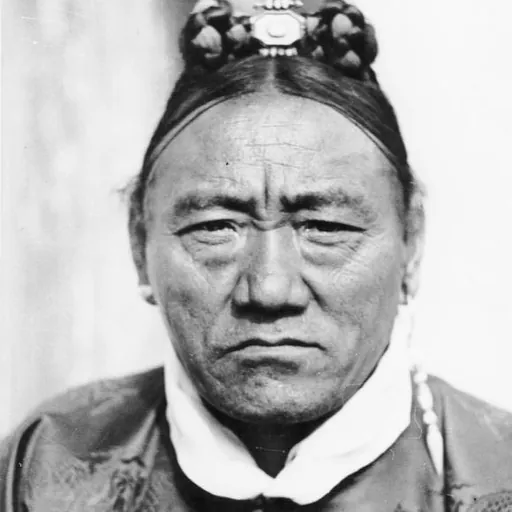
About Tsarong Dazang Dramdul
Lived 1888 – 1959 (aged 70–71). Tsarong Dazang Dramdul was an economist.
Tsarong Dasang Dramdul (1888–1959), commonly known mononymously as Tsarong or by his title Tsarong Dzasa, was a Tibetan politician and general in the Tibetan Army. He was a close aide of the 13th Dalai Lama and played an important role in the early twentieth century politics of Tibet. Eager to accelerate economic progression and pursue the modernization of Tibet, Tsarong believed that the old order in Tibet had to be broken by hierarchical reforms to prepare the way for a more modern society which would be compatible with the outside world. In his efforts to build up Tibet's defense systems and relations with European powers as well as to facilitate trade and strengthen the Tibetan currency, he made a series of diplomatic visits to British India. His diplomatic skills came to see him regarded by the British as being, "the most powerful friend of His Majesty's Government in Tibet."
Tsarong was captured by the People's Liberation Army following the failed March 1959 uprising in Lhasa. He died in prison shortly afterwards, before his scheduled "struggle session" in Lhasa.
Growth of a military leader (1888–1913) Namgang Dazang Damdu was born into a peasant family in Phenpo, north of Lhasa in 1888 according to the Tibet Museum (other sources suggest 1885).
International diplomacy and ideologies of modernization (1914–1932)
In September 1915 Tsarong visited Sikkim on diplomatic purposes and visited India again on a pilgrimage in 1924. Following the declaration of Tibetan Independence and victory, Tsarong became a leading figure in Tibet in the 1910s and the decades that followed, and was entrusted with a significant amount of responsibility for the running of Tibet. His status was something unique in Tibet, growing to possess military, political and economic power. In conjunction he was not only the Commander-in-Chief of the Army, but became Senior Cabinet Minister and later Head of the Tibetan Mint and Armoury after 1933.
Tsarong gained practical and theoretical experiences by visiting neighboring countries and educating himself about their national policies and strategies. He learned that for a state to be successful, there must be not only a great value placed on internal domestic unity and prosperity, but the country must exert a strong military presence and engage in active diplomacy with foreign nations to affect the balance of international power in favor of Tibet. This strong military force in Tsarong's ideology must also exert power over those within the country, driving out the threats from internal disunity and taking away local and class privileges in favor of a centralized military-based elite, a modern Tibetan state. However, although Tsarong was very popular with many ordinary Tibetans throughout Tibet, Tsarong's revolutionary ideas of modernization and a dramatic restructure of local aristocrats and estates made him strongly disliked by many of the aristocracy or authoritative monks in Tibet who viewed him as a serious threat to their historical privileges and order. Dzasa was notably concerned about the weakness of the financial situation and Tsepon Wangchuk Deden Shakabpa recounted the economic situation in Tibet and Dzasa's aims at this time;
"In 1947 there was little of either grain reserves or gold. Tsarong was worried about this situation since we continued to print new paper currency. He always used to say that the paper money had to have some hard backing; that a currency note means that the government guarantees the value of the note in gold or some other commodity. He also used to talk about a foreign country where all the people suddenly came and asked to change paper money into silver and gold and the government had nothing, so the finance minister had to commit suicide."
During this period Tsarong was also an active figure in civil engineering works and buildings in Tibet. In 1937 for instance he supervised the construction of a steel bridge over the Trisum River, about eight miles from Lhasa, on the main trade route from Lhasa to India and western Tibet. Immediately after its completion, Tsarong began planning a more ambitious structure across the Kyichu, the Kyichu Bridge which was to be located east of Lhasa. The project was given the seal of approval from the Tibetan government and Tsarong had organised the purchase of steel girders from Calcutta to be used to construct it. However, growing concerns over the Chinese meant the project had to be abandoned. Later after the Chinese successfully annexed Tibet, they would finance a notable bridge at Perong, close to the original site.
Relations with People's Republic of China in Tibet (1950–1959) Tsarong and Tibetan monks captured by the People's Liberation Army in March 1959 in an image taken from a Chinese propaganda film. Tsarong would soon die in a prison before his scheduled "struggle session". In the late 1940s and 1950s the threat from the Chinese grew increasingly ominous. In 1959 a revolt broke out in Lhasa against the Chinese government. Tsarong had been appointed to use his diplomatic skills to head a delegation to negotiate with the Chinese authorities in Lhasa but before negotiations could be finalized, Lhasa came under fire with bombing of the Potala and Norbulingka palaces. Several hundred Tibetans died in the attack (with approximately 87,000 dying in genocidal reprisals after the uprising's failure) and Tsarong and a number of other important officials were captured during the battle, or others died. Shortly after his arrest, on 14 May 1959, Tsarong died in a Chinese military prison in Lhasa.
Personal life
Tsarong was said to be able to speak Russian, Hindustani and Mongolian. He was described by the British as "the most powerful friend of His Majesty's Government in Tibet" and being "very friendly to British officials". He was described as "wealthy, with great energy, sound sense and was progressively minded".
Don’t just read it —
keep it.
Full-length biographies made to live with: read them, listen on the way to work, watch them tonight.
- E-book
- Audio
- Video
Instant download · yours to keep · every purchase keeps this site free
Important facts
Related people
Same field, nearest in time

Contemporaries
People whose lives overlapped Tsarong Dazang Dramdul's




Frequently asked questions
Who was Tsarong Dazang Dramdul?
Tibetan aide to the Dalai Lama (1888–1959)
When was Tsarong Dazang Dramdul born?
Tsarong Dazang Dramdul was born in 1888 in Tibet.
When did Tsarong Dazang Dramdul die?
Tsarong Dazang Dramdul died on 14 May 1959 in Lhasa.
What was Tsarong Dazang Dramdul's occupation?
Tsarong Dazang Dramdul was an economist.
Sources & further reading
· Wikipedia: Tsarong Dazang Dramdul
Cite this page
APA: Biography.guide. (2026). Tsarong Dazang Dramdul. https://biography.guide/tsarong-dazang-dramdul/
MLA: "Tsarong Dazang Dramdul." Biography.guide, https://biography.guide/tsarong-dazang-dramdul/.
Chicago: "Tsarong Dazang Dramdul." Biography.guide. https://biography.guide/tsarong-dazang-dramdul/.
Data last updated: 2026-09-20 · Spot an error? Report a correction.
Portrait: Wikimedia Commons · author & licence
Page generated 2026-09-27 04:57 UTC