
About Trần Kim Tuyến
Lived 1925 – 1995 (aged 70). Trần Kim Tuyến was a Vietnamese diplomat.
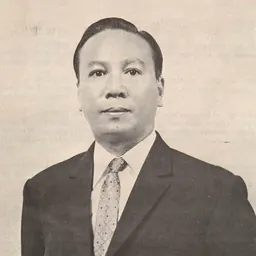
Dr. Trần Kim Tuyến (24 May 1925 – 23 July 1995) was the chief of intelligence of South Vietnam under its first President Ngô Đình Diệm from 1955 to 1963. As a Roman Catholic, he was trusted by the Ngô family, and was part of their inner circle. Tuyến was responsible for a variety of propaganda campaigns against communists, and was prominent in operating the secret Cần Lao party apparatus which maintained the Ngô family's rule. In the course of his work, Tuyến emulated the tactics of the communists. He eventually became disillusioned and plotted against the regime before being exiled. After Diệm was deposed, Tuyến returned to South Vietnam, but the military junta which had replaced the Ngô family jailed him for five years. He fled the country in 1975 as Saigon was falling.
Early years A short and light man at less than ,
Rise to power
In mid-1954, at the time the Geneva Conference had concluded, Tuyến had been working for the anti-communist Vietnamese National Army of the State of Vietnam in an outlying province, only travelling to Hanoi during the weekends. As a result of the discussions in Geneva, Vietnam was to be temporarily partitioned pending national reunification elections in 1956. In the meantime, the Vietminh controlled the Democratic Republic of Vietnam in the north, and the State of Vietnam was handed the south. The agreements also allowed for the free passage of civilians between either side for 300 days, while military personnel were obliged to move to their respective zones. Tuyến had persuaded a substantial number of northern Catholics to leave their homes and move south. As a result, he later tried to persuade Diệm to maintain some contact with members of the communist regime in Hanoi in the hope of persuading them to defect.
Tuyến was in Hanoi when his sister's husband told him that he could travel to Saigon immediately on the plane of Prime Minister Diệm of the State of Vietnam — Diệm had been in Hanoi to urge civilians to flee communist rule and head into the south of the country. Tuyến decided to make use of the opportunity and left with only a pair of spare trousers and the clothes on his back. His fiancée accepted his indirect marriage proposal — he asked her if she would join him in the south. Tuyến accepted Diệm's offer that he work for his younger brother, Nhu. Tuyến lived in the Independence Palace, sleeping on the floor, as Diệm sought to restore order in the south. Tuyến was unemployed for two months before being assigned to the Ministry of Information, essentially a propaganda unit.
In 1955, Diem created the Service des Études Politiques et Sociales (Service for Political and Social Studies, SEPES), which for the surveillance of government officials, which according to the historian Edward Miller, 'would eventually become one of the most feared components of the Diem government's security apparatus', and Tuyến was made its inaugural director. Tuyến later supervised the operations of various newspapers that acted as government mouthpieces, including the Cach Mang Quoc Gia (National Revolution). SEPES, with Tuyến leading the way, was responsible to screening prospective members, fundraising and indoctrination of new recruits. Tuyến had an intelligence unit of 500 men, and was used by Nhu as a fixer, to arrange secret meetings with dissidents.
Tuyến was involved in internal power struggles within the Diem regime's intelligence sector, overcoming the chairman of the National Revolutionary Movement, the regime's mass movement, Tran Chanh Thanh, who was removed in 1957 with Nhu's assistance.
Due to Tuyến's profile in the regime's repression, US Ambassador Elbridge Durbrow suggested to Diem in 1960 that Tuyến be removed from public power and sent overseas in a suite of liberalisation measures, which Diem rejected.
Tuyến was a key figure in persuading undecided ARVN divisions to support Diệm and put down the 1960 South Vietnamese coup attempt.
In 1962, Nhu appointed Tuyến and Colonel Phạm Ngọc Thảo, a communist double agent from a Catholic background, to oversee the Strategic Hamlet Program, which attempted to isolate the Viet Cong by barricading villagers inside fortified compounds, theoretically locking the communists out. Tuyến led the way in promoting the concept to the populace.
Downfall
Time passed and Tuyến began to show displeasure at the increasing interference of Nhu's wife, Madame Nhu into politics; displeasure turned to offence and Nhu began to ignore Tuyến. In early 1963, Tuyến was ordered by Diệm to go home and rest because the latter thought the former had been too lenient with disillusioned military officers and politicians who were veering towards opposition. Tuyến was never recalled to work. Instead, Tuyến responded by dispatching his staff back to their former position they had held before they joined his department, leaving the intelligence bureau in a state of collapse. In May, when the Buddhist crisis erupted after Diệm's forces had banned Buddhists from flying the Buddhist flag to commemorate Vesak, and fatally fired on them, Diệm recalled Tuyến, hoping he could resolve the crisis.
Tuyến eventually began to plot against the Ngo family. He began meeting with Colonel Đỗ Mậu, the chief of military security and other colonels in key leadership positions in the marine and paratroop divisions around Saigon. He also used his contacts in the Cao Đài and Hòa Hảo religious sects in plotting the coup. With growing displeasure among the populace against the Diệm regime, Tuyến targeted July 15 as the date for a coup, but was unable to recruit the generals required for his plan, since he was too closely associated with Nhu to gain their trust. In the end, Tuyến's old group ended up being led by Thảo, who was deliberately fomenting discord among the army in order to help the communists. Thảo's group did not lead the coup, as they were integrated into the main group led by Generals Dương Văn Minh and Trần Văn Đôn, which would depose and assassinate Diệm and Nhu on 2 November 1963.
Aware that Tuyến might be involved in plotting against Diệm, Nhu sent him to Cairo as ambassador. At the time, the Soviet Union-aligned Egypt was leading a campaign of African countries against South Vietnam at the United Nations, and Nhu ostensibly sent him to Cairo to lead a diplomatic push against communist influence there. It was effectively an exile for Tuyến, and there were rumours that Madame Nhu's younger brother, Trần Văn Khiêm, was planning to assassinate him. Upon arriving in Cairo, Tuyến was greeted with the news that Egypt had extended diplomatic relations to North Vietnam. Tuyến eventually flew to Hong Kong, where British intelligence provided him with protection; Tuyến kept in contact with anti-Diệm forces in Vietnam.
After Diệm was overthrown in November 1963, Tuyến decided to return to Vietnam. His wife was pregnant and he reasoned that as he had no enemies in the military junta and had worked well with them in the past, he would be safe. However, he was arrested and tried by the junta for corruption and abuse of power, and sentenced to five years in prison. Tuyến believed he was jailed because the generals were afraid that he would claim they were corrupt puppets of Nhu.
When his prison term ended, Tuyến remained under house arrest after the brother of President Nguyễn Văn Thiệu intervened. Tuyến's wife was allowed to teach in a high school and Tuyến was allowed to write political columns under an assumed name. In April 1975, as South Vietnam collapsed amid a communist onslaught, British intelligence arranged for Tuyến's wife and their three youngest children to leave for Cambridge, where their eldest son was studying. Tuyến was reluctant to leave, but did so on 29 April 1975, the day before the fall of Saigon. He departed on one of the last helicopters from 22 Gia Long Street and flew out of the besieged city with the help of Phạm Xuân Ẩn, a Time magazine correspondent and – ironically – a communist spy.
Don’t just read it —
keep it.
Full-length biographies made to live with: read them, listen on the way to work, watch them tonight.
- E-book
- Audio
- Video
Instant download · yours to keep · every purchase keeps this site free
Important facts
People in Trần Kim Tuyến's life
Named in this biography and alive at the same time




Related people
Same field, nearest in time

Contemporaries
People whose lives overlapped Trần Kim Tuyến's



Frequently asked questions
Who was Trần Kim Tuyến?
Vietnamese diplomat (1925-1995)
When was Trần Kim Tuyến born?
Trần Kim Tuyến was born on 24 May 1925.
When did Trần Kim Tuyến die?
Trần Kim Tuyến died on 23 July 1995.
What was Trần Kim Tuyến's occupation?
Trần Kim Tuyến was a diplomat.
What nationality was Trần Kim Tuyến?
Trần Kim Tuyến was Vietnamese.
Sources & further reading
Cite this page
APA: Biography.guide. (2026). Trần Kim Tuyến. https://biography.guide/tran-kim-tuyen/
MLA: "Trần Kim Tuyến." Biography.guide, https://biography.guide/tran-kim-tuyen/.
Chicago: "Trần Kim Tuyến." Biography.guide. https://biography.guide/tran-kim-tuyen/.
Data last updated: 2026-09-20 · Spot an error? Report a correction.
Page generated 2026-09-27 05:04 UTC