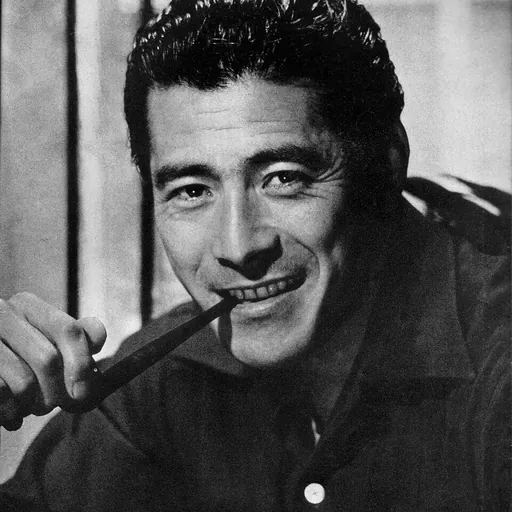
About Toshirō Mifune
Lived 1920 – 1997 (aged 77). Toshirō Mifune was a Japanese actor, film producer, film actor, film director, television actor and director.
was a Japanese actor and producer. The recipient of numerous awards and accolades over a lengthy career, he is widely considered one of the greatest actors of all time. Noted for his commanding screen presence in the Japanese film industry, he typically played hypermasculine or heroic characters.
Although he amassed more than 180 screen credits, Mifune is best known for his 16 collaborations with director Akira Kurosawa. These collaborations included Kurosawa's critically acclaimed jidaigeki films such as Rashomon (1950), for which Mifune won the San Marco Golden Lion at the Venice Film Festival, Seven Samurai (1954), Throne of Blood (1957), The Hidden Fortress (1958), and Yojimbo (1961), for which Mifune won the Volpi Cup for Best Actor at the Venice Film Festival and was recognised at the Blue Ribbon Awards as Best Actor. He also portrayed Miyamoto Musashi in Hiroshi Inagaki's Samurai Trilogy (1954–1956), Lord Toranaga in the NBC television miniseries Shōgun, and Admiral Isoroku Yamamoto in three different films.
In 1962, he established Mifune Productions, achieving success with large-scale works including The Sands of Kurobe (1968) and Samurai Banners (1969). He also starred in his directorial debut Legacy of the 500,000 (1963). Following his performance in the 1965 film Red Beard, which won him the Best Actor at the Venice Film Festival for a second time, He is the subject of the feature-length documentary, Mifune: The Last Samurai (2015), about his life and his films. In 2016, his name was inscribed on the Hollywood Walk of Fame. His father Tokuzo was a trade merchant and photographer who ran a photography business in Qingdao and Yingkou, and the son of a physician from Kawauchi, Akita Prefecture. His mother Sen was the daughter of a hatamoto, a high-ranking samurai official. Mifune grew up with his parents and two younger siblings in Dalian, Fengtian from the age of 4 to 19.
In his youth, Mifune worked at his father's photo studio. After spending the first 19 years of his life in China, as a Japanese citizen, he was drafted into the Imperial Japanese Army Aviation division, where he served in the Aerial Photography unit during World War II.
Career
Early work In 1947, a large number of Toho Productions actors, after a prolonged strike, had left to form their own company, Shin Toho. Toho then organized a "new faces" contest to find new talent.
Nenji Oyama, a friend of Mifune's who worked for the Photography Department of Toho, sent Mifune's resume to the New Faces audition as the Photography Department was full, telling Mifune he could later transfer to the Photography Department if he wished. He was accepted, along with 48 others (out of roughly 4,000 applicants), and allowed to take a screen test for Kajirō Yamamoto. Instructed to mime anger, he drew from his wartime experiences. Yamamoto took a liking to Mifune, recommending him to director Senkichi Taniguchi. This led to Mifune's first feature role, in Shin Baka Jidai.
Mifune first encountered director Akira Kurosawa when Toho Studios, the largest film production company in Japan, was conducting a massive talent search, during which hundreds of aspiring actors auditioned before a team of judges. Kurosawa was originally going to skip the event, but showed up when Hideko Takamine told him of one actor who seemed especially promising. Kurosawa later wrote that he entered the audition to see "a young man reeling around the room in a violent frenzy ... it was as frightening as watching a wounded beast trying to break loose. I was transfixed." When Mifune, exhausted, finished his scene, he sat down and gave the judges an ominous stare. He lost the competition but Kurosawa was impressed. "I am a person rarely impressed by actors," he later said. "But in the case of Mifune I was completely overwhelmed." Mifune immersed himself into the six-month training and diligently applied himself to studying acting, although at first he still hoped to be transferred to the camera department.
1950s–1990s
His imposing bearing, acting range, facility with foreign languages and lengthy partnership with acclaimed director Akira Kurosawa made him the most famous Japanese actor of his time, and easily the best known to Western audiences. He often portrayed samurai or rōnin who were usually coarse and gruff (Kurosawa once explained that the only weakness he could find with Mifune and his acting ability was his "rough" voice), inverting the popular stereotype of the genteel, clean-cut samurai. In such films as Seven Samurai and Yojimbo, he played characters who were often comically lacking in manners, but replete with practical wisdom and experience, understated nobility, and, in the case of Yojimbo, unmatched fighting prowess. Sanjuro in particular contrasts this earthy warrior spirit with the useless, sheltered propriety of the court samurai. Kurosawa valued Mifune highly for his effortless portrayal of unvarnished emotion, once commenting that he could convey in only three feet of film an emotion for which the average Japanese actor would require ten feet. He starred in all three films of Hiroshi Inagaki's Samurai Trilogy (1954–1956), for which the first film in Samurai I: Musashi Miyamoto was awarded an Honorary Academy Award. Mifune and Inagaki worked together on twenty films, which outnumbered his collaborations with Kurosawa, with all but two falling into the jidaigeki genre, most notably with Rickshaw Man (1958), which won the Venice Film Festival Golden Lion.
He was also known for the effort he put into his performances. To prepare for Seven Samurai and Rashomon, Mifune reportedly studied footage of lions in the wild. For the Mexican film Ánimas Trujano, he studied tapes of Mexican actors speaking so that he could recite all of his lines in Spanish. Many Mexicans believed that Toshiro Mifune could have passed for a native of Oaxaca due to his critically acclaimed performance. When asked why he chose Mexico to do his next film, Mifune quoted, "Simply because, first of all, Mr. Ismael Rodríguez convinced me; secondly, because I was eager to work in beautiful Mexico, of great tradition; and thirdly, because the story and character of 'Animas Trujano' seemed very human to me". The film was nominated for both a Golden Globe and an Oscar. Mifune gave a Japanese pistol as a gift to then-Mexican president Adolfo López Mateos when they met in Oaxaca.
Mifune has been credited as originating the "roving warrior" archetype, which he perfected during his collaboration with Kurosawa. His martial arts instructor was Yoshio Sugino of the Tenshin Shōden Katori Shintō-ryū. Sugino created the fight choreography for films such as Seven Samurai and Yojimbo, and Kurosawa instructed his actors to emulate his movements and bearing.
Clint Eastwood was among the first of many actors to adopt this wandering ronin with no name persona for foreign films, which he used to great effect in his Western roles, especially in Spaghetti Westerns directed by Sergio Leone where he played the Man with No Name, a character similar to Mifune's seemingly-nameless rōnin in Yojimbo.
Mifune may also be credited with originating the yakuza archetype, with his performance as a mobster in Kurosawa's Drunken Angel (1948), the first yakuza film. Most of the sixteen Kurosawa–Mifune films are considered cinema classics. These include Drunken Angel, Stray Dog, Rashomon, Seven Samurai, The Hidden Fortress, High and Low, Throne of Blood (an adaptation of Shakespeare's Macbeth), Yojimbo, and Sanjuro.
Mifune and Kurosawa finally parted ways after Red Beard. Several factors contributed to the rift that ended this career-spanning collaboration. Mifune had a passion for film in his own right and had long wanted to set up a production company, working towards going freelance. Kurosawa and Taniguchi advised against it out of concern they would not be able to cast Mifune as freely. Most of Mifune's contemporaries acted in several different movies in this period. Since Red Beard required Mifune to grow a natural beard — one he had to keep for the entirety of the film's two years of shooting — he was unable to act in any other films during the production. This put Mifune and his financially strapped production company deeply into debt, creating friction between him and Kurosawa. Although Red Beard played to packed houses in Japan and Europe, which helped Mifune recoup some of his losses, the ensuing years held varying outcomes for both Mifune and Kurosawa. After the film's release, the careers of each man took different arcs: Mifune continued to enjoy success with a range of samurai and war-themed films (Rebellion, Samurai Assassin, The Emperor and a General, among others). In contrast, Kurosawa's output of films dwindled and drew mixed responses. During this time, Kurosawa attempted suicide. In 1980, Mifune experienced popularity with mainstream American audiences through his role as Lord Toranaga in the television miniseries Shogun, which Kurosawa criticised for its historical inaccuracy. Mifune spoke respectfully of Kurosawa and loyally attended the premiere of Kagemusha.
Mifune turned down an opportunity from United Artists to play the Japanese spy chief Tiger Tanaka in the James Bond film You Only Live Twice (1967). According to his daughter, he also turned down an offer from George Lucas to play either Darth Vader or Obi-Wan Kenobi in Star Wars (1977). Mifune was considered for the role of Spock's nemesis in the unproduced Star Trek film Star Trek: Planet of the Titans.
Mifune himself was always professional, memorizing all of his lines and not carrying scripts on set. He was seen as unusually humble for an international star, and was known for treating his co-stars and crew generously, throwing catered parties for them and paying for their families to go to onsen resorts. When American actor Scott Glenn was asked about his experience of filming The Challenge (1982) alongside Mifune, Glenn recalled disappointment that the original script (about "a surrogate father and son finding each other from completely different cultures") lost its "character-driven scenes" and was reduced to "a martial arts movie" but stated, "...I remember Mifune came to me, and he said, "Look, this is what's happening. I'm disappointed, and I know you are, but this is what it is. So you can either have your heart broken every day, or you can use this experience as an opportunity to be spending time in the most interesting time in Japan and let me be your tour guide." So it wound up with me learning an awful lot of stuff from Toshirô."
In 1979, Mifune joined the ensemble cast of the Steven Spielberg war comedy 1941 as the commander of a lost Imperial Japanese Navy submarine searching for Hollywood shortly after the Pearl Harbor attack. Mifune received wide acclaim in the West after playing Toranaga in the 1980 TV miniseries Shogun. However, the series' blunt portrayal of the Tokugawa Shogunate and the greatly abridged version shown in Japan meant that it was not as well received in his homeland.
The relationship between Kurosawa and Mifune remained ambivalent. Kurosawa criticized Mifune's acting in Interview magazine and also said that "All the films that I made with Mifune, without him, they would not exist". He also presented Mifune with the Kawashita award which he himself had won two years prior. They frequently encountered each other professionally and met again in 1993 at the funeral of their friend Ishirō Honda, but never collaborated again.
Personal life Among Mifune's fellow performers, one of the 32 women chosen during the new faces contest was Sachiko Yoshimine. Eight years Mifune's junior, she came from a respected Tokyo family. They fell in love and Mifune soon proposed marriage.
Director Senkichi Taniguchi, with the help of Akira Kurosawa, convinced the Yoshimine family to allow the marriage. The wedding took place in February 1950 at the Aoyama Gakuin Methodist Church. Yoshimine was a Buddhist but since Mifune was a Christian, they were married in church as per Christian tradition.
In November of the same year, their first son, Shirō was born. In 1955, they had a second son, Takeshi. Mifune's daughter was born to his mistress, actress Mika Kitagawa, in 1982.
Death On 24 December 1997, he died in Mitaka, Tokyo, of multiple organ failure at the age of 77.
Honors Mifune won the Volpi Cup for Best Actor twice, in 1961 and 1965. He was awarded the Medal of Honor with Purple Ribbon in 1986 and the Order of the Sacred Treasure in 1993. In 1973, he was a member of the jury at the 8th Moscow International Film Festival. In 1977, he was a member of the jury at the 10th Moscow International Film Festival.
On 14 November 2016, Mifune received a star on the Hollywood Walk of Fame for his work in the motion picture industry.
Personal quotations Of Akira Kurosawa, Toshiro Mifune said, "I have never as an actor done anything that I am proud of other than with him". "Since I came into the industry very inexperienced, I don't have any theory of acting. I just had to play my roles my way."
"Generally speaking, most East–West stories have been a series of cliches. I, for one, have no desire to retell Madame Butterfly."
"An actor is not a puppet with strings pulled by the director. He is a human being with seeds of all emotions, desires, and needs within himself. I attempt to find the very center of this humanity and explore and experiment."
Peary also wrote,
Amazingly physical, [Mifune] was a supreme action hero whose bloody, ritualistic, and, ironically, sometimes comical sword-fight sequences in Yojimbo and Sanjuro are classics, as well-choreographed as the greatest movie dances. His nameless sword-for-hire anticipated Clint Eastwood's 'Man With No Name' gunfighter. With his intelligence, eyes seemingly in back of his head, and experience evident in every thrust or slice, he has no trouble – and no pity – dispatching twenty opponents at a time (Bruce Lee must have been watching!). It is a testament to his skills as an actor that watching the incredible swordplay does not thrill us any more than watching his face during the battle or just the way he moves, without a trace of panic, across the screen – for no one walks or races with more authority, arrogance, or grace than Mifune's barefoot warriors. For a 20-year period, there was no greater actor – dynamic or action – than Toshiro Mifune. Just look at his credits.
Filmography Mifune appeared in roughly 170 feature films. In 2015, Steven Okazaki released Mifune: The Last Samurai, a documentary chronicling Mifune's life and career. Due to variations in translation from the Japanese and other factors, there are multiple titles to many of Mifune's films (see IMDb link). The titles shown here are the most common ones used in the United States, with the original Japanese title listed below it in parentheses. Mifune's filmography mainly consists of Japanese productions, unless noted otherwise (see Notes column).
Films
The 1999 Danish film Mifune is named after the actor.
Television All programs originally aired in Japan except for Shōgun which aired in the U.S. on NBC in September 1980 before being subsequently broadcast in Japan on TV Asahi from 30 March to 6 April 1981. Date(s) Title Role Notes 1967.05.11 He of the Sun (太陽のあいつ) Himself1 episode 1968–1969 Five Freelance Samurai (五人の野武士) Jirō Yoshikage Funayama6 episodes 1971 Daichūshingura (大忠臣蔵) Kuranosuke ŌishiAll 52 episodes 1972–1974 Ronin of the Wilderness (荒野の素浪人) Kujūrō TōgeAll 104 episodes, over two seasons; also producer 1973 Yojimbo of the Wilderness (荒野の用心棒) Kujūrō Tōge5 episodes 1975 The Sword, the Wind, and the Lullaby (剣と風と子守唄) Jūzaburō TorideAll 27 episodes 1976 The Secret Inspectors (隠し目付参上) Naizen-no-shō Tsukumo/Izu-no-kami Nobuakira Matsudaira 10 episodes 1976 Ronin in a Lawless Town (人魚亭異聞 無法街の素浪人) Mr. DannaAll 23 episodes 1977.07.16 Ōedo Sōsamō (大江戸捜査網) Yūgen Ōtaki1 episode 1978 Falcons of Edo (江戸の鷹 御用部屋犯科帖) Kanbei Uchiyama All 38 episodes 1979.04.02 Edo o Kiru IV (江戸を斬るIV) Chiba Shusaku Narimasa 1 episode special appearance 1979 Prosecutor Saburo Kirishima (検事霧島三郎) Chief Prosecutor Mori 1979 Akō Rōshi (赤穂浪士) Sakon Tachibana 1 episode 1979–1980 Fangs of Edo (江戸の牙) Gunbei Asahina 3 episodes 1979 Hideout in Room 7 (駆け込みビル7号室) Gōsuke Saegusa 1980 Shōgun Toranaga YoshiiAll 5 parts 1980.12.27 It's 8 O'Clock! Everybody Gather 'Round (8時だョ!全員集合) Himself 1 episode 1981 Sekigahara (関ヶ原) Sakon Shima All 3 parts 1981–1982 Ten Duels of Young Shingo (新吾十番勝負) Tamon UmeiTwo of three parts 1981.07.09 My Daughter! Fly on the Wings of Love and Tears (娘よ! 愛と涙の翼で翔べ) TV film 1981.09.29 Tuesday Suspense Theater: The Spherical Wilderness (火曜サスペンス劇場 球形の荒野) Kenichirō Nogami TV film 1981–1982 Bungo Detective Story (文吾捕物帳) Shūsaku Chiba 5 episodes 1981–1983 The Lowly Ronin (素浪人罷り通る) Shūtō ShunkaTV film series, all 6 parts 1982.09.19 The Happy Yellow Handkerchief (幸福の黄色いハンカチ) Kenzō Shima 1 episode 1983 The Brave Man Says Little (勇者は語らず いま、日米自動車戦争は) Ryūzō KawanaAll 4 episodes 1983.11.03 The Women of Osaka Castle (女たちの大坂城) Tokugawa Ieyasu TV film 1983.11.10 The Secret of Cruel Valley (魔境 殺生谷の秘密) Lowly Rōnin TV film 1984 The Burning Mountain River (山河燃ゆ) Otoshichi Amō 1984.04.02 Okita Soji: Swordsman of Fire (燃えて、散る 炎の剣士 沖田総司) Shūsai KondōTV film 1984.08.26 Toshiba Sunday Theater #1442: Summer Encounter (東芝日曜劇場 第1442回 夏の出逢い) Takeya ŌnukiTV film 1987.09.10 Masterpiece Jidaigeki:National Advisor Breakthrough! Hikozaemon Geki (傑作時代劇 天下の御意見番罷り通る!彦左衛門外記) Ōkubo Tadataka 1 episode 1990.04.20 Heaven and Earth: Dawn Episode (天と地と~黎明編) Nagao Tamekage TV film
Awards and nominations
Mifune won and was nominated for many awards during his acting career, including six Blue Ribbon Awards, three Mainichi Film Awards, three Japan Academy Film Prize nominations (winning two), and two Kinema Junpo Awards.
Don’t just read it —
keep it.
Full-length biographies made to live with: read them, listen on the way to work, watch them tonight.
- E-book
- Audio
- Video
Instant download · yours to keep · every purchase keeps this site free
Important facts
People in Toshirō Mifune's life
Named in this biography and alive at the same time




Related people
Same field, nearest in time



Contemporaries
People whose lives overlapped Toshirō Mifune's





Frequently asked questions
Who was Toshirō Mifune?
Japanese actor (1920–1997)
When was Toshirō Mifune born?
Toshirō Mifune was born on 1 April 1920 in Qingdao.
When did Toshirō Mifune die?
Toshirō Mifune died on 24 December 1997 in Tokyo, Mitaka.
What was Toshirō Mifune's occupation?
Toshirō Mifune was an actor, film producer, film actor, film director, television actor and director.
What nationality was Toshirō Mifune?
Toshirō Mifune was Japanese.
Sources & further reading
Cite this page
APA: Biography.guide. (2026). Toshirō Mifune. https://biography.guide/toshiro-mifune/
MLA: "Toshirō Mifune." Biography.guide, https://biography.guide/toshiro-mifune/.
Chicago: "Toshirō Mifune." Biography.guide. https://biography.guide/toshiro-mifune/.
Data last updated: 2026-09-20 · Spot an error? Report a correction.
Portrait: Wikimedia Commons · author & licence
Page generated 2026-09-27 05:19 UTC