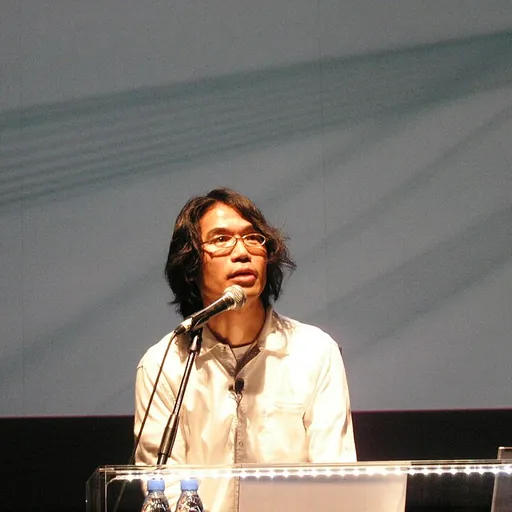
About Toshio Iwai
Born 1962. Toshio Iwai is a Japanese artist, composer, designer, television producer, picture book writer and illustrator.
is a Japanese interactive media and installation artist who has also created a number of commercial video games. In addition he has worked in television, music performance, museum design and digital musical instrument design.
Education and early work
Iwai was born in 1962 in Kira, Aichi, Japan. As a child, he spent time creating flip book-style animations in the corner of text books and making motor-driven mechanical toys, since these were the only technologies available to him. In 1981 Iwai matriculated in the Fine Arts Department at the University of Tsukuba, studying Plastic Art and Mixed Media. Influenced by the work of Norman McLaren, he began producing installation art that combined pre-cinema animation techniques (the phenakistoscope and the zoetrope) with modern methods of image capture and creation (photocopiers, video cameras and computer graphics) and of stroboscopic lighting (video monitors, video projectors and LEDs). His 1985 installation Time Stratum won the Gold prize at the High Technology Art Exhibition '85, held in Shibuya Seibu, Tokyo.
In Piano - As Image Media (1995), audience members operate a trackball to draw lighted dots on a grid projected onto a sheet of fabric that leads to the keyboard of a small grand piano. The dots move towards the piano keyboard, and as they come close to it they accelerate and strike a key. The piano, controlled by a computer, plays the note corresponding to the 'struck' key, and at the same time, a computer-generated graphical figure appears on another sheet of fabric suspended above the piano, appearing to fly out of the piano and up into the air. This work, along with Composition on the Table, was shown in the Play Zone at the Millennium Dome in London, 1999–2000. It was also one of the works used in Iwai's performance collaboration with Ryuichi Sakamoto, Music Plays Images x Images Play Music.
Composition on the Table (1998/99) comprises four white tables bearing physical interface components: switches, dials, and turntables. Computer graphics images are projected onto the tables from ceiling-mounted video projectors, and loudspeakers are present. As the audience manipulates the interface elements, graphical and audio changes take place in a way that is intimately connected to the audience's input. The objective of this work was to create a mixed reality environment where multiple participants could create visuals and music together. Elements of this work are recognizable in Iwai's Nintendo DS videogame Electroplankton. The piece was presented as part of the Art Gallery at SIGGRAPH'99, Los Angeles.
From 1996 to 1998 Iwai was the first Artist in Residence at IAMAS in Ōgaki, Japan. In 1997 he had a major retrospective exhibition at the NTT InterCommunication Center in Tokyo. From 1998 to 2001 he was Artist in Residence at Mixed Reality Systems Laboratory in Yokohama, Japan.
Iwai's first game was the musical shoot 'em up Otocky (1987), produced in association with ASCII Corporation for the Famicom Disk System, an add-on for the NES available only in Japan. The game is notable for being the first to include creative/procedural generative music. Through association with different game mechanics and player actions, the game plays quantized-in-time musical notes in a variety of digitally synthesized voices. Otocky is a precursor of Rez, Tetsuya Mizuguchi's 2002 Dreamcast and PlayStation 2 game exploring similar themes of player action and musical evolution.
Later, leveraging work done on the 1993 installation art project Music Insects at San Francisco's Exploratorium, Iwai went to Nintendo, where he created another sound-based game for the Super Nintendo Entertainment System called Sound Fantasy. However, the game's release was cancelled and it was eventually converted into the PC title SimTunes, published by Maxis, a division of Electronic Arts.
In 2000, Iwai worked to publish , a collaborative drawing game that became the PlayStation 2's first mouse-compatible title. This was followed in 2001 by the limited-edition release of a simple step sequencer, , for the WonderSwan. This non-game would be the precursor to the more advanced 2005 version released together with Yamaha.
Iwai's acclaimed Electroplankton for the Nintendo DS was released in Japan in 2005 and in Europe and North America in 2006. A suite of ten different interactive music and audio toys themed around cartoon plankton and using the novel touchscreen and microphone interface features of the Nintendo DS, Electroplankton draws heavily on Iwai's earlier work, including Composition on the Table.
Games designed by Toshio Iwai Otocky (1987; Famicom Disk System) Sound Fantasy (canceled; Super Famicom) SimTunes (1996, PC) (2000, PlayStation 2) (2001, WonderSwan) Electroplankton (2005, Nintendo DS)
Television In 1990 Iwai's solo show Machine for Trinity exhibited at the Laforet Museum in Tokyo; some of the works shown there demonstrated that computer graphics could be generated and combined in real-time with live action images. The TV director Shinji Fukuhara visited the exhibition and shortly afterward contracted Iwai to create concepts and a virtual set for a weekly half-hour science news show Einstein TV (Fuji TV, 1990–91). Created on the Amiga, the virtual set included GUI-like pop-up menus. Influenced by Pee-wee's Playhouse, which Iwai had seen during his tenure at the Exploratorium in the United States, the show was imaginative and irreverent and featured talking TVs, a tomato that gave advice to call-in guests, a robot named Robot that asked riddles and broke down when given silly answers, anthropomorphic faeces named Professor Poo Poo, and a cubo-surrealist artist named Surr.
Museum design Created during his time as an Artist-in-Residence at the Exploratorium in San Francisco, California, Iwai's works Well of Lights (1992) and Music Insects (1992) are part of the Exploratorium's permanent collection.
Iwai contributed to the construction of the Bouncing Totoro 3-dimensional zoetrope at the Ghibli Museum in Mitaka, Tokyo. He helped conceive an LED strobe device to be used in place of conventional strobe lights, softening the lighting as a result. He also made a layout plan for the positioning of the figures using a computer.
Digital musical instrument design A current project of Iwai's, in collaboration with Yamaha Corporation, is the creation of a new interactive digital musical instrument. Called Tenori-on, the instrument is a sixteen-by-sixteen array of illuminated LED switches which can be activated in a variety of ways to create a changing musical soundscape.
Tenori-on was showcased throughout its development through stage and conference performances. It went on sale in the United Kingdom on 4 September 2007.
Notable works Installations Time Stratum IV 1990 Another Time, Another Space NHK version 1994 Resonance of 4 1994 Piano - As Image Media 1995 Composition on the Table 1998/99 Shanghai World Financial Center, Observation Deck 2008
Permanent Exhibits Well of Lights Exploratorium, 1992 Music Insects Exploratorium, 1992 Another Time, Another Space, National Museum of Photography, Film and Television (now the National Media Museum), Bradford, UK 1999
Videogames Otocky 1986 SimTunes 1996 Electroplankton 2005
Television Einstein TV 1990–91 Ugo Ugo Lhuga 1992–94
Performance Music Plays Images x Images Play Music 1996–97
Digital Musical Instrument Design Tenori-on
Books, magazines and printed matters Artist, Designer and Director SCAN (Rikuyosha, 2000) 100 Floors House (Kaiseisha, 2008) Docchiga!? Books (Books KInokuniya, 2006)
Others Docchi Ga Hen?' poster (Tokyu Railways, 2007–2008)
Don’t just read it —
keep it.
Full-length biographies made to live with: read them, listen on the way to work, watch them tonight.
- E-book
- Audio
- Video
Instant download · yours to keep · every purchase keeps this site free
Important facts
People in Toshio Iwai's life
Named in this biography and alive at the same time

Related people
Same field, nearest in time





Contemporaries
People whose lives overlapped Toshio Iwai's






Frequently asked questions
Who is Toshio Iwai?
Japanese artist (born 1962)
When was Toshio Iwai born?
Toshio Iwai was born in 1962 in Kira.
What is Toshio Iwai's occupation?
Toshio Iwai is an artist, composer, designer, television producer, picture book writer and illustrator.
What nationality is Toshio Iwai?
Toshio Iwai is Japanese.
Sources & further reading
Cite this page
APA: Biography.guide. (2026). Toshio Iwai. https://biography.guide/toshio-iwai/
MLA: "Toshio Iwai." Biography.guide, https://biography.guide/toshio-iwai/.
Chicago: "Toshio Iwai." Biography.guide. https://biography.guide/toshio-iwai/.
Data last updated: 2026-09-22 · Spot an error? Report a correction.
Portrait: Wikimedia Commons · author & licence
Page generated 2026-09-27 05:01 UTC