About Torii Kotondo
Lived 1900 – 1976 (aged 75). Torii Kotondo was a Japanese painter, printmaker and ukiyo-e artist.
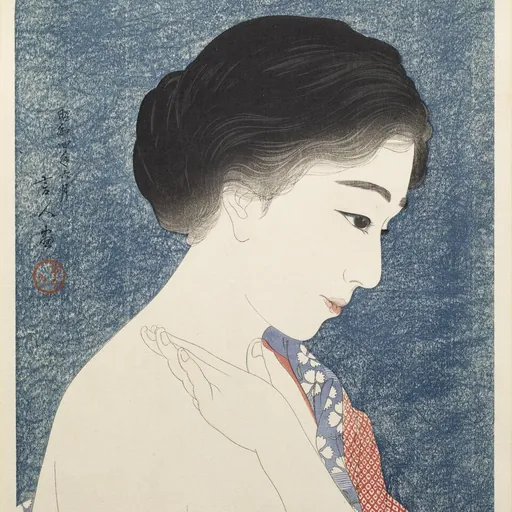
Torii Kotondo (, 21 November 1900 – 13 July 1976) or Torii Kiyotada V was a Japanese painter and woodblock printer of the Torii school of ukiyo-e artists. He followed his school's tradition of making prints of kabuki actors (yakusha-e) and involvement with commercial work for kabuki theater. His twenty-one bijin-ga (pictures of beautiful women) are particularly celebrated.
Life and career
Kotondo was born Saitō Akira in the Nihonbashi district of Tokyo. At age fourteen his father sent him to study art and history with the yamato-e painter Kobori Tomone, known for his historical and military scenes and for kuchi-e designs for the popular magazine Bungei Kurabu. , the seventh head of the Torii school of ukiyo-e artists, adopted Kotondo at age 15 and trained him in the school's specialty producing yakusha-e, portraits of kabuki actors. Kiyotada gave him the name Genjin, alternatively readable as Kotondo, and he began signing kabuki actor prints as Kotondo for the short-lived magazine Shin Nigao and the much longer-running Engei Gahō (1907–1943). which were sold in the United States. Seventeen of Kontodo's prints were shown at the seminal shin hanga exhibition at the Toledo Museum of Art in 1936.
Kotondo's bijin-ga are marked by a certain nostalgia: rather than fashionable beauties defiantly dressed in Western-influenced clothing and accessories, his subjects were modern women who still embraced traditional values, offering intimate glimpses of dress, make-up, hairstyle and manner that appealed to Japanese and Western connoisseurs alike, drawn to an image of old Japan that seemed to be disappearing in the 1930s.
For Kamisuki (1929), depicting a crouching woman surrounded by bathhouse steam, the printer emphasised the volume of her body with near-luminous contour lines set against a dark blue ground printed with the baren sujizuri technique to suggest steam; a similar effect distinguishes Yuge (1929), whose title, meaning "steam", refers to the circular baren strokes of the background, lighter toward the top as if dissipating, behind a bather whose averted gaze and covering towel are typical of Kotondo's restrained treatment of the nude.
Authorities considered Kotondo's print Morning Hair of 1930 provocative and banned it after seventy of its hundred copies had sold and had the remaining thirty destroyed. In Yugaeri (1933), depicting a bijin in a light kimono passing through the curtained entrance of a public bath, Kotondo used his own wife as the model.
When Kiyotada died in 1941 Kotondo became the eighth head of the school and took the name Kiyotada V.
Kotondo lectured at Nihon University in Tokyo from 1966 to 1972. Collectors did not place a high value on Kotondo's prints while he was alive; the prints have since appreciated in collectability and fetch prices comparable to those of the great masters.
Don’t just read it —
keep it.
Full-length biographies made to live with: read them, listen on the way to work, watch them tonight.
- E-book
- Audio
- Video
Instant download · yours to keep · every purchase keeps this site free
Important facts
Related people
Same field, nearest in time





Contemporaries
People whose lives overlapped Torii Kotondo's





Frequently asked questions
Who was Torii Kotondo?
Japanese painter (1900-1976)
When was Torii Kotondo born?
Torii Kotondo was born on 21 November 1900 in Nihonbashi-Kakigarachō.
When did Torii Kotondo die?
Torii Kotondo died on 13 July 1976.
What was Torii Kotondo's occupation?
Torii Kotondo was a painter, printmaker and ukiyo-e artist.
What nationality was Torii Kotondo?
Torii Kotondo was Japanese.
Sources & further reading
Cite this page
APA: Biography.guide. (2026). Torii Kotondo. https://biography.guide/torii-kotondo/
MLA: "Torii Kotondo." Biography.guide, https://biography.guide/torii-kotondo/.
Chicago: "Torii Kotondo." Biography.guide. https://biography.guide/torii-kotondo/.
Data last updated: 2026-09-20 · Spot an error? Report a correction.
Page generated 2026-09-27 05:09 UTC