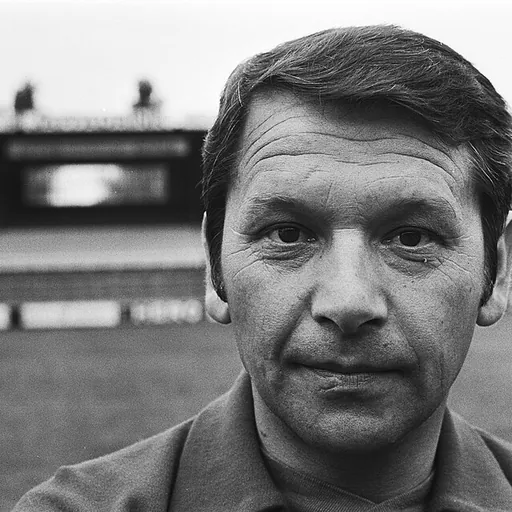
Tomislav Ivić
Croatian football player and manager
About Tomislav Ivić
Lived 1933 – 2011 (aged 77). Tomislav Ivić was a Yugoslav and Croatian association football player and association football coach.
Tomislav Ivić (; 30 June 1933 – 24 June 2011) was a Croatian professional football player and manager. Often described as a brilliant strategist, Ivić is credited with helping develop the modern style of the game. In April 2007, Italian sports daily La Gazzetta dello Sport proclaimed him as the most successful football manager in history, due to his seven league titles won in five countries. He is also one of six managers—along with Carlo Ancelotti, José Mourinho, Giovanni Trapattoni, Ernst Happel and Eric Gerets—to have won top-flight domestic league championships in at least four countries.
Playing career Tomislav Ivić played as a midfielder and joined the youth team at RNK Split in 1950, and he won titles and cups in seven countries: Yugoslavia, the Netherlands, Belgium, Portugal, Spain and France. Ivić never won the league title in Greece.
Ivić won seven top flight championships (three in Yugoslavia and one each in the Netherlands, Belgium, Portugal and France); six national cups (four in Yugoslavia and one each in Spain and Portugal); an UEFA Super Cup and an Intercontinental Cup.
In Croatia, Ivić coached RNK Split, Hajduk Split, Dinamo Zagreb and (in one match replacing suspended Miroslav Blažević) the Croatia national team; in the Netherlands, Ajax; in Belgium, Anderlecht and Standard Liège; in Turkey, Galatasaray and Fenerbahçe; in Italy, Avellino; in Greece, Panathinaikos; in Portugal, Porto and Benfica; in France, Paris Saint-Germain and Marseille (the latter, his last club before retiring in 2002); in Spain, Atlético Madrid; in the United Arab Emirates, Al Wasl and the UAE national team; and in Iran, Persepolis and the Iran national selection.
Early years Ivić's coaching career began with a year-long engagement in RNK Split from 1967 to 1968. In that season, his team finished 8th in the Yugoslav Second League West Division. From 1968 to 1972, he was the coach at the Hajduk Split Academy. At the end of the 1971-72 season, he replaced Slavko Luštica as Hajduk Split's first team manager. His first and only game was a 2-1 win over Dinamo Zagreb in the 1972 Yugoslav Cup Final. The season after, he was coaching the then second division team HNK Šibenik, finishing 5th.
Hajduk Split In 1973, Ivić came back as coach. He knew what potential lay in the youngsters who had been in his charge at the academy, and immediately gave many of them a taste of first-team action. The talented youngster such as Vedran Rožić, Šime Luketin, and Slaviša Žungul developed to be key players under Ivic. Hajduk Split and Partizan battled it out until the last match of the season, in which Hajduk Split unexpectedly drew with OFK Beograd but that was enough for them to qualify as champion as Partizan still could not beat Olimpija in the 90th minute. However, the referee extended the game until Partizan ultimately scored and was crowned champion. The team's performance in the European Cup was improved, Hajduk Split beat Floriana and Molenbeek on their way to face PSV Eindhoven in the quarter final. They got eliminated in extra time. Ivić left Hajduk Split at the end of the season.
Ajax
Ivić joined Ajax in 1976, he guided them to their 17th Eredivisie in his first season. Ajax was eliminated from the UEFA Cup in the first round after a 2-0 loss to Manchester United at Old Trafford, despite winning 1-0 at home. In the 1977-78 season, Ajax finished second in Eredivisie and lost the final of the KNVB Cup to AZ. Ajax returned to compete in the European Cup, eliminated by Juventus in the quarter final. During his 2 seasons with Ajax, Ivić had his team play counter-attack style which was against the club's culture. A group of players led by Ruud Krol initially opposed his style but later believed in his approach. He left Ajax at the end of the season to rejoin Hajduk Split.
Third stint at Hajduk Split Ivić returned to Hajduk Split for the third time in 1978. He won another yugoslav league title in his first season back, the club first league title since he done it in the 1974-75 season. Ivić's team stayed strong in the second half of the season after Slaviša Žungul left for the United States in December 1978. In the 1979-80 season, Hajduk Split was underperforming. They were knocked out in the first round of the Yugoslav Cup, and after seven winless games from April to June, the team sat in fifth of the table and ended the season there. Ivić left Hajduk Split, marking the end of their golden generation. In his first season, Anderlecht became champions for the first time in seven years, with an eleven-point lead over second place Lokeren.
The following season, Anderlecht lost their first Belgian Super Cup to Standard Liège. They finished second in the league, two points behind Standard Liège. In the European Cup, Ivić's team made an impressive performance. They beat Trapattoni's Juventus in the second round and Red Star Belgrade in the quarter final, then was eliminated in the semi-final by the event champion, Aston Villa.
In the summer of 1982, chairman Constant Vanden Stock brought the Belgian national team's striker duo, Erwin Vandenbergh and Alexandre Czerniatynski to Anderlecht. However, Ivić did not agree because he thought the duo would not suit his system. Anderlecht has struggled to deliver good results, they lost 4-1 to Standard Liège on the seventh matchday and dropped to seventh in the table. After a 2–1 defeat against Waregem on the eighth matchday, Ivić was dismissed and replaced by Paul Van Himst.
Galatasaray Ivić joined Galatasaray in 1983, He coached them for one season. Galatasaray finished third in the Turkish First Football League and were eliminated in quarter final of the Turkish Cup. He parted ways with the club at the end of the season.
Brief spell at Benfica Ivić arrived on July 17, 1984, to succeed Sven-Göran Eriksson. However, he left on August 1 without signing a contract because the board refused to pay him in dollars. During that brief spell, he managed only one friendly match and Pál Csernai named to be his successor.
Dinamo Zagreb Ivić returned to Yugoslavia in 1984, this time to join Dinamo Zagreb. Unfortunately, Dinamo Zagreb finished outside the top five, meaning they did not qualify for European football. After a poor result, Ivić was dismissed before the season ended. Zdenko Kobešćak took over as an interim coach and reached the 1984–85 Yugoslav Cup final.
Avellino On July 11, 1985, Avellino presented Tomislav Ivić as the club's technical director. Despite his role, he would be on the bench in every match like a coach. He was supported by the Italian Enzo Robotti, who was officially a coach. After a poor start to the season, he was accused of having issues with the players and a lack of knowledge of Italian football. Avellino was fighting hard to avoid relegation, they earned some good results against big teams such as a 1-0 win over Inter and Roma and a draw with AC Milan and Juventus. The two defeats in February and a draw against Pisa, the other relegation battle team, resulted in Avellino being fourth-last on the table with one point over the relegation zone. Ivić was sacked on 24th February 1986 and Robotti continued his role until the end of the season. There was a report that Ivić did not expect to be sacked and Avellino's fans were furious with the board's decision.
Panathinaikos On June 10, 1986, Panathinaikos announced that Tomislav Ivić had been appointed as the club's new manager. After one win in six matches in the league, and being knocked out in the first round of the European Cup, he was dismissed on November 2 after about five months in the job.
Fourth stint at Hajduk Split Ivić returned for a brief spell as Hajduk Split manager in 1987, following the end of the 1986–87 season, succeeding Josip Skoblar, who had moved to HSV Hamburg. However, before the start of the 1987–88 season, Ivić left to join Porto. Marin Kovačić was appointed as his successor.
Paris Saint-Germain After Paris Saint-Germain's disastrous 1987–88 season, the club made a managerial change by appointing Ivić as their new manager. The team performed well in the league, spending most of the season in first or second place. However, their performance dropped after entering the new calendar year of 1989; the team managed only 4 wins from their remaining 14 matches, ultimately finishing second at the end of the 1988–89 campaign. The 1989 summer transfer window featured several high-profile signings, including 1984 Euro winners Yvon Le Roux and Daniel Bravo. Additionally, Zlatko Vujović arrived from Cannes to reunite with Ivić, following their time together at Hajduk. Despite an impressive transfer window, the team enjoyed less success than the previous year, finishing fifth in the league and being knocked out of the 1989–90 UEFA Cup in the second round. As a result, Ivić left Paris Saint-Germain at the end of the season.
Atlético Madrid On 3 September 1990, Tomislav Ivić was appointed as manager of Atlético Madrid by President Jesús Gil. He took over from Iselín Santos Ovejero, who had managed the opening game of the season. The team did not start very strong but achieved some memorable victories, such as a 2-1 win over Johan Cruyff's Barcelona on matchday 9. In October, Bernd Schuster was signed from rivals Real Madrid, and the team's performance improved significantly. Atlético Madrid went unbeaten for 18 matches between December 1990 and April 1991, keeping a massive 13 clean sheets. This allowed goalkeeper Abel Resino to set a new European record for the longest clean-sheet streak in a single season.
However, their form suddenly collapsed on matchday 31, and they lost six of their eight remaining games. In the final fixture against Espanyol, Gil directly asked the players to lose the match so Espanyol could avoid the relegation playoff, allegedly to facilitate a deal for Espanyol’s manager, Luis Aragonés, to take over Atlético Madrid the following season. The game ended in a 3-1 loss, and the club finished the season in second place, 10 points behind Barcelona. In the return leg of the Copa del Rey quarterfinals, Ivić's team lost 1-0 to Real Valladolid, which was still enough to advance to the next round. Following the match, Ivić fell out with his players after suffering a nervous breakdown in the locker room. The next day, on 17 June 1991, Gil called Ivić to his office intending to dismiss him and replace him with Luis Aragonés immediately, but Aragonés insisted on starting the role the following season. Gil subsequently stated to the press that Ivić was sick and Ovejero would replace the Croat for the Copa del Rey semifinals against Barcelona. He also added that the players don't want Ivić. Under Ovejero, the team won 1990–91 Copa del Rey.
Marseille Bernard Tapie, the president of Olympique de Marseille, appointed Ivić as the club's new manager on the advice of technical director Raymond Goethals, who had known him since his time with Anderlecht. Upon his appointment, Ivić promised to abandon his traditionally defensive playing style, explaining: 'In Paris and Madrid, I had to shut up shop to get results. In Marseille, I have the best squad in Europe, and I won't restrict the players.' He ultimately left the club on October 29, 1991, even though OM was sitting at the top of the league after fifteen matchdays. Officially, Ivić only wanted to step back temporarily due to the breakout of the Croatian War of Independence. However, Goethals replaced him permanently. Reports later confirmed that the co-management duo had broken down, with Goethals actively undermining and sabotaging Ivić behind the scenes.
In the spring of 1993, while he was without a club, Tapie asked him to analyze AC Milan's game, the club's future opponent in the Champions League final which eventully help them to win the historic 1992–93 UEFA Champions League.
Benfica Ivić returned to Portugal for the third time, he was once again appointed to succeed Sven-Göran Eriksson at Benfica. The team struggled to get good results and lagging behind in the title race. After less than four months in charge, Ivić was sacked on October 25.
European and international club competitions
He took Hajduk Split to the European Cup quarter final two times: 1975–76 and in 1979–80; he also reached it with Ajax in 1977–78. His biggest achievement in the European Cup was reaching the semi-finals during the 1981–82 season with Anderlecht. With Porto, he won the 1987 European Super Cup and the 1987 Intercontinental Cup.
Ivić has one of the best Champions League win ratios, having won 29 out of 46 matches with a ratio of 63.0%.
International career He was national team head coach of Yugoslavia, Iran, United Arab Emirates and even Croatia for one match as caretaker manager subbing in for Miroslav Blažević.
While UAE head coach, Ivić lost the 1996 AFC Asian Cup final against Saudi Arabia on penalties.
Retirement In 2001, under the advisement of his doctor Ivić retired from coaching so he could be under less stress. Three years later, he coached Al-Ittihad for a season before taking up the youth selections of Standard Liège.
Death Ivić died on 24 June 2011, six days before his 78th birthday, in his hometown of Split. He was reportedly suffering from cardiac troubles, as well as diabetes.
Managerial statistics
Honours Manager Hajduk Split (Youth) Yugoslav Youth Cup: 1970, 1971, 1972
Hajduk Split Yugoslav First League: 1973–74, 1974–75, 1978–79 Yugoslav Cup: 1971–72, 1973, 1974, 1975–76
Ajax Eredivisie: 1976–77
Anderlecht Belgian First Division: 1980–81
Porto Primeira Liga: 1987–88 Taça de Portugal: 1988 Supertaça Cândido de Oliveira: 1993 European Super Cup: 1987 Intercontinental Cup: 1987
Al-Ittihad Saudi Crown Prince Cup: 2004
United Arab Emirates AFC Asian Cup runner-up: 1996
Individual Hajduk Split golden badge: 1975 Golden badge and charter by the city of Paris awarded by Jacques Chirac: 1990 Croatian Olympic Committee trophy: 2003 Most successful manager in history by La Gazzetta dello Sport: 2007 Split sports house hall of fame: 2009 Heart of Hajduk Award: 2011 (postmortem) World Soccer 36th Greatest Manager of All Time: 2013 France Football 42nd Greatest Manager of All Time: 2019
Orders
Don’t just read it —
keep it.
Full-length biographies made to live with: read them, listen on the way to work, watch them tonight.
- E-book
- Audio
- Video
Instant download · yours to keep · every purchase keeps this site free
Important facts
People in Tomislav Ivić's life
Named in this biography and alive at the same time





Related people
Same field, nearest in time


Contemporaries
People whose lives overlapped Tomislav Ivić's




Frequently asked questions
Who was Tomislav Ivić?
Croatian football player and manager (1933-2011)
When was Tomislav Ivić born?
Tomislav Ivić was born on 30 June 1933 in Split.
When did Tomislav Ivić die?
Tomislav Ivić died on 24 June 2011 in Split.
What was Tomislav Ivić's occupation?
Tomislav Ivić was an association football player and association football coach.
What nationality was Tomislav Ivić?
Tomislav Ivić was Yugoslav and Croatian.
Sources & further reading
Cite this page
APA: Biography.guide. (2026). Tomislav Ivić. https://biography.guide/tomislav-ivic/
MLA: "Tomislav Ivić." Biography.guide, https://biography.guide/tomislav-ivic/.
Chicago: "Tomislav Ivić." Biography.guide. https://biography.guide/tomislav-ivic/.
Data last updated: 2026-09-22 · Spot an error? Report a correction.
Portrait: Wikimedia Commons · author & licence
Page generated 2026-09-27 05:03 UTC