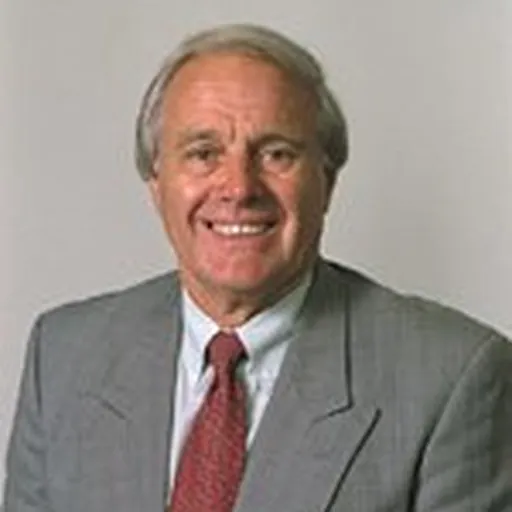
About Tom Middlehurst
Born 1936. Tom Middlehurst is a British politician.
Thomas Middlehurst (born 25 June 1936) is a British retired politician who served as Leader of Flintshire County Council from 1996 to 1999 and Assembly Secretary for Education and Training in the National Assembly for Wales from 1999 to 2000. A member of the Labour Party, he was Assembly Member (AM) for Alyn and Deeside from 1999 until his retirement in 2003.
Middlehurst was born in Ormskirk, Lancashire, England. He was educated at Ormskirk Grammar School, Wigan Technical College and Liverpool Polytechnic, and in his early life lived in Skelmersdale. He was an engineering apprentice from 1952 to 1957 and worked as an engineer at the National Coal Board from 1957 to 1963, before working as an engineer and manager in the private sector until 1971. In 1971, he moved to Wales and became a local government officer for Flintshire County Council and its successor Clwyd County Council, remaining in this job until 1993.
In 1963, Middlehurst was elected as a Labour councillor for Skelmersdale Urban District Council, stepping down in 1968. In Wales, he was elected to Alyn and Deeside District Council in 1986 and Clwyd County Council in 1993 before becoming the first leader of the re-established Flintshire County Council in 1996, where he implemented council tax increases and cut local services to balance the budget. He also fought to prevent the closure of Theatr Clwyd and persuaded Terry Hands to become its director. From 1997 to 1999, he also chaired the Welsh Local Government Association.
In the first election to the National Assembly for Wales in 1999, Middlehurst was elected as AM for Alyn and Deeside. He was appointed to the cabinet of First Secretary Alun Michael as Assembly Secretary for Education and Training. In this role, he implemented free entry for children to galleries and museums, reformed the post-16 system of education and training and trialled a welfare scheme for benefit claimants in Newport, Torfaen and Monmouthshire. He also intervened in the Wales Millennium Centre project to keep government spending under control. He remained in his post under Michael's successor Rhodri Morgan until October 2000, when he resigned in protest of Labour's coalition agreement with the Liberal Democrats. He retired at the 2003 assembly election after becoming disillusioned with the politics of the National Assembly.
Early life Thomas Middlehurst He was also a fitter and lived in Sherrat Street, Skelmersdale.
Career in local government Middlehurst is a member of the Labour Party. In the 1960s, he was the secretary of the local branch of the Labour Party in Skelmersdale. in Skelmersdale Urban District Council to fill the vacancy left by the death of Labour councillor Tom Pye. He stood for re-election in the 1964 local elections, where he won a second 12-month term, and the 1965 local elections. In 1966, he was elected chair of the council's parks committee. In 1968, Skelmersdale Urban District Council was abolished and replaced by Skelmersdale and Holland Urban District Council; Middlehurst was one of six Labour councillors who did not stand for election to the new council.
In 1971 Middlehurst moved to Wales, settling in Ewloe, Flintshire. He worked as a local government officer for Flintshire County Council and its successor Clwyd County Council until 1993. as the councillor for Sealand in Clwyd County Council at the 1993 local elections, where he went on to chair the personnel committee. At the 1995 local elections, Middlehurst was elected alongside Labour colleague Alison Halford as one of two incoming councillors for Ewloe in Flintshire County Council. On 31 May 1995, the incoming members of the council elected him as Leader of the council. He formally took office as the first leader of the reconstituted council on its re-establishment in 1996, becoming leader of a Labour majority administration.
Middlehurst became Leader of Flintshire County Council on a background of government spending cuts for the county of Flintshire. This meant the council had to raise an extra £3 million in 1996 to provide services at the same standard as provided by its predecessors. He chose to cut other services to balance the budget. In May 1997, he persuaded Terry Hands to become its director and draw up a plan to secure its future, helping to successfully save the theatre.
In December 1996, Middlehurst said he was considering another rise in council tax, this time by 20%, and cutting spending by 8% to maintain services for 1997. However, the government blocked the council from implementing any more council tax increases in that year; as a result the decision was made to cut more services instead. By February 1997, spending on all services including education had been cut by 8%. In December 1997, Middlehurst announced that the government had allowed the council to implement more tax rises, meaning that services would not need to be cut in 1998 and 1999 like in the previous two years. In May 1998, the Audit Commission published its report on the financial performance of local authorities in Wales. Flintshire was judged to have performed above average in most areas while also underperforming in other areas, particularly in the levels of funding for school pupils.
On 4 December 1998, Middlehurst was shortlisted for Labour's prospective candidacy in the constituency of Alyn and Deeside in the first election to the soon-to-be established National Assembly for Wales.
National Assembly for Wales
At the first election to the National Assembly for Wales on 6 May 1999, Middlehurst was elected as Assembly Member (AM) for Alyn and Deeside with 9,772 votes, or 51.35% of the popular vote in the constituency; he had a majority of 6,359 votes.
At the election, Labour on a national level won the most seats in the assembly but fell short of securing an absolute majority. Labour leader Alun Michael mooted a potential coalition with the Liberal Democrats which would give his administration a majority in the assembly. Middlehurst spoke out against a coalition and declared his support for a Labour minority administration; he said coalitions "give too much power to small parties so I don't think we will let the tail wag the dog."
Assembly Secretary for Education and Training At the first plenary session of the National Assembly on 12 May 1999, First Secretary Alun Michael appointed Middlehurst to his cabinet as Assembly Secretary for Education and Training. This made him the only member of the cabinet to represent a constituency in North Wales. He had a broad portfolio and was responsible for the following policy areas: post-16 education and training, including further and higher education as well as work place and vocational training; employment and the New Deal; arts and culture, including museums and libraries; sports and recreation; and the Welsh language. His appointment was criticised by Welsh language campaigners who pointed out that he could not speak or understand Welsh, although he had started to take lessons to learn the language. Supporters of his appointment noted that Middlehurst was not opposed to the promotion of Welsh like other members of the assembly, and that four in five people in Wales at the time also could not speak the language. As Assembly Secretary for Education and Training, Middlehurst was also a member of and accountable to the Post-16 Education and Training Committee, which scrutinised his portfolio and worked with him to draw up policy.
In addition to Middlehurst, the cabinet also had another education secretary in Rosemary Butler. Butler was appointed Assembly Secretary for Education and Childcare, a post which included responsibility for education to the age of 16. Although intended to have separate responsibilities, it was soon discovered that part of Butler's education portfolio inadvertently extended into post-16 education policy, leaving her and Middlehurst with overlapping responsibilities for policies relating to qualifications and the curriculum. Middlehurst and the Post-16 Education and Training Committee drew up reforms to reorganise the system of post-16 education and training in Wales. The reforms included abolishing training and enterprise councils and the Further Education Funding Council and replacing them with a new National Council for Education and Training which would administer and fund education. Other reforms included transferring responsibility for local provision from local education authorities to new community consortiums, and encouraging colleges and schools to cooperate more. Middlehurst said these reforms revolved around reducing competition between schools and colleges. The reforms were also presented as a way to improve standards in the system and make it more accessible. The reforms were controversial with teaching unions; there were fears that there would be cuts in sixth form funding to increase funding for further education, and leading trade unionists claimed that the new community consortiums would be more unreliant and costly. The unions also argued that local education authorities should continue to hold an important role in funding sixth forms.
In November 1999, Middlehurst launched a trial programme for welfare benefits called ONE in Newport, Torfaen and Monmouthshire with Labour MP David Hanson. The programme entitled benefit claimants in these areas to personalised welfare support and advice. In the same month, he also announced a £58 million increase in funding for post-16 education and a £52 million increase in funding for the arts, culture and sport for 2000 and 2001. These increases in spending would pay for his policy of introducing free entry for children to museums and galleries operated by the National Museum of Wales, a change which came into effect from April 2000. The spending increases would also pay for new apprenticeships and contribute to new financial support for children from poorer backgrounds. In October, Middlehurst confirmed that the centre would not be opened until 2002 because of an unexpected delay in financial agreements and planning permissions which were required before the project could continue as planned. A year later, the expected costs of the project were projected to increase from the original budget of £70.2 million to an estimated £85 million. To keep government spending under control, Middlehurst intervened and enforced a £75 million cap on spending for the project. He also requested a review of the existing plans for the project. With the passage of the motion, the opposition parties expected Gwyther to resign. Gwyther refused to do so, and she secured the support of First Secretary Alun Michael and the cabinet to remain in her post. Over the next few months, the opposition parties worked together to oust Michael from the premiership over his failure to secure EU Objective One funding for South West Wales and the South Wales Valleys. In February 2000, the opposition leaders jointly tabled a motion of no confidence in his premiership; the motion was passed by 31 votes to 27 votes because of Labour's minority status in the assembly and Michael resigned as first secretary. His economic development secretary Rhodri Morgan was elected by the assembly to succeed him. By July, he had sacked Christine Gwyther. This prompted speculation over the potential dismissals of Middlehurst and Rosemary Butler later in the year, as it was possible that Morgan would formally merge their education portfolios in the cabinet. Over the next few months, Morgan negotiated a coalition agreement with the Liberal Democrat leader Mike German. This would give his administration a working majority in the assembly. The deal was announced on 5 October and entitled the Liberal Democrats to two cabinet seats and several policy concessions including significant changes to education. Middlehurst later said he was concerned with these concessions.
I have never envisaged an outcome where Liberals would sit in the Cabinet. That to me is too high a price to pay. Apart from this I have no regard for the Liberal Democrats and do not trust them as long-term allies. I cannot forget how they conspired with the Tories and the Nationalists to censure Christine Gwyther on wholly spurious grounds and then committed the ultimate act of treachery in aiding and abetting the downfall of Alun Michael. — Excerpt from Middlehurst's resignation letter to Rhodri Morgan in October 2000. He said he did "not accept the need for the Labour administration to work with the fourth largest party in the assembly [the Liberal Democrats]". He explained that he found the coalition unacceptable, as he did not agree with "significant issues" in its new policy programme and disagreed with the idea of the Liberal Democrats having two cabinet seats; he said he had "never envisaged" them serving in the cabinet and said it was "too high a price to pay" for a majority. Middlehurst's resignation was generally perceived as a move made to avoid his widely anticipated dismissal from the cabinet, as the coalition agreement also included the merger of Middlehurst's education portfolio with Butler's. Butler was indeed sacked not long after, with Jane Davidson appointed to manage a now combined education portfolio as Minister for Education and Lifelong Learning.
In December 2001, Middlehurst announced that he would retire at the next assembly election in 2003. He said he had grown disillusioned with the politics of the assembly since his resignation from the cabinet, stating: "I don't like the politics of this place". He criticised the opposition parties in the assembly for forcing Alun Michael's resignation and said they had harmed the assembly's reputation with the Welsh public, calling their behaviour in the assembly "an absolute disgrace". He also reaffirmed his disapproval of Labour's coalition with the Liberal Democrats, stating that it had given the latter "influence and power disproportionate to their number". He said this was the result of the assembly's "failed" proportionally representative electoral system, which he claimed to have opposed, and added that his experience in the assembly had justified his support for the first-past-the-post electoral system. Other stated reasons for his retirement included the "demanding" journey from his constituency to the location of the assembly in Cardiff and personal issues relating to his family. For the remainder of his term, Middlehurst said he would continue to support Rhodri Morgan as first secretary and remain "committed to devolution". He has provided political commentary since his retirement. After Labour fell short of a majority in the 2007 assembly election, Middlehurst opined that it was likely that Labour would seek another coalition agreement with the Liberal Democrats. Less likely, in his opinion, was an informal deal with Plaid Cymru. Labour went on to form a coalition government with Plaid Cymru which lasted until 2011. In a letter to WalesOnline following the 2009 Welsh Labour leadership election, Middlehurst voiced his opposition to a proposed minister for North Wales. He advised the new party leader Carwyn Jones against acting on this proposal, as he believed introducing such a role would be a "token gesture that could prove extremely divisive" and "exacerbate the perceived divide" between the North and the perceivingly South-dominated National Assembly. In 2011, he expressed concern over the Welsh Government's policy to appoint unelected commissioners to intervene in troubled local authorities and administer them, stating that these commissioners had no democratic legitimacy.
Personal life Middlehurst married Patricia Mary on 11 April 1986. He has two children from a previous marriage. He is a supporter of Everton Football Club and enjoys rugby league, theatre and crown green bowling.
Don’t just read it —
keep it.
Full-length biographies made to live with: read them, listen on the way to work, watch them tonight.
- E-book
- Audio
- Video
Instant download · yours to keep · every purchase keeps this site free
Important facts
People in Tom Middlehurst's life
Named in this biography and alive at the same time




Related people
Same field, nearest in time




Contemporaries
People whose lives overlapped Tom Middlehurst's



Frequently asked questions
Who is Tom Middlehurst?
British politician (born 1936)
When was Tom Middlehurst born?
Tom Middlehurst was born on 25 June 1936 in Ormskirk.
What is Tom Middlehurst's occupation?
Tom Middlehurst is a politician.
What nationality is Tom Middlehurst?
Tom Middlehurst is British.
Sources & further reading
Cite this page
APA: Biography.guide. (2026). Tom Middlehurst. https://biography.guide/tom-middlehurst/
MLA: "Tom Middlehurst." Biography.guide, https://biography.guide/tom-middlehurst/.
Chicago: "Tom Middlehurst." Biography.guide. https://biography.guide/tom-middlehurst/.
Data last updated: 2026-09-23 · Spot an error? Report a correction.
Portrait: Wikimedia Commons · author & licence
Page generated 2026-09-27 05:05 UTC