
About Tom Hurndall
Lived 1981 – 2004 (aged 22). Tom Hurndall was a British photographer, journalist and peace activist.
Thomas Hurndall (27 November 1981 – 13 January 2004) was a British photography student, a volunteer for the International Solidarity Movement (ISM), and an activist against the Israeli occupation of the Palestinian territories. On 11 April 2003, he was shot in the Gaza Strip by an Israeli IDF sniper, Taysir Hayb. Hurndall was left in a coma and died nine months later.
Hayb was convicted of manslaughter and obstruction of justice by an Israeli military court in April 2005 and sentenced to eight years in prison. On 10 April 2006, a British inquest jury returned a verdict of unlawful killing.
Tom's mother Jocelyn Hurndall has written a biography of him called Defy the Stars: The Life and Tragic Death of Tom Hurndall, published in April 2007 and reprinted in May 2008 with the alternative title My Son Tom: The Life and Tragic Death of Tom Hurndall. His sister, Sophie, works for Medical Aid for Palestinians.
Student turns activist Hurndall was educated at Winchester College, a boarding independent school in Winchester in England.
Aged 21, Tom Hurndall took a working break from his degree course at Manchester Metropolitan University in photographic journalism to join the "human shields" in Iraq before the 2003 Iraq War. As the volunteers ran out of money and war became inevitable, he moved to Jordan and donated £500 to medical supplies for refugees from Iraq. It was here that he encountered the International Solidarity Movement (ISM), and decided to make his way overland to Gaza. He arrived in the town of Rafah on 6 April 2003 and began emailing images of the Israel Defense Forces (IDF) and the Palestinians back to his family. His Guardian obituary states that "the tone of his journals changed dramatically" The IDF transferred him to Israel, and he was taken to Soroka Medical Center in Beersheba, where he was kept on a ventilator and underwent surgery. Six weeks after the surgery, he was flown back to the United Kingdom, where he was taken to the Royal Hospital for Neuro-disability in London, where he remained in a persistent vegetative state, suffering from irreversible brain damage. He died on 2004, after nine months in a coma.
His father told a British inquest that, according to ISM and Palestinian witnesses, Hurndall had seen a group of children playing and had noticed that bullets were hitting the ground between them. Several children had run away but some were "paralysed with fear" and Hurndall went to help them. Hurndall's father told the inquest: "Tom went to take one girl out of the line of fire, which he did successfully, but when he went back, as he knelt down [to collect another], he was shot."
Autopsy report The defence in the trial of Sergeant Hayb attempted to raise doubts as to what ultimately caused Hurndall's death. A military court was informed that Hurndall died of pneumonia. Chen Kugel, an Israeli forensic pathologist appearing for the defence, stated that the pneumonia had not been properly treated and "the large amounts of morphine" Hurndall was receiving contributed to his death. The court rejected these claims.
Military police report access denial Tom Hurndall's family and their legal team were denied access to the military police report which led to the trial. After an appeal to the Israeli Supreme Court, in early August the state prosecution offered the legal team access to the report, but not to the Hurndall family themselves. According to a spokesman for the Tom Hurndall Foundation, this will allow them to decide whether Hayb could be indicted for the more serious charge of murder, and to find out if responsibility for Hurndall's death lies higher up the chain of command.
Coroner's inquest On 10 April 2006, an English inquest jury at St Pancras coroner's court in London found that Hurndall had been "unlawfully killed". Hurndall's father told reporters that there had been a "general policy" to shoot civilians in the area without fear of reprisals, The lawyer representing the family, Michael Mansfield QC, stated:
Make no mistake about it, the Israeli defence force have today been found culpable by this jury of murder.
A week earlier, an inquest found that the British journalist James Miller had been killed by an Israeli soldier just three weeks after Mr. Hurndall was shot, a mile away from Hurndall's position. The coroner Dr. Andrew Reid stated that he would write to the Attorney General about how similar incidents could be prevented, including the possible prosecutions of Israeli commanders, and that the case raised issues of command within the IDF. He stated that "two British citizens engaged in lawful activities" had been killed by Israeli soldiers, and that "British citizens, journalists, photographers or others may be subject to the risk of fatal shots."
Media Tom's mother Jocelyn Hurndall wrote a commentary in The Guardian on 10 January 2004, in which she stated:
It seems that life is cheap in the occupied territories. Different value attached to life depends on whether the victim happens to be Israeli, international or Palestinian.
Documentaries On 13 October 2008, Channel 4 broadcast a dramatised documentary The Shooting of Thomas Hurndall, which was written by Simon Block and directed by Rowan Joffe. Stephen Dillane plays Anthony Hurndall and Kerry Fox plays Jocelyn Hurndall. Anthony and Jocelyn Hurndall were interviewed at length in The Observer prior to the airing of the documentary:
The Shooting of Thomas Hurndall was nominated for the 2009 British Academy Television Award for Best Single Drama (Simon Block, Rowan Joffe, Barney Reisz, Charles Furneaux) and won Best Actor (Stephen Dillane) and Best Director Fiction/Entertainment (Rowan Joffe). At the Monte Carlo TV Festival Rowan Joffe won Golden Nymph 2009 as Best Director in a TV Film.
Artistic tributes
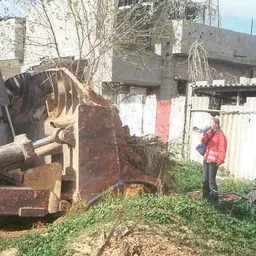
Tom Hurndall memorialised in second movement (Dance for Tom Hurndall (no lyrics)) of US composer Philip Munger's 2003 cantata The Skies are Weeping which is titled after by Thushara Wijeratna's poem. The cantata which comprises seven movements for a soprano soloist, chamber choir, and percussion ensemble, is written in memory of Rachel Corrie, an American member of the International Solidarity Movement killed in 2003 by a bulldozer operated by the Israel Defence Forces while she tried to prevent a house demolition in the southern Gaza Strip during the Second Intifada.
Memorial lectures
Since 2005, an annual Memorial Lecture has been held at Manchester Metropolitan University. Speakers have included Salman Abu-Sitta, Ilan Pappé, Avi Shlaim, Karma Nabulsi, Eyal Weizman, Adam Hanieh, Penny Green, Miriyam Aouragh, Rabab Abdulhadi and several others. The lectures from 2005 to 2021 have been published in the collection For Palestine: Essays from the Tom Hurndall Memorial Lecture Group.
Don’t just read it —
keep it.
Full-length biographies made to live with: read them, listen on the way to work, watch them tonight.
- E-book
- Audio
- Video
Instant download · yours to keep · every purchase keeps this site free
Important facts
People in Tom Hurndall's life
Named in this biography and alive at the same time


Related people
Same field, nearest in time



Contemporaries
People whose lives overlapped Tom Hurndall's


Frequently asked questions
Who was Tom Hurndall?
British photographer and activist (1981–2004)
When was Tom Hurndall born?
Tom Hurndall was born on 27 November 1981 in London.
When did Tom Hurndall die?
Tom Hurndall died on 13 January 2004 in London.
What was Tom Hurndall's occupation?
Tom Hurndall was a photographer, journalist and peace activist.
What nationality was Tom Hurndall?
Tom Hurndall was British.
Sources & further reading
Cite this page
APA: Biography.guide. (2026). Tom Hurndall. https://biography.guide/tom-hurndall/
MLA: "Tom Hurndall." Biography.guide, https://biography.guide/tom-hurndall/.
Chicago: "Tom Hurndall." Biography.guide. https://biography.guide/tom-hurndall/.
Data last updated: 2026-09-22 · Spot an error? Report a correction.
Page generated 2026-09-27 05:00 UTC