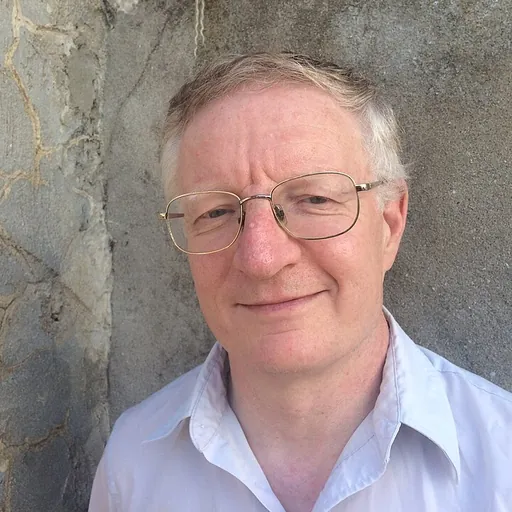
About Timothy Williamson
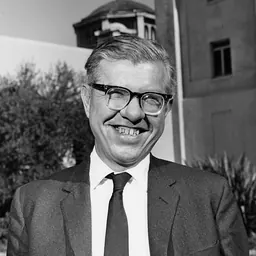
Born 1955. Timothy Williamson is a British philosopher and university teacher.
Timothy Williamson (born 6 August 1955) is a British philosopher whose main research interests are in philosophical logic, philosophy of language, epistemology and metaphysics. He is the former Wykeham Professor of Logic at the University of Oxford, and a fellow of New College, Oxford.
Education and career Born on 6 August 1955, Williamson's education began at Leighton Park School and continued at Henley Grammar School (now the Henley College). He then went to Balliol College, Oxford University. He graduated in 1976 with a Bachelor of Arts degree with first-class honours in mathematics and philosophy, and in 1980 with a doctorate in philosophy (DPhil) for a thesis entitled The Concept of Approximation to the Truth.
Williamson was professor of logic and metaphysics at the University of Edinburgh (1995–2000), fellow and lecturer in philosophy at University College, Oxford (1988–1994), and lecturer in philosophy at Trinity College, Dublin (1980–1988). He took up the Wykeham Professorship in 2000 and retired in 2023, when he took up a Senior Research and Teaching Fellowship in Philosophy.
He has been visiting professor at Yale University, Princeton University, MIT, the University of Michigan, and the Chinese University of Hong Kong.
He was president of the Aristotelian Society from 2004 to 2005.
He is a Fellow of the British Academy (FBA), the Norwegian Academy of Science and Letters, Fellow of the Royal Society of Edinburgh (FRSE), and a Foreign Honorary Fellow of the American Academy of Arts & Sciences.
Since 2022 he is visiting professor at the Università della Svizzera Italiana.
Philosophical work Williamson has contributed to analytic philosophy of language, logic, metaphysics, epistemology, metaethics and metaphilosophy.
On vagueness, he holds a position known as epistemicism, which states that every seemingly vague predicate (like "bald" or "thin") actually has a sharp cutoff, which is impossible for us to know. For instance, there is some number of hairs such that anyone with that number is bald, and anyone with even one more hair is not. In actuality, this condition will be spelled out only partly in terms of numbers of hairs, but whatever measures are relevant will have some sharp cutoff. This solution to the difficult Sorites paradox was considered a surprising and unacceptable consequence, but has become a relatively mainstream view since his defence of it. Williamson is fond of using the statement, "no one knows whether I am thin" to illustrate his view.
In epistemology, Williamson suggests that knowledge is unanalysable. This went against the common trend in philosophical literature up to that point, which was to argue that knowledge could be analysed into constituent concepts. (Typically, this would be justified true belief plus an extra factor.) He agrees that knowledge entails justification, truth and belief, but argues that it is conceptually primitive. He accounts for the importance of belief by discussing its connections with knowledge, but avoids the disjunctivist position of saying that belief can be analysed as the disjunction of knowledge with some distinct, non-factive mental state.
Williamson also argues against the traditional distinction of knowing-how and knowing-that. He claims that knowledge-how is a type of knowledge-that. Williamson argues that knowledge-how does not relate one's ability. He provides the example of a ski instructor who knows how to perform a complex move without having the ability to do it himself.
In metaphysics, Williamson defends necessitism, according to which necessarily everything is necessarily something; in short, that everything exists of necessity. Likewise, it is possible for something to have a property only if there is something which has that property. For instance, since it is possible for Wittgenstein to have had a child, there is something which is a possible child of Wittgenstein. Necessitism is a theoretical interpretation of the Barcan formula, which is a theorem of the modal logic S5. However, Williamson has also developed an ontology of “bare possibilia” which he argues accounts for the seemingly unintuitive consequences of necessitism.
Publications Identity and Discrimination, Oxford: Blackwell, 1990. Vagueness, London: Routledge, 1994. Knowledge and Its Limits, Oxford: Oxford University Press, 2000. The Philosophy of Philosophy, Oxford: Blackwell, 2007 The Philosophy of Philosophy (2nd ed.), Hoboken: Wiley Blackwell, 2022. Modal Logic as Metaphysics, Oxford: Oxford University Press, 2013. Tetralogue: I'm Right, You're Wrong, Oxford: Oxford University Press, 2015. Doing Philosophy: From Common Curiosity to Logical Reasoning, Oxford University Press, 2017. Suppose and Tell: The Semantics and Heuristics of Conditionals, Oxford University Press, 2020. Debating the A Priori (with Paul Boghossian), Oxford University Press, 2020. Overfitting and Heuristics in Philosophy, Oxford University Press, 2024. Good as Usual: Anti-Exceptionalist Essays on Values, Norms and Actions, Oxford University Press, 2025.
Williamson has also published more than 120 articles in peer-reviewed scholarly journals.
Don’t just read it —
keep it.
Full-length biographies made to live with: read them, listen on the way to work, watch them tonight.
- E-book
- Audio
- Video
Instant download · yours to keep · every purchase keeps this site free
Important facts
People in Timothy Williamson's life
Named in this biography and alive at the same time



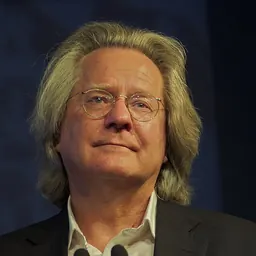
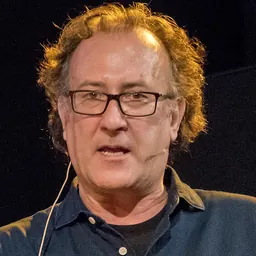
Related people
Same field, nearest in time


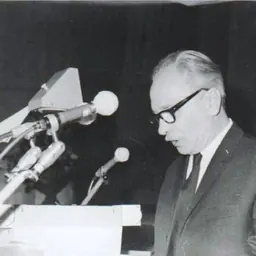
Contemporaries
People whose lives overlapped Timothy Williamson's

Frequently asked questions
Who is Timothy Williamson?
British philosopher
When was Timothy Williamson born?
Timothy Williamson was born on 6 August 1955 in Uppsala.
What is Timothy Williamson's occupation?
Timothy Williamson is a philosopher and university teacher.
What nationality is Timothy Williamson?
Timothy Williamson is British.
Sources & further reading
· Wikipedia: Timothy Williamson
Cite this page
APA: Biography.guide. (2026). Timothy Williamson. https://biography.guide/timothy-williamson/
MLA: "Timothy Williamson." Biography.guide, https://biography.guide/timothy-williamson/.
Chicago: "Timothy Williamson." Biography.guide. https://biography.guide/timothy-williamson/.
Data last updated: 2026-09-22 · Spot an error? Report a correction.
Portrait: Wikimedia Commons · author & licence
Page generated 2026-09-27 05:02 UTC