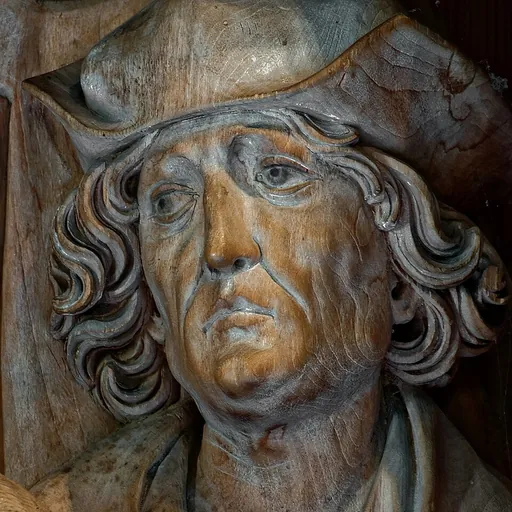
About Tilman Riemenschneider
Lived 1460 – 1531 (aged 70–71). Tilman Riemenschneider was a German sculptor, carver and sculpture.
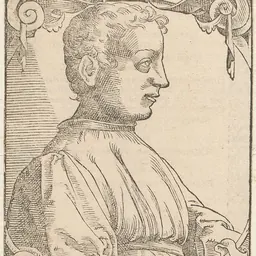
Tilman Riemenschneider ( 1460 – 7 July 1531) was a German woodcarver and sculptor active in Würzburg from 1483. A master in limewood and stone, he was one of the most prolific and versatile sculptors of the transition period between the Late Gothic, to which he essentially belonged, and Northern Renaissance art. He was also a local politician in the council of Würzburg.
Most of his subjects are religious, including several very large and spectacular carved wood altarpieces, as well as tombs in stone, and statues. He was largely forgotten soon after his death, but rediscovered by art historians in the 19th century.
Limewood carved figure of Saint George Fighting the Dragon, c. 1490 (Bode Museum, Berlin)
Biography
Tilman Riemenschneider was born around the year 1460 at Heiligenstadt im Eichsfeld in present-day Thuringia.
When Riemenschneider was about five years old, his father was involved in a violent political conflict, the , so the family had to leave Heiligenstadt and all their possessions. They resettled in Osterode, where his father became Master of the Mint (a good position at that time) and where Riemenschneider spent his childhood years. In 1490, the town council of Münnerstadt ordered an retable for the altar of St Mary Magdalene, the parish church, which included a carving of Mary Magdalene with six angels. It was set up in 1492. In 1491, the town council of Würzburg ordered two life-sized stone figures of Adam and Eve for the south portal of the council's church, the Marienkapelle (erected in 1493). Between 1501 and 1517 he had twelve apprentices registered, more than any other in Würzburg, and in 1508 he stated three stone sculptors would work for him. For that timespan alone at least a dozen retables are known to have been made by Riemenschneider's workshop.
In November 1504, Riemenschneider became a member of the sub-council of the town of Würzburg, an office he held until 1525. Together with the rest of the council, Tilman was set free after two months, with loss of most of his property. The only order he is known to have received after this was work in 1527 for a Benedictine nunnery at Kitzingen. It is assumed he learned stone and alabaster carving first and only later turned to wood carving. Some wooden figures, though unmistakably his own work, show some signs of less-than-perfect choice of wood or handling. The reasons for shifting to a new type of art, where the wood remained visible, are still debated by art historians.
Mourning Women from the high altar of the Franciscan church in Rothenburg o. d. T., c. 1485/1490, with original painting by Martin Schwarz (Bode Museum, Berlin)
Souren Melikian places Riemenschneider's best work, such as the Virgin listening to the Annunciation, in the same league as the oil paintings of Albrecht Dürer.Ref? Art historian Kenneth Clark views the Riemenschneider figures as showing the serious personal piety in Germany in the late fifteenth century and as harbingers of the coming Reformation.Ref? Among his successors and/or pupils –beside his sons– were and Philipp Koch.
Major works Since his rediscovery in the 19th century countless sculptural works from the region were attributed to him. The largest collection of his work, 81 pieces, can be found in the Mainfränkisches Museum (Marienberg Fortress) in Würzburg, including most stone sculptures from the city's churches. Hassenbacher Vesperbild, church of Hassenbach (Bad Kissingen), limewood, around 1490 Altar of the Farewell of the Apostles, near Nuremberg, limewood, polychromed, 1491 Altarpiece of Mary Magdalene, Münnerstadt, limewood, monochrome, 1490/1492 Original central Ascension figures, and the upper relief of left wing today at Bayerisches Nationalmuseum, Munich, Noli me Tangere, the other relief of the left wing, and the four sitting Apostles from the predella in the Bode Museum, Berlin Adam and Eve, sandstone, 1491/1493, originally Marienkapelle Würzburg, Mainfränkisches Museum Madonna of an Annunciation, alabaster, c. 1495, formerly St Peter's church in Erfurt (Thuringia), Louvre, Paris (RF1384) Seebenstein Madonna, limewood, c.1495-1505, formerly Burg Seebenstein, Yale University Art Gallery, New Haven, Connecticut Creglingen altarpiece, Herrgottskirche, Creglingen, limewood (framing in pinewood), monochrome, 1495–1499 Epitaph of Bishop Rudolf von Scherenberg, Würzburg Cathedral, marble, 1496/1499 Tomb of Emperor Henry II and Empress Cunigund, Bamberg Cathedral, limestone, partly gilded, sandstone (base), 1499/1513 Altar of the Apostles, Altar of the Church Fathers, and Altar of the Annunciation, carvings of St. Kilian, Crucifix, and Epitaph of Hans von Bibra, St. Leo, Bibra near Meiningen, limewood except epitaph, around 1500 Crucifixion, St Nicolas in Eisingen, Bavaria, 1500–1505 Holy Blood Altar, Jakobskirche, Rothenburg ob der Tauber, limewood, 1501–1505 Mary Salome and Zebedee, Würzburg, 1501/1505, now in the Victoria and Albert Museum, London Saint Anne and her three husbands, limewood, 1505/1510, Bayerisches Nationalmuseum, Munich Grieving Mary, around 1505/1510, from Acholshausen, Mainfränkisches Museum, Würzburg Altar of Virgin Mary, Creglingen, limewood, around 1505/1508 Altar of the Apostles, St Kilian, Windsheim, 1509, now in the Kurpfälzisches Museum, Heidelberg St Barbara, limewood, c. 1510, Bayerisches Nationalmuseum, Munich Crucifixion Altar, St. Peter and St. Paul's Church, Detwang (Rothenburg ob der Tauber), limewood, 1510/1513, now in the Kurpfälzisches Museum, Heidelberg Epitaph of Bishop Lorenz of Bibra, Würzburg Cathedral, 1520/1522 Madonna of the Rosary, pilgrim's church of Maria im Weingarten, near Volkach, limewood, around 1521/1524 The Lamentation of Christ, abbey church of Maidbronn near Würzburg, sandstone, 1525
Gallery
In literature The character Goldmund in the 1930 book Narcissus and Goldmund by Hermann Hesse serves as an apprentice with a master sculptor who is socially prominent in the town where he worked and whose character appears to be loosely based on that of Riemenschneider. He serves both as an artistic inspiration for Goldmund and as a foil for the less restrained temperament of Goldmund. Hesse describes Riemenschneider's statue of Mary with child which resides in the Pfarrkirche St Burkard in Würzburg as: "Dreamily she gazes out from her glass case, far away from our world... in her gracefulness and distinction she is refined to a degree of perfection far above that of mankind today."
The plot of Elizabeth Peters's first Vicky Bliss mystery novel, Borrower of the Night (1973) centers around the search for a missing Riemenschneider sculpture. Most of the action takes place in Rothenburg ob der Tauber.
Don’t just read it —
keep it.
Full-length biographies made to live with: read them, listen on the way to work, watch them tonight.
- E-book
- Audio
- Video
Instant download · yours to keep · every purchase keeps this site free
Important facts
more
Till Rymenschnyder, Dillmann Rimenschneider, Tillman Rimschneider, Till Rimenschneider, Dill Rymenschnyder, Dill Rimschneider, Dillmann Rymenschnyder, Tilman Rymenschnyder, Thilman Riemenschneider, Dillmann Riemenschneider, Till Rimschneider, Thilman Rimenschneider, Dillmann Rimschneider, Dill Rimenschneider, Thilman Rymenschnyder, Tilmann RiemenschneiPeople in Tilman Riemenschneider's life
Named in this biography and alive at the same time
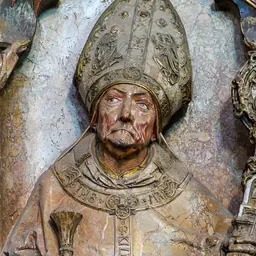
Related people
Same field, nearest in time
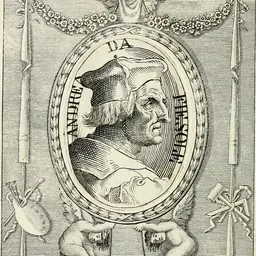
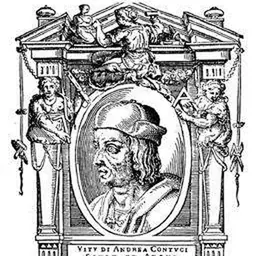


Contemporaries
People whose lives overlapped Tilman Riemenschneider's



Frequently asked questions
Who was Tilman Riemenschneider?
German sculptor and woodcarver (c.1460–1531)
When was Tilman Riemenschneider born?
Tilman Riemenschneider was born in 1460 in Heilbad Heiligenstadt.
When did Tilman Riemenschneider die?
Tilman Riemenschneider died on 17 July 1531 in Würzburg.
What was Tilman Riemenschneider's occupation?
Tilman Riemenschneider was a sculptor, carver and sculpture.
What nationality was Tilman Riemenschneider?
Tilman Riemenschneider was German.
Sources & further reading
· Wikipedia: Tilman Riemenschneider
· DBpedia: Tilman Riemenschneider
Cite this page
APA: Biography.guide. (2026). Tilman Riemenschneider. https://biography.guide/tilman-riemenschneider/
MLA: "Tilman Riemenschneider." Biography.guide, https://biography.guide/tilman-riemenschneider/.
Chicago: "Tilman Riemenschneider." Biography.guide. https://biography.guide/tilman-riemenschneider/.
Data last updated: 2026-09-22 · Spot an error? Report a correction.
Portrait: Wikimedia Commons · author & licence
Page generated 2026-09-27 05:01 UTC