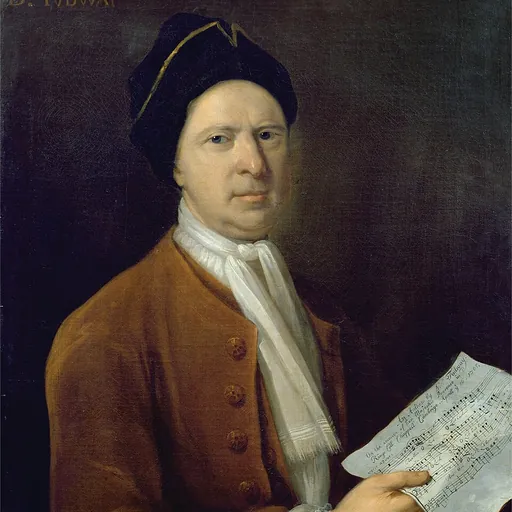
About Thomas Tudway
Lived 1656 – 1726 (aged 69–70). Thomas Tudway was a British composer.
Thomas Tudway (died 1726) was an English musician and Professor of Music at Cambridge University. He is known as a composer, and for his compilation of a collection of Anglican church music.
Life Tudway was born probably before 1650, as he became a choirboy in the Chapel Royal very soon after the Restoration. He is sometimes confused with his father (of the same name) who on 22 April 1664 obtained a tenor's place in the choir of St. George's, Windsor. In 1670 he succeeded Henry Loosemore as organist of King's College, Cambridge, and acted as instructor of the choristers from Christmas 1679 to midsummer 1680. He also became organist at Pembroke College and Great St. Mary's. In 1681 he graduated Mus. Bac., composing as his exercises Psalm 20 in English and Psalm 2 in Latin, both with orchestral accompaniment.
After the death in 1700 of Nicholas Staggins, the first professor of music at Cambridge, Tudway was chosen as his successor on 30 January 1705. He then proceeded to the degree of Mus. Doc.; his exercise and anthem, "Thou, O God, hast heard our desire", was performed in King's College Chapel on 16 April, on the occasion of Queen Anne's visit to the university. He was nominated composer and organist extraordinary to the queen, His music is at least the equal of his contemporaries. He was a Tory, one of the subscribers to John Walker's Sufferings of the Clergy, and a critic of Richard Bentley.
Tudway died on 23 November 1726, and was succeeded as professor by Maurice Greene in July 1730. Tudway's anthem "Is it true that God will dwell with men?" was performed in St George's Chapel, Windsor, at Queen Anne's first attendance there; and composed a thanksgiving anthem, "I will sing of Thy great mercies", for the victory at the battle of Blenheim.
In 1720 Tudway composed anthems and a Te Deum with orchestral accompaniment for the consecration of Lord Oxford's private chapel at Wimpole Hall, adding a Jubilate in 1721. The chapel itself was never consecrated and it seems unlikely that the works were performed there in Tudway's lifetime. Some songs and catches of his were published in various collections, and a birthday ode for Queen Anne was left in manuscript. The anthem "Thou, O Lord, hast heard our desire" was printed by Arnold in Cathedral Music.
Don’t just read it —
keep it.
Full-length biographies made to live with: read them, listen on the way to work, watch them tonight.
- E-book
- Audio
- Video
Instant download · yours to keep · every purchase keeps this site free
Important facts
People in Thomas Tudway's life
Named in this biography and alive at the same time



Related people
Same field, nearest in time

Contemporaries
People whose lives overlapped Thomas Tudway's




Frequently asked questions
Who was Thomas Tudway?
English musician and composer
When was Thomas Tudway born?
Thomas Tudway was born in 1656.
When did Thomas Tudway die?
Thomas Tudway died in 1726.
What was Thomas Tudway's occupation?
Thomas Tudway was a composer.
What nationality was Thomas Tudway?
Thomas Tudway was British.
Sources & further reading
Cite this page
APA: Biography.guide. (2026). Thomas Tudway. https://biography.guide/thomas-tudway/
MLA: "Thomas Tudway." Biography.guide, https://biography.guide/thomas-tudway/.
Chicago: "Thomas Tudway." Biography.guide. https://biography.guide/thomas-tudway/.
Data last updated: 2026-09-23 · Spot an error? Report a correction.
Portrait: Wikimedia Commons · author & licence
Page generated 2026-09-27 05:04 UTC