
About Thomas Stephens
Lived 1821 – 1875 (aged 53). Thomas Stephens was a British historian, literary critic and apothecary.
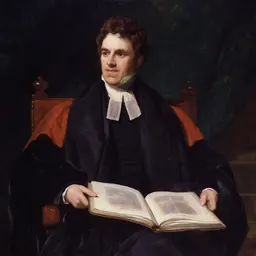
Thomas Stephens (Bardic names: Casnodyn, Gwrnerth, Caradawg) (21 April 1821 – 4 January 1875) was a Welsh historian, literary critic, and social reformer. His works include The Literature of the Kymry (1849,1876), Madoc: An Essay on the Discovery of America by Madoc ap Owen Gwynedd in the Twelfth Century (1858,1893), and Orgraff yr Iaith Gymraeg (an orthography of Welsh), as well as a number of prize-winning essays presented at eisteddfodau between 1840 and 1858. He was the first Welsh historian and literary critic to employ rigorous scientific methods, and is considered to have done more to raise the standards of the National Eisteddfod than any other Welshman of his time. Stephens also figured prominently in efforts to implement social, educational and sanitary reforms both locally in Merthyr Tydfil and more broadly throughout Wales.
Life Thomas Stephens was born on 21 April 1821 at Pont Nedd Fechan, Glamorganshire, Wales, the son of a boot-maker. In 1835 he was apprenticed as a chemist and druggist in Merthyr Tydfil and took over the business in 1841. He was also appointed manager of the Merthyr Express newspaper in 1864.
Stephens suffered a series of strokes from 1868. He died on 4 January 1875 in Merthy Tydfil and was buried at Cefncoedycymmer cemetery.
Writings Stephens began submitting prize-winning essays to eisteddfodau from 1840. His bardic names were Casnodyn, Gwrnerth, and Caradawg. Stephens' book, The Literature of the Kymry (1849, 2nd ed. 1876), was based on his essay "The Literature of Wales during the Twelfth and Succeeding Centuries" which won the Prince of Wales Prize at the 1848 eisteddfod held in Abergavenny. In this work, Stephens pioneered the use of rigorous methods of literary criticism in the study of medieval Welsh literature.
Stephens' 1858 eisteddfod essay Madoc: An Essay on the Discovery of America by Madoc ap Owen Gwynedd in the Twelfth Century, which demolished Welsh claims of the discovery of the Americas by Madoc, was acknowledged as the outstanding submission. However, although convincing, the essay was not awarded the prize due to the adjudicators' reluctance to discard the old claims. Disgusted, Stephens refused to compete in future eisteddfod competitions.
Stephens' modern biographer Marion Löffler describes his "main contributions to the shaping of Wales" in terms of his work to transform Merthyr's social organisation and modernise Welsh culture, and "his pioneering works of scholarship". )
Don’t just read it —
keep it.
Full-length biographies made to live with: read them, listen on the way to work, watch them tonight.
- E-book
- Audio
- Video
Instant download · yours to keep · every purchase keeps this site free
Important facts
Related people
Same field, nearest in time





Contemporaries
People whose lives overlapped Thomas Stephens's



Frequently asked questions
Who was Thomas Stephens?
Welsh historian (1821–1875)
When was Thomas Stephens born?
Thomas Stephens was born on 21 April 1821 in Glamorgan.
When did Thomas Stephens die?
Thomas Stephens died on 4 January 1875 in Merthyr Tydfil.
What was Thomas Stephens's occupation?
Thomas Stephens was a historian, literary critic and apothecary.
What nationality was Thomas Stephens?
Thomas Stephens was British.
Sources & further reading
· DBpedia: Thomas Stephens (historian)
Cite this page
APA: Biography.guide. (2026). Thomas Stephens. https://biography.guide/thomas-stephens-historian/
MLA: "Thomas Stephens." Biography.guide, https://biography.guide/thomas-stephens-historian/.
Chicago: "Thomas Stephens." Biography.guide. https://biography.guide/thomas-stephens-historian/.
Data last updated: 2026-09-26 · Spot an error? Report a correction.
Page generated 2026-09-27 05:15 UTC