
About Thomas Roderick Dew
Lived 1802 – 1846 (aged 43–44). Thomas Roderick Dew was an American economist, university teacher, writer and metaphysics.
Thomas Roderick Dew (December 5, 1802 – August 6, 1846) was a professor and public intellectual, then president of The College of William & Mary (1836–1846). Although he first achieved national stature for opposing protective tariffs, today Dew may be best known for his pro-slavery advocacy.
Early life and education Thomas Dew was born in King and Queen County, Virginia, in 1802, son of the former Lucy Gatewood and her Maryland-born husband, Captain Thomas Dew (1763–1849). His father had been a Revolutionary War soldier. Settling in Virginia, the elder Thomas Dew established a plantation near Newtown in King and Queen County that he named "Dewsville" and which prospered by the use of enslaved labor (Thomas R. Dew owned 39 slaves in King and Queen County in 1820). The family included five sons. The eldest son, Dr. William Dew (1796–1855), received 500 acres and a new house (now operating as Providence Plantation and Farm) as a wedding present in 1826. The family also included at least one daughter who survived to adulthood, married and had children, Mary Ellen Gresham (1786–1836).
Dew received a private education appropriate to his class, and in 1818 began attending The College of William & Mary in Williamsburg. After graduating in 1820, Dew continued his studies and received a master's degree in 1824. A source was P. Austin Nuttall's 1840 Classical and Archaeological Dictionary.
Pro-slavery advocate
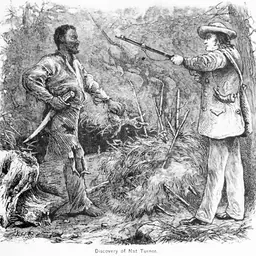
In 1832, Dew published a review of the celebrated slavery debate of 1831–32 in the Virginia General Assembly, A Review of the Debates in the Legislature of 1831 and 1832, which went far towards putting a stop to a movement, then assuming considerable proportions, to proclaim the end of slavery in Virginia. The Virginia Legislature's debate was a response to Nat Turner's slave rebellion of August 1831. Dew argued that whites and freed blacks could not live alongside one other in peace, and stated that slavery was established by God while also acknowledging slavery violated the spirit of Christianity. One recent scholar denies the nuances or contradictions in Dew's market-based slavery advocacy.
In his inaugural speech as president at William & Mary, Dew "admonished young planters to resist fanatics who wished to eliminate slavery. Dew emphasized the importance of a broad-based liberal arts education but singled out morals and politics as the most significant subjects of study."
Contemporaries credited Dew for defeating proposals to end slavery in Virginia in the 1830s. Dew opposed even gradual emancipation. His teaching and his writings influenced later generations, which opposed Reconstruction and created Jim Crow.
Dew on men and women Dew characterized women as modest, passive, virtuous, and religiously devout, which he attributed to women's physical weakness, and which made them dependent on male goodwill. Dew also asserted that men were intellectually superior to women (across all cultures and historical periods), but blamed the disparity on educational differences rather than unequal natural endowments. Dew advocated denying suffrage to women "because their intense focus on their own families impeded their ability to comprehend broader political developments." A compilation of his history lectures was published posthumously as A Digest of the Laws, Customs, Manners, and Institutions of the Ancient and Modern Nations (1853). Although Dew had no children and thus no direct descendants, a collateral relative, Charles B. Dew, a professor of Southern history at Williams College, wrote in The Making of a Racist (2016) of his Southern family's tradition of racism.
Works by Thomas R. Dew
(The "first edition" is the 1833 publication cited above.)
(16 page pamphlet)
Briefer pieces, letters, speeches
Archival material Dew's family papers and papers from his time as president of the College of William and Mary can be found at the Special Collections Research Center at the College of William and Mary.
Media A non-existent book by Dew, Inequality Is the Basis of Society, appears in the Spaghetti Western Sabata (1969) starring Lee Van Cleef, in which the book is read by the villain. Stengel reads a quotation from it: "All men gifted with superior talent and thus with superior powers must command and use inferior men."
Don’t just read it —
keep it.
Full-length biographies made to live with: read them, listen on the way to work, watch them tonight.
- E-book
- Audio
- Video
Instant download · yours to keep · every purchase keeps this site free
Important facts
People in Thomas Roderick Dew's life
Named in this biography and alive at the same time
Related people
Same field, nearest in time


Contemporaries
People whose lives overlapped Thomas Roderick Dew's






Frequently asked questions
Who was Thomas Roderick Dew?
American economist (1802–1846)
When was Thomas Roderick Dew born?
Thomas Roderick Dew was born in 1802 in King and Queen County.
When did Thomas Roderick Dew die?
Thomas Roderick Dew died in 1846.
What was Thomas Roderick Dew's occupation?
Thomas Roderick Dew was an economist, university teacher, writer and metaphysics.
What nationality was Thomas Roderick Dew?
Thomas Roderick Dew was American.
Sources & further reading
· Wikipedia: Thomas Roderick Dew
· DBpedia: Thomas Roderick Dew
Cite this page
APA: Biography.guide. (2026). Thomas Roderick Dew. https://biography.guide/thomas-roderick-dew/
MLA: "Thomas Roderick Dew." Biography.guide, https://biography.guide/thomas-roderick-dew/.
Chicago: "Thomas Roderick Dew." Biography.guide. https://biography.guide/thomas-roderick-dew/.
Data last updated: 2026-09-20 · Spot an error? Report a correction.
Page generated 2026-09-27 05:23 UTC