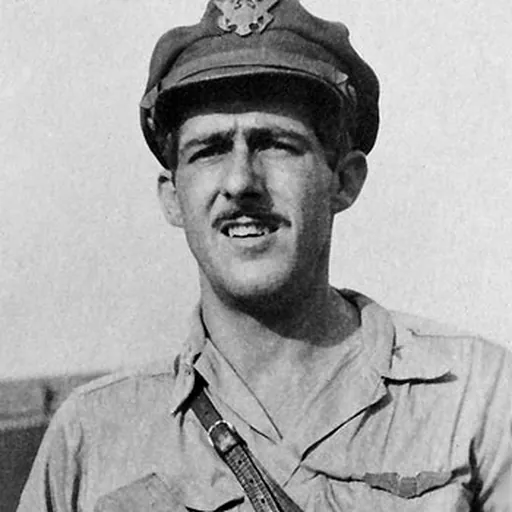
About Thomas McGuire
Lived 1920 – 1945 (aged 24). Thomas McGuire was an American aircraft pilot and military personnel.
Thomas Buchanan McGuire Jr. (August 1, 1920 – January 7, 1945) was an American United States Army major who was killed in action while serving as a member of the United States Army Air Forces during World War II and posthumously awarded the Medal of Honor. He was one of the most decorated American fighter pilots and the second-highest scoring American ace of the war.
McGuire was memorialized by the renaming of Fort Dix Army Air Force Base in Burlington County, New Jersey, to McGuire Air Force Base in 1948.
Early years McGuire was born in Ridgewood, New Jersey, on August 1, 1920. He and his mother moved to Sebring, Florida in the late 1920s and McGuire graduated from Sebring High School in 1938. He enrolled at the Georgia Institute of Technology to study aeronautical engineering, where he played in the marching band, was a sergeant major in the ROTC cadet corps, and became a member of Beta Theta Pi fraternity. He left after his third year to enter the U.S. Army Air Corps Aviation Cadet Program on July 12, 1941.
United States Army Air Forces
McGuire would become one of the top scoring combat pilots in U.S. Air Force history. Civilian contractor Charles Lindbergh bunked with him for a time and flew as his wingman on several missions. Visitors recalled McGuire ordering Lindbergh around, telling him to run errands as though he were a servant. With a total of 38 enemy planes destroyed to his credit in World War II, McGuire was only two victories behind Major Richard Bong.
World War II McGuire reported to the flying school in Corsicana, Texas, as an aviation cadet. He received further training in San Antonio, and was commissioned a second lieutenant and awarded his pilot wings at Kelly Field, Texas, on February 2, 1942. He was assigned to the 313th Pursuit Squadron at Selfridge Field, Michigan from February to May and the 56th Pursuit Squadron at Paine Field, Texas.
Combat missions
Last mission and death
January 7, 1945, McGuire took off from Dulag Airfield on Leyte and led a group of four P-38s – himself, Major Jack Rittmayer (who was visiting the area from the Thirteenth Air Force), Captain Edwin Weaver, and Lieutenant Douglas Thropp – on a fighter sweep over northern Negros Island in the central Philippines. Their aim was to gain victories. McGuire desperately wanted to pass Bong's score of 40 kills. Descending through cloud cover, McGuire's flight circled a Japanese airfield at Fabrica and then proceeded to a second airstrip at Manapla (also referred to as Carolina). As they approached Manapla, they were confronted by a lone Ki-43 "Oscar", which immediately engaged McGuire's flight.
Flying in the number-three position, Lt. Thropp saw the Oscar trying to attack him in a head-on pass. Thropp broke hard left. The Japanese pilot turned with him and fell into position behind him while firing. Major Rittmayer, flying as Thropp's wingman, turned sharply towards and began firing on the attacker. McGuire saw the Oscar was being engaged by Rittmayer and turned to face an imminent threat to the flight from the opposite direction. McGuire and his flight had encountered Warrant Officer Akira Sugimoto (杉本明, Sugimoto Akira), who was an instructor pilot with some 3,000+ hours in type.
As Sugimoto approached Weaver from behind, Weaver radioed he was attacked and cut inside of the turn to present a more difficult shot. McGuire eased up on his turn rate in an effort to draw the attacker off of his wingman and onto himself. Sugimoto took the bait and switched his attack to McGuire. As Sugimoto approached from behind, McGuire rapidly increased his turn rate. ), caused McGuire's P-38 to stall. It snap rolled inverted and nosed down into the ground. Despite the low altitude, McGuire nearly pulled out successfully; had he jettisoned his drop tanks at the start of the dogfight, he might have managed it. McGuire was killed on impact. Sugimoto was soon hit by gunfire from Rittmayer and forced to crash-land in the jungle where he was killed by Filipino guerrillas. Minutes later a Ki-84 "Frank" flown by Technical Sergeant Mizunori Fukuda avenged the loss of Sugimoto by attacking Rittmayer in a head-on attack. Rittmayer's cockpit was riddled with bullets and his plane was shot down, killing him. Fukuda's plane was soon heavily damaged by the two other remaining American planes but he successfully hard-landed back at his airbase. He survived the war.
McGuire's crash was witnessed by Filipinos who immediately rushed to the scene and secured his body so it would not be captured. In 1949, his remains were recovered by the U.S. Army and returned to the United States. He was buried with full military honors at Arlington National Cemetery on May 17, 1950. A memorial was erected at McGuire's fatal crash site on Negros Island in 2007, placed by aviation archaeologist and former fighter pilot David Mason. McGuire was posthumously awarded the Medal of Honor due to sacrificing himself with his dangerous turn that ended up saving his wingman's life.
Military awards McGuire's military decorations and awards include:
United States Army Air Forces pilot badgeMedal of HonorDistinguished Service CrossSilver Star w/ two Bronze Oak Leaf ClustersDistinguished Flying Cross w/ one Silver Oak Leaf ClusterPurple Heart w/ two Bronze Oak Leaf ClustersAir Medal w/ two Silver Oak Leaf Clusters and two Bronze Oak Leaf ClustersAir Medal w/ one Bronze Oak Leaf ClusterAmerican Defense Service MedalAmerican Campaign MedalAsiatic-Pacific Campaign Medal w/ one " silver star and two " bronze starsWorld War II Victory MedalPhilippine Liberation Medal w/ two " bronze stars
Army Presidential Unit Citation w/ three bronze oak leaf clustersPhilippine Presidential Unit Citation
Medal of Honor citation Rank and organization: Major, U.S. Army Air Forces, Fifth Air Force
Namings and other honors
McGuire Air Force Base, New Jersey, January 1948. The base has a P-38 Lightning on static display and the C-17 and KC-10 aircraft flown by the 305 AMW and 514 AMW carry the image of a P-38 in the fin flash of each aircraft's vertical stabilizer San Jose Airport in San Jose, Occidental Mindoro, Philippines, formerly McGuire Field until 1951 Major Thomas B. McGuire Medal of Honor Exhibit: National Museum of the United States Air Force, Wright-Patterson AFB, Ohio. National Aviation Hall of Fame, Dayton, Ohio Aviation Hall of Fame of New Jersey (Teterboro Airport) Georgia Aviation Hall of Fame National Medal of Honor Grove, Valley Forge, Pennsylvania Florida Medal of Honor Grove Georgia Tech Alumni Medal of Honor Garden United States and Canadian Military Service display of the Beta Museum at the Beta Theta Pi General Fraternity headquarters in Oxford, Ohio
Don’t just read it —
keep it.
Full-length biographies made to live with: read them, listen on the way to work, watch them tonight.
- E-book
- Audio
- Video
Instant download · yours to keep · every purchase keeps this site free
Important facts
People in Thomas McGuire's life
Named in this biography and alive at the same time
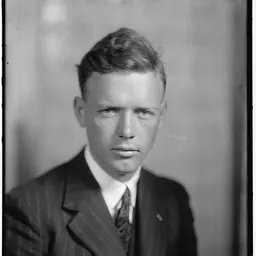



Related people
Same field, nearest in time
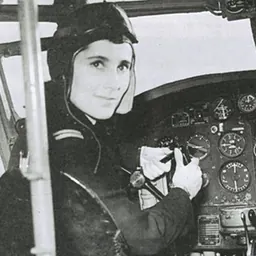
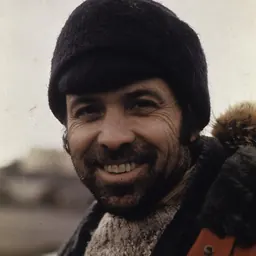


Contemporaries
People whose lives overlapped Thomas McGuire's




Frequently asked questions
Who was Thomas McGuire?
United States Army officer (1920–1945)
When was Thomas McGuire born?
Thomas McGuire was born on 1 August 1920 in Ridgewood.
When did Thomas McGuire die?
Thomas McGuire died on 7 January 1945 in Negros.
What was Thomas McGuire's occupation?
Thomas McGuire was an aircraft pilot and military personnel.
What nationality was Thomas McGuire?
Thomas McGuire was American.
Sources & further reading
Cite this page
APA: Biography.guide. (2026). Thomas McGuire. https://biography.guide/thomas-mcguire/
MLA: "Thomas McGuire." Biography.guide, https://biography.guide/thomas-mcguire/.
Chicago: "Thomas McGuire." Biography.guide. https://biography.guide/thomas-mcguire/.
Data last updated: 2026-09-20 · Spot an error? Report a correction.
Page generated 2026-09-27 05:10 UTC