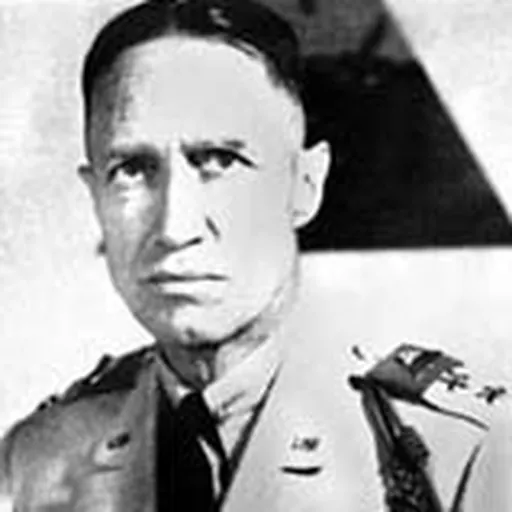
About Thomas J. H. Trapnell
Lived 1902 – 2002 (aged 99). Thomas J. H. Trapnell was an American military personnel.
Thomas John Hall "Trap" Trapnell (23 November 1902 – 13 February 2002) was a United States Army lieutenant general. He was a career officer who served in World War II and the Korean War. Trapnell survived the Bataan Death March and the sinking of two transportation ships during World War II, put down a rebellion of prisoners of war in the Korean War, was the top US advisor to the French during the French Indochina War, and advised against US involvement in Vietnam. He rose to the rank of three-star general before his military retirement and, at the time of his death, was the oldest living member of the Philippine Scouts.
Early life Thomas Trapnell was born on 23 November 1902, in Yonkers, New York, to Joseph Trapnell and Laura Kennedy. The Trapnells are a prosperous and distinguished family originally from the Chesapeake area whose roots stretch back to early Colonial America. One brother, Walter Scott Kennedy Trapnell, rose to the rank of commander in the United States Navy during World War II, while another brother, William Holmes Trapnell, was a prominent attorney. A cousin, Frederick M. Trapnell, was a famous naval test pilot who retired from the navy as a vice admiral. Several other cousins also served as commissioned officers in the armed forces.
Military career
After graduating from Episcopal High School in Alexandria, Virginia, in 1923, Trapnell attended the United States Military Academy at West Point, New York. Known as the "warhorse of the West Point backfield," he was an All-America halfback in football—where he teamed with future Hall of Famer Chris Cagle. In 1926, in one of West Point's best years, Trapnell participated in a memorable game against Navy that tied at 21–21. The match was played at Soldier Field in Chicago – the only time either team has played that venue. Army suffered only one loss that entire season (to Notre Dame).
Trapnell was also a top rated lacrosse player who rose to the captaincy of the Army team. His first brush with public notoriety came when his crew defeated the highly rated team from Hobart College captained by his younger brother, William. The characteristically athletic and competitive Trapnells did their best to outshine each other as evidenced by one report:
Trapnell graduated in 1927 and was commissioned as a platoon leader in the 11th Cavalry Regiment. During this time, he served under two future generals Jonathan Wainwright and George Patton. In 1937, he was promoted to captain; two years later he was assigned to the Philippine Scouts.
While in the Philippines, Trapnell was instrumental in recruiting Sofia Adamson, future founder of the Pacific Asia Museum in Los Angeles and co-founder of Adamson University in Manila, to the staff of General Douglas MacArthur. He also became a star polo player. Trapnell was promoted to major and was made XO of the 26th Cavalry Regiment.
World War II In 1941, Japan invaded the Philippines, routing combined U.S.-Filipino defensive forces. During their withdrawal into the Bataan Peninsula in December, Trapnell, commanding a unit of the 26th Cavalry, fought a desperate rear-guard action that included the last tactical cavalry charge of the U.S. Army. Using a medical truck to block one of the bridges used by retreating Fil-Am force and setting it afire, Trapnell then remained at this position under constant fire until the bridge was rendered unpassable. Although he had a command car with which to beat a hasty retreat, he instead withdrew slowly with a picked force retrieving wounded soldiers along the way. For this engagement he was awarded the Distinguished Service Cross and commended by Gen. MacArthur: "With complete disregard for his safety, Major Trapnell delayed the hostile advance and set an inspiring example to his entire regiment." While interned, he was promoted to lieutenant colonel.
Interbellum Upon his return to the United States, Trapnell attended the Command and General Staff College, graduating in 1947. Afterward, he completed Airborne School and assumed command of the 505th Parachute Infantry Regiment, 82nd Airborne Division at Fort Bragg, North Carolina. On May 8, 1948, Trapnell led the 505th as part of a record-setting exercise that saw 2,200 paratroopers travel some 500 miles to make a jump at Camp Campbell, Kentucky. He graduated from the Army War College in 1951. From May to June, 1952, the 187th under Trapnell was instrumental in suppressing the rebellion of 80,000 Chinese and North Korean prisoners at the Geoje POW camp. Some 40 prisoners were killed during the uprising which had been fomented by communist leaders attempting to disrupt truce negotiations.
Indochina From 1952 to 1954, Major General Trapnell headed the U.S. advisory mission in French Indochina, leaving just before Ho Chi Minh's victory at Dien Bien Phu. While serving as the chief advisor, he issued a series of reports to his superiors in which he predicted that the French would not be able to defeat the communist insurgency. Trapnell was replaced by Maj. Gen. John W. O'Daniel and returned to the United States for a succession of commands: the recently reactivated 4th Armored Division at Ft. Hood, Texas from 1954 to 1955 and the 82nd Airborne Division from 1955 to 1956.
Trapnell returned to South Korea in 1958 commanding I Corps for two years before becoming the Chief of Staff to Gen. Isaac White, Commander-in-Chief, United States Army Pacific. In 1960, after briefly commanding Third U.S. Army at Ft. McPherson, Georgia, he took command of both the XVIII Airborne Corps and the Strategic Army Corps at Ft. Bragg. While there, Trapnell presided over the dedication of the Airborne Trooper statue in September 1961. He also strongly advocated for the joint forces reaction force that became Strike Command.
Trapnell's final command came in 1961. In that year, SAC and Tactical Air Command were unified as Strike Command; Trapnell once again assumed command of Third Army. He retired in 1962.
Trapnell later served as an advisory board member of the Center for Internee Rights in Florida advocating for just treatment of US prisoners of war and fair compensation from holding nations. His second marriage, to Elizabeth Elder, lasted from 1956 to her death in 2001. He had no children.
Like many other males in his family, Trapnell was known as "Trap" from his last name. As such, Trapnell became the first person whose nickname appeared in an official War Department record (Communiqué 69):
Trapnell died of heart failure at the Fairfax retirement facility at Ft. Belvoir, Virginia on 13 February 2002. He was buried with full military honors at West Point Cemetery.
Military awards Trapnell's military decorations and awards include: Badges
Decorations
Unit Award Army Presidential Unit Citation Service Medals
Foreign Awards Philippine Defense MedalCroix de Guerre with Palm (France)Vietnam Army Distinguished Service Order (1st Class)Vietnam Gallantry Cross with PalmPhilippine Republic Presidential Unit Citation Republic of Korea Presidential Unit CitationVietnam Presidential Unit CitationUnited Nations Korea MedalVietnam Campaign MedalRepublic of Korea War Service Medal
Don’t just read it —
keep it.
Full-length biographies made to live with: read them, listen on the way to work, watch them tonight.
- E-book
- Audio
- Video
Instant download · yours to keep · every purchase keeps this site free
Important facts
People in Thomas J. H. Trapnell's life
Named in this biography and alive at the same time





Related people
Same field, nearest in time





Contemporaries
People whose lives overlapped Thomas J. H. Trapnell's


Frequently asked questions
Who was Thomas J. H. Trapnell?
Recipient of the Purple Heart medal (1902-2002)
When was Thomas J. H. Trapnell born?
Thomas J. H. Trapnell was born on 23 November 1902 in Yonkers.
When did Thomas J. H. Trapnell die?
Thomas J. H. Trapnell died on 13 February 2002 in Fort Belvoir.
What was Thomas J. H. Trapnell's occupation?
Thomas J. H. Trapnell was a military personnel.
What nationality was Thomas J. H. Trapnell?
Thomas J. H. Trapnell was American.
Sources & further reading
· Wikipedia: Thomas J. H. Trapnell
· DBpedia: Thomas J. H. Trapnell
Cite this page
APA: Biography.guide. (2026). Thomas J. H. Trapnell. https://biography.guide/thomas-j-h-trapnell/
MLA: "Thomas J. H. Trapnell." Biography.guide, https://biography.guide/thomas-j-h-trapnell/.
Chicago: "Thomas J. H. Trapnell." Biography.guide. https://biography.guide/thomas-j-h-trapnell/.
Data last updated: 2026-09-23 · Spot an error? Report a correction.
Portrait: Wikimedia Commons · author & licence
Page generated 2026-09-27 05:06 UTC