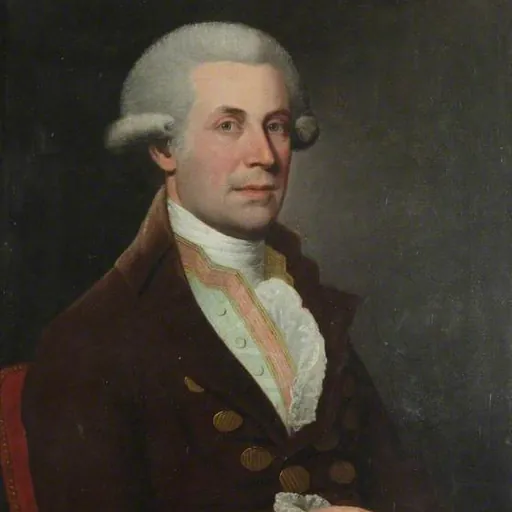
About Thomas Farnolls Pritchard
Lived 1723 – 1777 (aged 53–54). Thomas Farnolls Pritchard was a British architect.
Thomas Farnolls Pritchard (also known as Farnolls Pritchard; baptised 11 May 1723 – 23 December 1777) was an English architect and interior decorator who is best remembered for his design of the first cast-iron bridge in the world.
Biography Pritchard was born in Shrewsbury, Shropshire, and baptised in St Julian's Church, Shrewsbury on 11 May 1723. His father was a joiner. Thomas also trained as a joiner, but then developed a professional practice as an architect and interior designer. He specialised in the design of chimney-pieces and other items of interior decoration, and in funerary monuments.
Pritchard worked closely with other local architects and craftsmen. William Baker of Audlem, an architect and contractor, used his plans to construct St John's Church, Wolverhampton. Joseph Bromfield, who worked for Pritchard initially as a plasterer, but became a very competent draughtsman and architect, appears to have taken over a large portion of Pritchard's architectural practice after Pritchard's death. Pritchard's houses and churches have been described as "no more than pleasant provincial work".
In the design of funerary monuments he employed coloured marbles, characterised by Rupert Gunnis as "school of Henry Cheere". These were usually in rococo or Gothic style, and later in neoclassical style. They include monuments to Ann Wilkinson, 1756, at Wrexham, Denbighshire; the Rev. John Lloyd, 1758, and Mary Morhall, 1765, both at St. Mary's Shrewsbury; and Richard Corbet, at Moreton Corbet, Shropshire. Pritchard carried out work in Ludlow, including rebuilding its jail and the Hosier's Almshouses, and making alterations to the Guildhall.
In 1769, he left Shrewsbury and moved to Eyton on Severn where he took up farming as well as continuing with his architectural work. He made various designs for bridges, none of which came to fruition, until he made plans for a bridge in cast iron to cross the River Severn in Coalbrookdale, Shropshire, adapting the principles of timber bridge-building. A modified version of his design was cast at the ironworks in Coalbrookdale in 1777–79.
Death Pritchard died, aged 54, before the bridge was completed, but his design of The Iron Bridge led to the building of the first cast-iron arch bridge in the world.
He was buried in St Julian's, Shrewsbury, where his memorial also commemorates his wife, Elinor Russell, of Shrewsbury (married 1751, died 1768) and three children who died young.
Don’t just read it —
keep it.
Full-length biographies made to live with: read them, listen on the way to work, watch them tonight.
- E-book
- Audio
- Video
Instant download · yours to keep · every purchase keeps this site free
Important facts
People in Thomas Farnolls Pritchard's life
Named in this biography and alive at the same time


Related people
Same field, nearest in time


Contemporaries
People whose lives overlapped Thomas Farnolls Pritchard's




Frequently asked questions
Who was Thomas Farnolls Pritchard?
English architect and interior decorator
When was Thomas Farnolls Pritchard born?
Thomas Farnolls Pritchard was born in 1723 in Shrewsbury.
When did Thomas Farnolls Pritchard die?
Thomas Farnolls Pritchard died in 1777.
What was Thomas Farnolls Pritchard's occupation?
Thomas Farnolls Pritchard was an architect.
What nationality was Thomas Farnolls Pritchard?
Thomas Farnolls Pritchard was British.
Sources & further reading
· Wikipedia: Thomas Farnolls Pritchard
· DBpedia: Thomas Farnolls Pritchard
Cite this page
APA: Biography.guide. (2026). Thomas Farnolls Pritchard. https://biography.guide/thomas-farnolls-pritchard/
MLA: "Thomas Farnolls Pritchard." Biography.guide, https://biography.guide/thomas-farnolls-pritchard/.
Chicago: "Thomas Farnolls Pritchard." Biography.guide. https://biography.guide/thomas-farnolls-pritchard/.
Data last updated: 2026-09-20 · Spot an error? Report a correction.
Page generated 2026-09-27 05:09 UTC