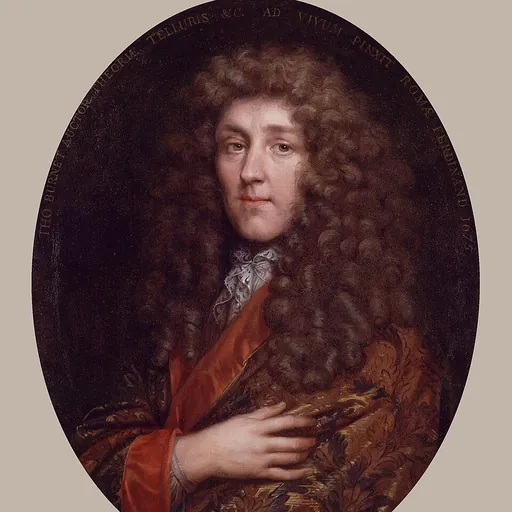
About Thomas Burnet
Lived 1635 – 1715 (aged 79–80). Thomas Burnet was an English and British philosopher and theologian.
Thomas Burnet ( – 27 September 1715 ) was an English theologian and writer on cosmogony.
Life He was born at Croft near Darlington in 1635. After studying at Northallerton Grammar School under Thomas Smelt, he went to Clare College, Cambridge in 1651.
Burnet took employment travelling with Lord Wiltshire, son of Charles Paulet, 6th Marquess of Winchester, and through Tillotson as tutor to Lord Ossory, grandson of James Butler, 1st Duke of Ormonde. The influence of the Duke of Ormonde, one of the governors, secured his appointment in 1685 to the mastership of Charterhouse . Burnet took part in the resistance offered to James II's attempt to make Andrew Popham a pensioner of the Charterhouse. At two meetings held by the governors 17 January and Midsummer day 1687, the king's letters of dispensation were produced, but, in spite of the efforts of George Jeffreys, a governor, the majority refused compliance.
After the Glorious Revolution Burnet became chaplain in ordinary and Clerk of the Closet to William III (until 1695). He received no clerical preferment and lived quietly in the Charterhouse, where he died on 27 September 1715, and was buried in the chapel.
Burnet's system had its novel features, as well as those such as the four classical elements that were very traditional: an initially ovoid Earth, a Paradise before the Flood that was always in the spring season, and rivers flowing from the poles to the Equator. Herbert Croft published criticism of the book in 1685, in particular accusing Burnet of following the Second Epistle of Peter rather than the Book of Genesis. During the 1690s John Beaumont and Johann Caspar Eisenschmidt picked up on Burnet's ideas. They engendered a great deal of controversy at the time, and Burnet defended himself against selected critics, John Keill and Erasmus Warren. However, Burnet did not find this explanation scientific enough. Lengthening the days would require an intervention on God's part. Burnet tightly held the belief that God created the world and all its processes perfectly from the start. He wrote: We think him a better Artist that makes a Clock that strikes regularly at every hour from the Springs and Wheels which he puts into the work, than he that hath so made his Clock that he must put his finger to it every hour to make it strike.
The Ancient Doctrine Concerning the Origin of Things Some of the views expressed in this work, also known as Archaeologiae Philosophicae sive Doctrina Antiqua de Rerum Originibus (1692), were so unacceptable to contemporary theologians that he had to resign his post at Court. In this he considered whether the fall of man was a symbolic event rather than literal history.
On the State of the Dead and of the Resurrection Burnet's treatise De Statu Mortuorum et Resurgentium was published posthumously in 1720. In Edward Gibbon's The History of the Decline and Fall of the Roman Empire III p. 99 Gibbon made reference to Burnet's De Statu Mortuorum et Resurgentium noting that Burnet "exposes the inconveniences which must arise", if souls "possess a more active and sensible existence". Thomas Newton, Bishop of Bristol and Dean of St. Paul's, criticised Gibbon and claimed that Burnet's views were exactly the opposite.
Influence Burnet's work had an influence on Samuel Taylor Coleridge. He is quoted at the beginning of the 1817 edition of his The Rime of the Ancient Mariner.
The ridge Dorsa Burnet in the Ocean of Storms on the Moon was named after him.
Don’t just read it —
keep it.
Full-length biographies made to live with: read them, listen on the way to work, watch them tonight.
- E-book
- Audio
- Video
Instant download · yours to keep · every purchase keeps this site free
Important facts
People in Thomas Burnet's life
Named in this biography and alive at the same time



Related people
Same field, nearest in time

Contemporaries
People whose lives overlapped Thomas Burnet's





Frequently asked questions
Who was Thomas Burnet?
English theologian and writer (1635-1715)
When was Thomas Burnet born?
Thomas Burnet was born in 1635 in Croft-on-Tees.
When did Thomas Burnet die?
Thomas Burnet died on 27 September 1715 in London, Charterhouse School.
What was Thomas Burnet's occupation?
Thomas Burnet was a philosopher and theologian.
What nationality was Thomas Burnet?
Thomas Burnet was English and British.
Sources & further reading
· DBpedia: Thomas Burnet (theologian)
Cite this page
APA: Biography.guide. (2026). Thomas Burnet. https://biography.guide/thomas-burnet/
MLA: "Thomas Burnet." Biography.guide, https://biography.guide/thomas-burnet/.
Chicago: "Thomas Burnet." Biography.guide. https://biography.guide/thomas-burnet/.
Data last updated: 2026-09-22 · Spot an error? Report a correction.
Portrait: Wikimedia Commons · author & licence
Page generated 2026-09-27 05:04 UTC