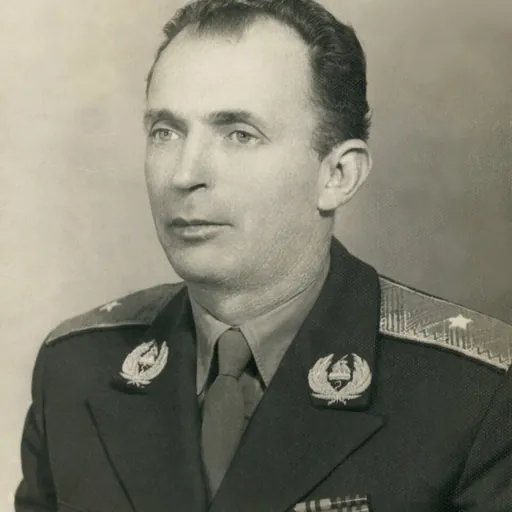
Thoma Xhixho
Albanian military commander and military theorist, World War II
About Thoma Xhixho
Lived 1920 – 2002 (aged 81–82). Thoma Xhixho was an Albanian.
Thoma Koço Xhixho (April 3, 1920 – November 29, 2002) was a major-general of the Albanian Army, military scientist, founder and first commander of the Albanian Military Academy. He is one of the framers of the Albanian Military Art, as well as the base documents and regulations for training in the Albanian Army. During World War II, Thoma Xhixho was one of the important leaders of the National Liberation Army (UNÇ). At the onset of the Antifascist National Liberation Movement (LANÇ) in Albania, he was one of its first members and one of the first commanders of the armed war against occupation forces.
Born in Suhë of the Lunxhëri region, Gjirokastër, Xhixho was raised in a family with longtime patriotic traditions. He came in touch early on with antifascism and the National Liberation Movement (LANÇ). Xhixho gradually rose through the ranks of the LANÇ and the National Liberation Army (UNÇ), from guerrilla unit commander, company kommissar, battalion kommissar and subsequently Brigade kommissar. During WWII he was at the command of some of the combat operations against the military forces of Fascist Italy and Nazi Germany in the Ist Operational Zone Vlorë-Gjirokastër-Mallakastër.
In the postwar years, Xhixho served at the helm of Divisions and other military units of the Albanian National Army (Ushtria Kombëtare Shqiptare) and contributed in raising and restructuring Albanian Army units, which had recently come out of the war. He was the commander of the Unified School of Officers and commander of the Albanian Military Academy. In the years 1960–1970, Xhixho was Director of the Army's Combat Training at the Defense Ministry.
Early life and activity Thoma Xhixho was born the youngest of fourteen children, to an Albanian family in Suhë, Lunxhëri, Gjirokastër County, in Southern Albania. His father, Kostandin (Koço) and his mother Katerina, along with his entire family worked in agriculture. Xhixho completes elementary school in Suhë and partly in Poliçan. At a time when most of the population of Albania did not receive any formal education or only completed elementary school, Xhixho with the support of his family, became the first from his birthplace to attend high school (gymnasium). He completed the gymnasium in Gjirokastër (today named "Asim Zeneli Gymnasium"). During these years, he helped and worked for the family who had sheltered him in the city and also worked briefly as an unpaid clerk in a law office in Gjirokastër. Upon finishing school, he returned to his family in Suhë, where he worked for some time in agriculture, in support of his family members. At this time he is accepted in a military instruction course organized and administered by the government. He is sent to Tirana and Caserta, Italy to study. With Albania's invasion by Fascist Italy, Xhixho returns to his homeland. During this time, he gets in touch with the communists and the National Liberation Movement (LANÇ) which was beginning to take shape. He gets in touch and works with some of the main figures of the LANÇ such as Bedri Spahiu, Tahir Kadare, Vasil Kati etc.
WWII and the Antifascist National Liberation War
Antifascist Resistance, National Liberation War and the Ist Operational Zone From April 1941, Xhixho became a member of the Antifascist National Liberation Movement. During the war, Xhixho's brother, Pano Xhixho was the Kommissar of the "Misto Mame" battalion and later assumes the duty of Kommissar of the III battalion of the VIII Assault Brigade. He is a Martyr of the Nation. At the helm of the partisan fighting formations, Thoma Xhixho participated in the liberation of the cities of Delvinë, Sarandë, Gjirokastër, Konispol, Libohovë etc.
Post-War
Creation, consolidation and command of units of the Albanian National Army Immediately after the Liberation of Albania, in 1945 Thoma Xhixho is selected to be part of the first group of officers sent to foreign Academies to pursue higher education. Together with this group of 15 military officers, he is sent to study at the Frunze Military Academy in the Soviet Union. In 1947, after returning to the homeland due to urgent needs of the army,
Founding and command of military schools and high academic courses
Commander of the Unified School of Officers In December 1952, Xhixho is appointed commander of the Unified School of Officers in Tirana. In this capacity, he became the first director and organizer of the High 2-year Course for Officers. This also constituted the first experience in Albania in the creation of an academic preparatory program of this level for career officers with experience.
Xhixho together with members of his staff Niko Dulaku, Ferik Hoda, Elami Hado, Veip Aliaj, Hysni Rusi and Dhimitër Ndrenika began working for the establishment of this institution. The Academy was being created under conditions when the Albanian Army did not inherit an institution of this kind. There had not been such a high level institution during the entire existence of the Albanian Army and as a result, there was no experience in this field. The only existing experience, was that of the High Course for Officers, which was also created and organized by Thoma Xhixho. The creation and upbuilding of the Academy was accomplished through working gradually. Initially, six-month and one-year courses were created for combined arms and artillery officers and later on, the rest one by one, until the Academy was completed and could prepare all arms branches and services needed by the army.
In this manner, the Albanian Army, for the first time created a high military institution, organized and directed by an Albanian cadre of officers and lectors. The Academy became an important scientific center and a laboratory in the refinement of the Military Art. And the rightful recipient of this honor was Thoma Xhixho, as the first commander of the Military Academy, who together with his staff laid its foundations.
In 1960, Xhixho went to study at the Voroshilov Military Academy and upon his return in 1961, is reappointed commander of the Military Academy. Major-general Thoma Xhixho was the commander of the Academy from its creation in 1958 until 1966. Subsequently, he returned to the Academy as deputy commander, General Instructor and Chief of the Military-Scientific Branch during 1972–1977. General Xhixho served as external counsel and lector at the Military Academy until 1981. He remains to this day one of the longest serving commanders and instructors at the Albanian Military Academy, being at its service for more than 13 years.
Life after retirement Thoma Xhixho retired in 1977. Meanwhile, he also became involved in the activity of the National Organization of the Veterans of the National Antifascist Liberation War, where he was elected to its presidency. General Xhixho is one of the founders of the National Organization for the Martyrs of the Nation.
Legacy In November 2022, the book titled "Gjeneral Thoma Xhixho I Pari Komandant i Akademisë Ushtarake Shqiptare" ("General Thoma Xhixho The First Commander of the Albanian Military Academy") was published, together with "Koncepte për Artin Ushtarak" ("Concepts on the Military Art"), a collection of studies, analyses and articles over the years authored by General Thoma Xhixho. General Xhixho is the recipient of orders and medals from the Presidium of the People's Assembly, Council of Ministers of the Republic of Albania, and countries such as Ukraine, Russia etc.
General Thoma Xhixho holds the title "Honor of the Gjirokastër County" awarded posthumously.
Decorations awarded to General Thoma Xhixho Source:
Medal of Liberation (February 2, 1945) Medal of Remembrance (November 26, 1945) Medal of Bravery (year 1946) Order "Partisan Star" III Class (year 1946) Order of Bravery (November 27, 1946) Order of Scanderbeg III Class (July 7, 1947) Order of Military Service II Class (July 11, 1949) Order of Military Service II Class (January 2, 1950) Order of Military Service II Class (November 22, 1950) Order Partisan Star II Class (November 20, 1952) Order "Partisan Star" (June 25, 1953) Medal for the 10th Anniversary of the Army (July 10, 1953) Order of Scanderbeg III Class (June 22, 1959) Order of Scanderbeg II Class (June 25, 1963) Medal of the 50th Anniversary of the Heroic Defense of Kiev (May 14, 1995) Medal of the 60th Anniversary of the Liberation of the Fatherland Medal of the 40th Anniversary of the PLA
Don’t just read it —
keep it.
Full-length biographies made to live with: read them, listen on the way to work, watch them tonight.
- E-book
- Audio
- Video
Instant download · yours to keep · every purchase keeps this site free
Important facts
People in Thoma Xhixho's life
Named in this biography and alive at the same time



Contemporaries
People whose lives overlapped Thoma Xhixho's






Frequently asked questions
Who was Thoma Xhixho?
Albanian military commander and military theorist, World War II (1920–2002)
When was Thoma Xhixho born?
Thoma Xhixho was born on 3 April 1920.
When did Thoma Xhixho die?
Thoma Xhixho died in 2002.
What nationality was Thoma Xhixho?
Thoma Xhixho was Albanian.
Sources & further reading
Cite this page
APA: Biography.guide. (2026). Thoma Xhixho. https://biography.guide/thoma-xhixho/
MLA: "Thoma Xhixho." Biography.guide, https://biography.guide/thoma-xhixho/.
Chicago: "Thoma Xhixho." Biography.guide. https://biography.guide/thoma-xhixho/.
Data last updated: 2026-09-21 · Spot an error? Report a correction.
Portrait: Wikimedia Commons · author & licence
Page generated 2026-09-27 05:00 UTC