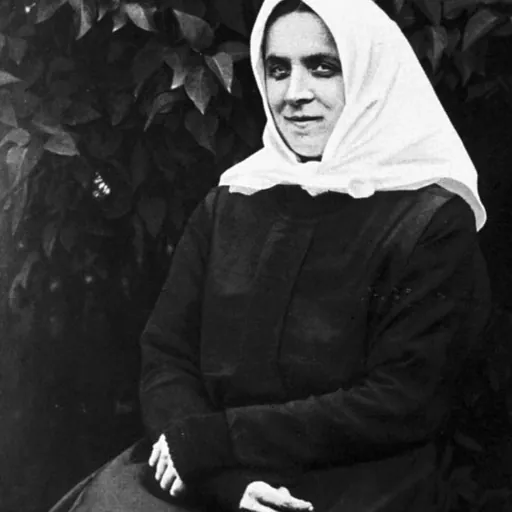
Therese Neumann
German mystic
About Therese Neumann
Lived 1898 – 1962 (aged 64). Therese Neumann was a German mystic and farmworker.
Therese Neumann (9 April 1898 – 18 September 1962) was a German Catholic mystic and stigmatic. Neumann has been considered a Servant of God by the Catholic Church since 2005.
She was born in the village of Konnersreuth in Bavaria, Germany, where she lived all her life. She was born into a large family with little income. She was a member of the Third Order of St. Francis.
Ailments On 11 March 1918, Therese Neumann was partially paralyzed after falling off a stool while attending to a fire in her uncle's barn. She sustained more falls and injuries during this period. After one particular fall she claimed to have lost much of her eyesight, and in 1919 she claimed to have been blinded completely. Bedridden, she reportedly developed horrible bed sores that sometimes exposed bone. According to skeptical investigator Joe Nickell, on one occasion Neumann claimed to have healed herself from blindness, but whilst "blind" she was examined and her pupils responded normally to light. Nickell suspected that Neumann's claims were performed by "hysterical hypochondria" or "outright fakery".
Stigmata
Therese would later apparently develop the stigmata. She said that on 5 March 1926, the first Friday of Lent, a wound had appeared slightly above her heart, but that she had kept this secret. However, she did report a vision of Jesus at Mount of Olives with three Apostles.
On Easter Sunday, she claimed a vision of the resurrection of Christ. For several consecutive Fridays after that, she stated she was experiencing the Passion of Christ, apparently suffering in her own body along with all his historic agonies. She claimed to have especially suffered the Passion on Good Friday each year.
Doctors directly observed the blood streaming from her wounds during her ecstasies, and confirmed that it was human blood by examining it under a microscope. H. W. Hynek concluded that "the evidence effectively disposes of any idea of fraud, and of any supposition that it is animal blood used in artificial wounds." Gottfried Ewald also conceded that they could not be explained by conscious fraud, and suggested that they may be caused by a poorly understood psychological mechanism. In a 2008 review article, Seidl agreed that the stigmata bled spontaneously and could not have been self-inflicted. Like Ewald, he suggested that they might be psychosomatic in origin.
On 22–23 March 1928, Neumann's stigmata claims were investigated at her home by a group of observers, including bishops and physicians. Professor Martini, the director of the University Hospital Bonn, observed Neumann and wrote a report about her stigmata. He found her behaviour suspicious, as the blood would only appear from her wounds when he was asked to leave the room.
Inedia
From 1923 until her death in 1962, Therese Neumann professed to have consumed no food other than Eucharist nor to have drunk any water from 1926 until her death.
Montague Summers, in his book The Physical Phenomena of Mysticism, speaks of her supposedly supernatural ability to survive for long periods without food or water.
In July 1927, Neumann's claims of inedia were examined at her house. She was physically examined and tested by the physician Otto Seidl and four Franciscan nurses, for fifteen days (July 14 to 28). Neumann was not observed to have eaten anything; however, suspicion was generated. At the beginning, she had weighed 121 pounds, which dropped during the test period to 112.5 pounds. By the last day, her weight had returned to normal. Historian Ian Wilson commented the evidence indicated that Neumann "went back to normal food and drink intake". The test was never repeated, and her family denied permission for any further tests.
Wilson found the inedia claims of Neumann suspicious. He noted that she "had a vigorous, stocky build throughout most of this time, and all reason tells us that it would be impossible to survive so long without food or drink."
Don’t just read it —
keep it.
Full-length biographies made to live with: read them, listen on the way to work, watch them tonight.
- E-book
- Audio
- Video
Instant download · yours to keep · every purchase keeps this site free
Important facts
People in Therese Neumann's life
Named in this biography and alive at the same time


Related people
Same field, nearest in time


Contemporaries
People whose lives overlapped Therese Neumann's



Frequently asked questions
Who was Therese Neumann?
German mystic (1898-1962)
When was Therese Neumann born?
Therese Neumann was born on 8 April 1898 in Konnersreuth.
When did Therese Neumann die?
Therese Neumann died on 18 September 1962 in Konnersreuth.
What was Therese Neumann's occupation?
Therese Neumann was a mystic and farmworker.
What nationality was Therese Neumann?
Therese Neumann was German.
Sources & further reading
Cite this page
APA: Biography.guide. (2026). Therese Neumann. https://biography.guide/therese-neumann/
MLA: "Therese Neumann." Biography.guide, https://biography.guide/therese-neumann/.
Chicago: "Therese Neumann." Biography.guide. https://biography.guide/therese-neumann/.
Data last updated: 2026-09-22 · Spot an error? Report a correction.
Portrait: Wikimedia Commons · author & licence
Page generated 2026-09-27 05:01 UTC