
About Theophilus Shepstone
Lived 1817 – 1893 (aged 76). Theophilus Shepstone was a British politician, functionary and diplomat.
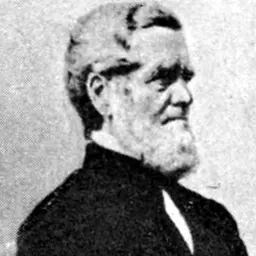
Sir Theophilus Shepstone (8 January 181723 June 1893) was a British South African statesman who was responsible for the annexation of the Transvaal to Britain in 1877.
Early life Theophilus Shepstone was born at Westbury-on-Trym near Bristol, England. When he was three years old his father, the Rev. William Theophilus Shepstone, emigrated to Cape Colony. Young Shepstone was educated at the native mission stations at which his father worked, and the boy acquired great proficiency in the indigenous languages of South Africa, a circumstance which determined his career. In the Xhosa War of 1835 he served as headquarters interpreter on the staff of the governor, Sir Benjamin d'Urban, and at the end of the campaign remained on the frontier as clerk to the agent for the local tribes.
Natal In 1838 he was one of the party sent from Cape Colony to occupy Port Natal on behalf of Britain. This force was recalled in 1839 when Shepstone was appointed British resident among the amaMfengu and other communities in Kaffraria. Here he remained until the definite establishment of British rule in Natal and its organisation as an administrative entity, when Shepstone was made (1845) Secretary for the Native Affairs. In 1848 he became captain-general of the native levies; in 1855 judicial assessor in native causes; and, in 1856, on the remodelling of the Natal government, secretary for native affairs and a member of the executive and legislative councils. This position he held until 1877. The main line of his policy was to maintain tribal customs as far as consistent with principles of humanity, and not to attempt to force the civilisation. The result of his policy remained traceable for some time in the condition and status of the Natal peoples. his rule was marked, according to Sir Bartle Frere, who described him as "a singular type of an Africander Talleyrand," by an "apparent absence of all effort to devise or substitute a better system" than that which had characterised the previous regime. Shepstone had been summoned home to advise the Colonial Office on South African affairs and he reached England in May 1879; on his return to Natal he retired (1880) from the public service. In 1883, however, he was commissioned to replace Cetshwayo as king in Zululand. He was active in church matters in Natal, and was, prior to the Langalibalele "rebellion", a close friend of Bishop Colenso. The two men, though, became estranged following Colenso's gradual realisation that Shepstone exerted a malign influence on Zulu affairs. Shepstone opposed the grant of self-government to Natal. He died at Pietermaritzburg on 23 June 1893.
Although Shepstone's life and work have at times been celebrated by Britons and South Africans, experts on the period such as South African historian Jeff Guy implicate him in building a conspiracy to promote the invasion of the Zulu kingdom and its dismemberment by forces from Natal and the Transvaal. His motive seems to have been both to fill the increasing demand for labour in Natal colony and to win back the friendship of the Transvaal government.
Family In 1833 Shepstone married Maria, daughter of Charles Palmer, commissary-general at Cape Town; they had six sons and three daughters. One of his sons, Captain George Shepstone, was killed at the Battle of Isandlwana; of the other sons H. C. Shepstone (born 1840) was secretary for native affairs in Natal from 1884 to 1893; Theophilus was adviser to the Swazis (1887–1891); and A. J. Shepstone (born 1852) served in various native expeditions, as assistant-commissioner in Zululand, in the South African War, 1899–1902, and became in 1909 secretary for native affairs (Natal) and secretary of the Natal native trust. A younger brother of Sir Theophilus, John Wesley Shepstone (born 1827), filled between 1846 and 1896 various offices in Natal in connection with the administration of native affairs.
Shepstone is the great-great-grandfather of international artist Conor Mccreedy.
Don’t just read it —
keep it.
Full-length biographies made to live with: read them, listen on the way to work, watch them tonight.
- E-book
- Audio
- Video
Instant download · yours to keep · every purchase keeps this site free
Important facts
People in Theophilus Shepstone's life
Named in this biography and alive at the same time



Related people
Same field, nearest in time





Contemporaries
People whose lives overlapped Theophilus Shepstone's





Frequently asked questions
Who was Theophilus Shepstone?
British South African statesman (1817-1893)
When was Theophilus Shepstone born?
Theophilus Shepstone was born on 8 January 1817 in Bristol.
When did Theophilus Shepstone die?
Theophilus Shepstone died on 23 June 1893 in Pietermaritzburg.
What was Theophilus Shepstone's occupation?
Theophilus Shepstone was a politician, functionary and diplomat.
What nationality was Theophilus Shepstone?
Theophilus Shepstone was British.
Sources & further reading
· Wikipedia: Theophilus Shepstone
· DBpedia: Theophilus Shepstone
Cite this page
APA: Biography.guide. (2026). Theophilus Shepstone. https://biography.guide/theophilus-shepstone/
MLA: "Theophilus Shepstone." Biography.guide, https://biography.guide/theophilus-shepstone/.
Chicago: "Theophilus Shepstone." Biography.guide. https://biography.guide/theophilus-shepstone/.
Data last updated: 2026-09-26 · Spot an error? Report a correction.
Page generated 2026-09-27 05:15 UTC