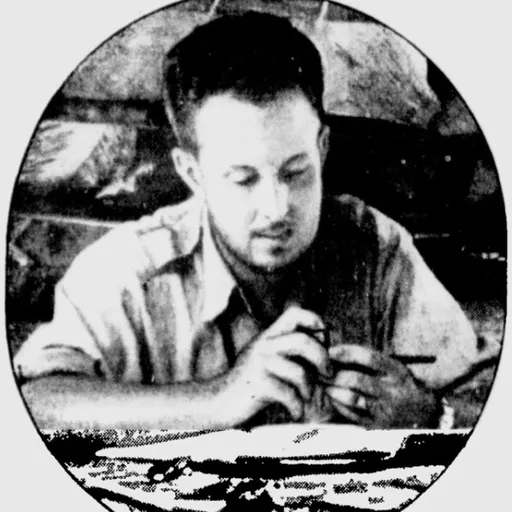
About Theodore A. Morde
Lived 1911 – 1954 (aged 43). Theodore A. Morde was an American explorer.
Theodore A. Morde (May 18, 1911 – June 26, 1954) was an American adventurer, explorer, diplomat, spy, journalist, and television news producer best known for his unverified claim of discovering the "Lost City of the Monkey God."
Morde began his career as a radio announcer before getting into journalism. In 1940, he was hired to lead an expedition to search for the "Lost City of the Monkey God" in Honduras. After five months, he claimed to have found the city and brought thousands of artifacts back to the United States to prove it. He promised to return soon for a proper excavation, but never did, nor did he reveal the precise location of his find.
Morde spent the later years of his life as a diplomat, and then a producer of news films. He killed himself in 1954. In 2013, Christopher S. Stewart wrote a book about Morde and his hunt for a legendary "lost city" that some have equated with la Ciudad Blanca. Douglas Preston's 2017 book The Lost City of the Monkey God shows that, based on Morde's own expedition journals, Morde never found any ruins and completely fabricated his story of having done so.
Early life Descended from whalers, Theodore A. Morde was born in New Bedford, Massachusetts on March 17, 1911. In addition to searching for the city, Morde's expedition sought to study the indigenous people of the region, further explore known archaeological sites, and chart the upper reaches of the Wampú River.
After four months, Morde and his colleague, Laurence C. Brown, emerged from the forest and sent news of a great find. "'City of the Monkey God' is believed located: Expedition reports success in Honduras expedition" read the headline in the New York Times. When they returned to the states, they brought thousands of artifacts to back their claim that they had found the lost city. They described their find as the capital of an agricultural civilization of the Chorotega people. Artifacts found included blades, a flute, sculptured idols, and stone utensils. Morde and Brown also reported seeing evidence of gold, silver, platinum, and oil in the region. According to Morde, flooding prevented formal excavation, but he planned to return in January 1941. He described "penetrating far into little known Mosquitia Territory" and warding off "malaria, deadly snakes, vicious insects and jungle beasts" before coming upon the ruins.
According to the stories Morde was told, the monkey god was once worshipped with human sacrifice by Chorotega people. He also described a "Dance of the Dead Monkeys," a still practiced "perverted memory of that old form of worship," according to Morde. as a Lieutenant, junior grade. After World War II, he served as a special adviser to the Egyptian Premier for the U.S. government, and as adviser to the Egyptian Ambassador in Washington, D.C. His death was ruled a suicide by the medical examiner. Conspiracy theorists later asserted sinister forces were behind his death. Some normally reliable sources written much later report that Morde had been run over by an automobile in London, England, "shortly" after his expedition to Honduras.
Legacy
Jungleland In 2013, journalist Christopher S. Stewart wrote a book titled Jungleland about the legend of la Ciudad Blanca and Morde. He went to Honduras and undertook an expedition with archaeologist Christopher Begley in 2008 where he attempted to retrace Morde's steps using his original field journals. Stewart interviewed Morde's surviving family members and provided an account of his life. In 2015 archeologists discovered a "lost city" in the region, thought to be associated with the civilization discovered by Morde. At the scientists' urging, the Honduran government dispatched army forces to protect the site from looters.
The Lost City of the Monkey God In his 2017 book The Lost City of the Monkey God, Douglas Preston states that Morde fabricated all of his claims about finding a lost city. Preston obtained copies of Morde's expedition journals from the National Geographic Society, which had in turn obtained the journals from Morde's family in 2016. The journals, written by Morde and Brown together, show that they never found any ruins, and indeed, they never searched for any in the first place. Their supposed archaeological expedition was actually a cover; the real purpose of the trip was to search for gold along the Río Blanco, nowhere near the reported location of the purported lost city. Their search for gold was a failure, and the men left the jungle after their supplies ran low and a storm destroyed their equipment. The artifacts the two men supposedly brought back from the lost city were acquired near Brewer's Lagoon after their return from the deep jungle.
The journals do not confirm whether the story about actually finding the fantastic lost city was pre-planned from the start or improvised after their failure to locate gold, although Preston indicates that he believes it was pre-planned. On June 17, 1940, the last day of the expedition, just before emerging from the jungle, Morde wrote, "We are convinced no great civilization ever existed up there. And there are no archaeological discoveries of importance to be made."
Don’t just read it —
keep it.
Full-length biographies made to live with: read them, listen on the way to work, watch them tonight.
- E-book
- Audio
- Video
Instant download · yours to keep · every purchase keeps this site free
Important facts
Related people
Same field, nearest in time




Contemporaries
People whose lives overlapped Theodore A. Morde's






Frequently asked questions
Who was Theodore A. Morde?
American ethnologist (1911–1954)
When was Theodore A. Morde born?
Theodore A. Morde was born on 17 March 1911 in New Bedford.
When did Theodore A. Morde die?
Theodore A. Morde died on 26 June 1954 in Dartmouth.
What was Theodore A. Morde's occupation?
Theodore A. Morde was an explorer.
What nationality was Theodore A. Morde?
Theodore A. Morde was American.
Sources & further reading
· Wikipedia: Theodore A. Morde
Cite this page
APA: Biography.guide. (2026). Theodore A. Morde. https://biography.guide/theodore-a-morde/
MLA: "Theodore A. Morde." Biography.guide, https://biography.guide/theodore-a-morde/.
Chicago: "Theodore A. Morde." Biography.guide. https://biography.guide/theodore-a-morde/.
Data last updated: 2026-09-22 · Spot an error? Report a correction.
Portrait: Wikimedia Commons · author & licence
Page generated 2026-09-27 05:01 UTC