About The Dogg
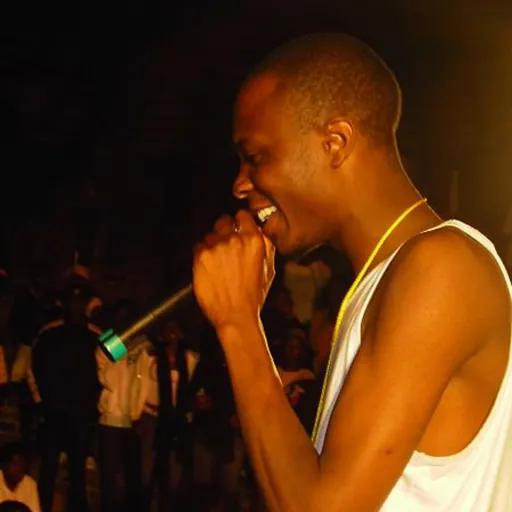
Born 1983. The Dogg is a Namibian musician and record producer.
Martin Morocky (born 31 March 1983), known by his stage name as The Dogg (or King TeeDee), is a Namibian musician. Considered a Kwaito artist, his debut album, Shimaliw' Osatana, was released in 2004 to mixed reviews. The Dogg was part of the group Omalaeti O'Swapo, which released one album in 2004. His music is enjoyed internationally, in countries such as South Africa, Botswana, Angola, Zambia, and Zimbabwe. The Dogg has performed in France, England, and Canada. He has received awards and nominations from Channel O. He is one of the highest-awarded artists in his country, as well as one of the highest-selling. As of 2022, King Tee Dee has about 11 albums, where most of his songs are on livestream.
The money earned through live performances, licenses, royalties, and awards has contributed significantly to King Tee Dee's net worth.
The Dogg is the owner of the Mshasho Productions record label and the associated Mshasho Clothing.
Early life The Dogg began his formal education at Onayena Primary School situated in Onayena, a village in east Ondangwa, where he has been living since returning from exile in Zambia, in 1989. Morocky is the youngest child of four siblings. His aspiration as a child was to become a mechanical engineer while music remained a dormant passion. In 1997, he moved to Windhoek City to attend his secondary education at Augustineum Secondary School in Khomasdal. After graduating from high school, Morocky chose to study for a Science degree at the University of Namibia. He left the university after one academic year to pursue a music career.
Musical career Rise to fame The Dogg used to perform at school concerts in his high school years. When he was in grade nine, he and long-time friend Joe Basson, now known as Auntie Sousa, created a kwaito dancing group called Amasilkies. Before pursuing a music career, he was a backup artist and a dancer and he also opened shows for his famous cousin Killa B and well-known friend Jossy Joss. Morocky also opened concerts for well-known South African artists, including Mzekezeke, Malaika, Mafikizolo, Mandoza, Brown Dash, Brickz, and Ishmael among others. He rose to fame following the release of his hit single "Jesus Otati", a kwaito-gospel song produced by Elvo in 2003.
"Jesus Otati" (meaning "Jesus is saying") opened doors for Morocky's career. The song was very popular and earned him comparison to South African kwaito star Mandoza due to the roughness in his voice, which was compared to that of Mandoza. His voice was also compared to American rapper DMX, who is also known as The Dog, from which Morocky possibly got his stage name. The success of "Jesus Otati" propelled The Dogg to win the award for Artist of the Year and Best Kwaito Song at the 2003 Sanlam-NBC Music Awards. The Dogg immediately started working on his debut album, releasing the critically acclaimed hit "Perfecto Tromentos" later that year. Around the same time, The Dogg was featured by Gazza on his hit "Shidolodolo", which went on to be very popular and won an award for Best Collaboration at the 2004 Sanlam-NBC Music Awards. The album was primarily produced by Elvo, who by then became The Dogg and Gazza's mentor.
Later that year in December, Morocky released his second studio album, Take Out Yo Gun. The album was released on his label Mshasho Productions. The lead single from the album, "The Dogg Is Back", won awards for Best Kwaito Song and Best Video at the 2005 Sanlam-NBC Music Awards. On the album, The Dogg also introduced his label's artists (OmPuff, Sunny Boy, Tre, and Nasti) who all appear on the album. The first single, "Baby Don't Go", won two awards at the 2006 Sanlam-NBC Music Awards, for Best Collaboration and Best Afro-pop. It also won Song of the Year and Best Single at the 2007 Sanlam-NBC Music Awards. The award ceremony was secretly held and never revealed who the winner was and denied nominating the rapper. The organizers made a controversial comment about who he was and from which country he was from. When asked about the issue, Dogg said it was funny to nominate a musician you do not know. The Dogg was chosen to be the first celebrity guest in the Big Brother Africa 4 house. He entered the house on Friday 16 (week 6 of the show) and left on Sunday 18. He also appeared the eviction show, performing "Forget" with Namibian singer Ricardo.
The Dogg released his sixth studio album, The Power of 7 – Elevating Elevators, on 30 April 2010. The album was criticized for its poor track listing and the ever-repeating sole production of The Dogg, which makes the album sound similar to its predecessors. In November of that year he announced that he was busy working on an album with rapper Qonja. The two rappers collaborated on a short album entitled Lets Celebrate, released on 16 December 2010 on Mshasho Records. Produced by The Dogg and Elvo, the album features the hits "Let's Celebrate" with TeQuila, "Be My Shepherd" with KK and Lil' D, and "Merry Christmas".
Mshasho released The Dogg's seventh studio album, The Deception, on 2 July. It was entirely produced by The Dogg and features big-name artists. It features South African Kwaito star Brickz on the song "Tromentos" and Zambian singer JK on the song "End of Time", and both songs feature Sunny Boy. Mshasho artist OmPuff also appeared on "End of Time".
The Dogg announced via his Facebook fan page that The Deception would shortly be followed by a part two album, also announcing the title of the upcoming album although not stating when it would be released: "MY NEW SINGLE FROM DECEPTION PART 2 WILL MUTE AFRICA ....PAKAMISH".
Producer role
Besides being a musician The Dogg is also an active music producer. He has produced hits for several famous Namibian artists. He started producing music in 2005 under the guidance of his mentor Elvo. He has so far shared production credits with Elvo, DJ Kboz, and Christian Poloni. He has produced and served as executive producer on all albums released under Mshasho Records. Additionally, he has produced hits for non-Mshasho artists, including Sunny Boy, Qonja, Kamasutra, Faizel MC, and Kavax. The Dogg served as the main producer on all of his solo albums since the 2006 release Introducing TeeDee.
"I've tried a few different things, like mixing some house and rave beats with traditional kwaito beats. I'm working on establishing my unique blend of music," says The Dogg in an interview with Mtc.com, in October 2007. Throughout his production career, he has collaborated with Elvo and DJ Kboz, the only two producers to have shared production credit with The Dogg.
Discography
Solo albums Shimaliw' Osatana – (2004), RC Ghetto Take Out Yo Gun – (2004), Mshasho Introducing TeeDee – (2006), Mshasho/KOOL Production You Can't Ignore – (2007), Mshasho/KOOL Production This Is My Time – (2009), Mshasho The Power of 7 – Elevating Elevators – (2010), Mshasho The Deception – (2011), Mshasho Live or Die – (2013), Mshasho Respect My Hustle (2015) Mshasho Concrete Jungle (2017) Mshasho
Other albums Omalaeti O'Swapo, (with Gazza, Elvo and Pablo) – (2004), Omalaeti Music
Don’t just read it —
keep it.
Full-length biographies made to live with: read them, listen on the way to work, watch them tonight.
- E-book
- Audio
- Video
Instant download · yours to keep · every purchase keeps this site free
Important facts
People in The Dogg's life
Named in this biography and alive at the same time




Related people
Same field, nearest in time




Contemporaries
People whose lives overlapped The Dogg's
Frequently asked questions
Who is The Dogg?
Namibian musician
When was The Dogg born?
The Dogg was born on 31 March 1983 in Maheba.
What is The Dogg's occupation?
The Dogg is a musician and record producer.
What nationality is The Dogg?
The Dogg is Namibian.
Sources & further reading
Cite this page
APA: Biography.guide. (2026). The Dogg. https://biography.guide/the-dogg/
MLA: "The Dogg." Biography.guide, https://biography.guide/the-dogg/.
Chicago: "The Dogg." Biography.guide. https://biography.guide/the-dogg/.
Data last updated: 2026-09-23 · Spot an error? Report a correction.
Portrait: Wikimedia Commons · author & licence
Page generated 2026-09-27 05:08 UTC