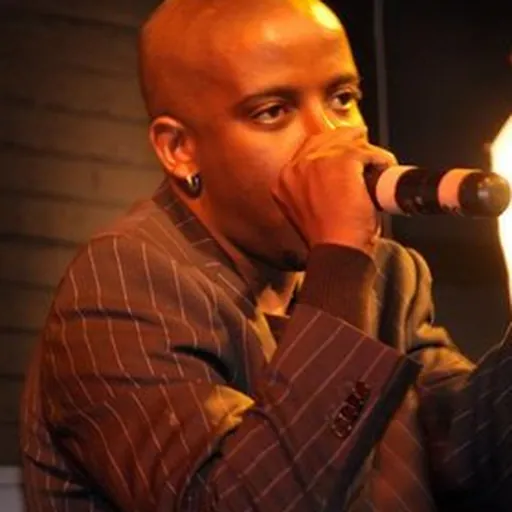
About Sunny Boy
Born 1983. Sunny Boy is a Namibian rapper, singer and songwriter.
Pendukeni Andreas Sunday Shipushu (born 13 March 1983), known as Sunny Boy, is a Namibian rapper from Ongwediva. He performs a brand of music known as hikwa, which he engineered by fusing hip hop and Kwaito. He rose to fame after collaborating with Gazza on his song "Koko" in 2004. He increased his buzz with his hit single "Balance" in 2005 when he signed with Mshasho Productions.
He is known for his socially conscious lyrics, story telling abilities and a complex flow. He has to date released seven albums from which he gained critical acclaim as a lyricist. Sunny runs his own record label Yaziza Entertainment. He is the former Ambassador of the Namibia Red Cross Society's for the youth.
Early life
Sunny Boy was born, Pendukeni Andreas Sunday Shipushu, in Oshakati, a town in northern Namibia, and grew up in its neighbouring Ongwediva. Since he was a small boy, he always wanted to make music that touched people's hearts. He used to sing and dance at school concerts. While in primary school, he and three other friends formed a dancing group called The Converse Boys, and with their Kwaito inspired moves, they entertained fellow students at social events. Even then, they dreamed of one day making it big in the music industry. However that dream was cut short by the untimely death of one of their group members. Production on the album was handled mainly by The Dogg, Elvo and DJ Kboz. Guest features includes The Dogg, Chipolopolo, Luvy, TeQuila and Kboz. The album was well received making it one of the best albums to be released under Mshasho Records. It was well crafted with lyrical structure which focus mostly on feel good and party themes. The song "Serious" is a motivational song. Videos were released for "Balance" and "Serious".
The song "Best of Both Worlds" performed by Faizel MC featuring The Dogg and Sunny Boy was added to the album as a bonus track.
His lyrical ability on the other hand placed him above all, and has influenced a lot of upcoming artists at the time, including Qonja among others. The two would later collaborate on "Fashion" from Qonja's Mdakadaka and "Yamkwanekamba" from Sunny's The Sleeping Giant.
(2006) Departing from Mshasho – Elai Lineendunge In September 2006, Sunny Boy left Mshasho Records, and launched his own record label, GreenHouse Entertainment (now Yaziza Entertainment). After financial issues and disappointments from his former manager Isak Nyambali, Sunny felt it was better to establish his own record label and be his own boss. An agreement was reached between him and The Dogg to revise his contract. He established GreenHouse Entertainment in 2006 (renamed; Yaziza Entertainment in 2008) which brought into the industry more of his hikwa style.
Upon its creation Sunny immediately started working on his second album, Elai Lineendunge. The album was released in December 2006 under GreenHouse Entertainment. The album is darker than his first, and feature more of his hikwa style music. It was approached with a different style from his last release. While Young, Black en Gifted focused more on feel good and party music, Elai Lineendunge focused more on story telling and wordplay. The album showcased Sunny Boy's lyrical ability distinguishing him from his colleagues in the industry.
The album feature guest appearance from The Dogg, OmPuff, Chipolopo, TeQuila, and Kamasutra. While production was handled by The Dogg, Elvo and Morgan.
The album holds the record of being the only, in Namibia to be nominated more than five times for seven categories at the 2007 Sanlam-NBC Music Awards. The Video of the album's most successful song "Summertime" was nominated for the 2008 Channel O Music Video Awards. Under Mercy's management Sunny Boy embarked on tours and started working on his fourth studio album. He would later appear on two songs from The Dogg's album The Deception, one of which features Brikz from South Africa and the other he appeared with OmPuff and JK from Zambia.
Controversies with Gazza Sunny Boy was first heard on Gazza's hit song "Koko" in 2004, which developed the duo into a good relationship. He refused to sign to Gazza's GMP Records. He then signed with The Dogg's Mshasho label same months later. Gazza explain the refusal as unfair and labelled Sunny a betrayal. Because he brought him into the game. As a protégé of The Dogg and member of the Mshasho label, Sunny Boy got more and more involved in the beef between The Dogg and Gazza, ironically known as "Mshasho vs. G.M.P.". He also exchanged verses with Gazza. He challenged Gazza on many of his songs. In 2008 he released a hip hop track titled "Intro" off his third album, where he called Gazza out. The song "Oyetu" also diss Gazza indirectly. In 2009, Gazza's crew StreetKids dissed Sunny on their song "Who's Fooling Who". Sunny replied through Chipolopolo's single titled "Mr She-Me" in which they make fun of Gazza and his girlfriend. The title of the song is also a mock of Gazza's surname Shiimi.
Musical style, rapping technique and influences Sunny Boy fused hip hop and Kwaito to create a sound he calls hikwa. Hikwa is composed of elements of both genres, although vocally it reflects more into hip hop. A lot of other artists has start to use this form of Kwaito to put more lyrics into their songs. Although Sunny Boy does not take credit for inventing the style, rapping in Kwaito has been used before by South African Kwaito artists such as Zola, Kabelo, Mandoza, Brown Dash and Brickz, however he was the first to populate it in Namibia.
Sunny Boy is also acclaimed for his complex rapping technique which includes the use of multisyllabic rhymes. He is well skilled with crafting intricate and intelligent rhymes. Sunny Boy also uses extended metaphor to elaborate his lyrics. His raps are mixed between three languages, (English, Afrikaans and Oshiwambo), of which he highly maintain the a story without losing its meaning. Another rapper who uses this technique is Qonja, but what set Sunny Boy aside is the ability to cohesively run back-and-forth between the three languages by telling the same story and bending words so that they rhyme.
Sunny Boy's draws most of his inspiration from hip hop. He named American rappers The Notorious B.I.G., Tupac Shakur, Jay-Z and Nas among others as his main influences. His voice pattern, flow and rhyme delivery is compared to that of Nas who is highly praised as one of hip hop's greatest poets. He also mentioned, Brickz and Brown Dash of South Africa as one of his influences.
Discography Young, Black en Gifted, (2005) Elai Lineendunge, (2006) The Sleeping Giant, (2008) Business and Pleasure, (2012) PASS The Hikwa, (2015) Ependafule, (2016)
Don’t just read it —
keep it.
Full-length biographies made to live with: read them, listen on the way to work, watch them tonight.
- E-book
- Audio
- Video
Instant download · yours to keep · every purchase keeps this site free
Important facts
People in Sunny Boy's life
Named in this biography and alive at the same time





Related people
Same field, nearest in time





Contemporaries
People whose lives overlapped Sunny Boy's



Frequently asked questions
Who is Sunny Boy?
Namibian rapper
When was Sunny Boy born?
Sunny Boy was born on 13 March 1983 in Oshakati.
What is Sunny Boy's occupation?
Sunny Boy is a rapper, singer and songwriter.
What nationality is Sunny Boy?
Sunny Boy is Namibian.
Sources & further reading
Cite this page
APA: Biography.guide. (2026). Sunny Boy. https://biography.guide/sunny-boy/
MLA: "Sunny Boy." Biography.guide, https://biography.guide/sunny-boy/.
Chicago: "Sunny Boy." Biography.guide. https://biography.guide/sunny-boy/.
Data last updated: 2026-09-23 · Spot an error? Report a correction.
Portrait: Wikimedia Commons · author & licence
Page generated 2026-09-27 05:07 UTC