
Thales
Ancient Greek philosopher and mathematician
About Thales
Lived 650 BC – 548 BC (aged 101–102). Thales was a mathematician, philosopher, astronomer, physicist, engineer and writer.
Thales of Miletus ( ; ; ) was a pre-Socratic Greek philosopher from Miletus in Ionia, Asia Minor. Thales was one of the Seven Sages, founding figures of Ancient Greece.
Beginning in eighteenth-century historiography, many came to regard him as the first philosopher in the Greek tradition, breaking from the prior use of mythology to explain the world and instead using natural philosophy. He is thus otherwise referred to as the first to have engaged in mathematics, science, and deductive reasoning.
Thales's view that all of nature is based on the existence of a single ultimate substance, which he theorized to be water, was widely influential among the philosophers of his time. Thales thought the Earth floated on water.
In mathematics, Thales is the namesake of Thales's theorem, and the intercept theorem can also be referred to as Thales's theorem. Thales was said to have calculated the heights of the pyramids and the distance of ships from the shore. In science, Thales was an astronomer who reportedly predicted the weather and a solar eclipse. The discovery of the position of the constellation Ursa Major is also attributed to Thales, as well as the timings of the solstices and equinoxes. He was also an engineer, known for having allowed the Lydian army to cross the Halys River. Plutarch wrote that "at that time, Thales alone had raised philosophy from mere speculation to practice."
Life
The main source concerning the details of Thales's life and career is the doxographer Diogenes Laërtius, in his third-century-AD work Lives and Opinions of the Eminent Philosophers. While it is all we have, Diogenes wrote some eight centuries after Thales's death and his sources often contained "unreliable or even fabricated information". It is known Thales was from Miletus, a mercantile city settled at the mouth of the Maeander River, near modern Didim, Turkey.
The dates of Thales's life are not exactly known, but are roughly established by a few datable events mentioned in the sources. According to the historian Herodotus, writing in the 5th century BC, Thales predicted a solar eclipse in 585 BC. Assuming one's acme (or floruit) occurred at the age of 40, the chronicle of Apollodorus of Athens, written during the 2nd century BC, therefore placed Thales's birth about the year 625 BC.
Ancestry and family
While the probability is that Thales was as Greek as most Milesians, Herodotus described Thales as "a Phoenician by remote descent". Diogenes Laërtius references Herodotus, Duris, and Democritus, who all agree "that Thales was the son of Examyas and Cleobulina, and belonged to the Thelidae who are Phoenicians and amongst the noblest descendants of Cadmus and Agenor" who had been banished from Phoenicia and that Thales was enrolled as a citizen in Miletus along with Neleus.
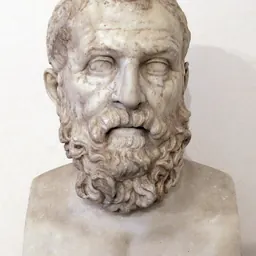
However, Friedrich Nietzsche and others interpret this quote as meaning only that his ancestors were seafaring Cadmeians from Boeotia. It is also possible that he was of mixed ancestry, given his father had a Carian name and his mother had a Greek name. Diogenes Laërtius seems to also reference an alternative account: "Most writers, however, represent him as a genuine Milesian and of a distinguished family". Encyclopedia Britannica (1952) concluded that Thales was most likely a native Milesian of noble birth and that he was certainly a Greek. Plutarch had earlier told this version: Solon visited Thales and asked him why he remained single; Thales answered that he did not like the idea of having to worry about children. Nevertheless, several years later, anxious for family, he adopted his nephew Cybisthus.
Travels The culture of Archaic Greece was heavily influenced by those of the Levant and Mesopotamia. It is said Thales was engaged in trade and visited either Egypt or Babylonia. However, there is no strong evidence that Thales ever visited countries in the Near East, and the issue is disputed among scholars. Visits to such places were a commonplace attribution to various philosophers by later writers, especially when these writers tried to explain the origin of their mathematical knowledge, such as with Thales or Pythagoras or Eudoxus. It is considered possible that Thales visited Egypt, since Miletus had a permanent colony there (namely Naucratis). It is also said Thales had close contacts with the priests of Thebes who instructed him, or even that he instructed them in geometry. It is also possible Thales knew about Egypt from accounts of others, without actually visiting it.
Babylon Aside from Egypt, the other mathematically advanced, ancient civilization before the Greeks was Babylonia, another commonplace attribution of travel for a mathematically-minded philosopher.
Historians Roger L. Cooke and B.L. Van der Waerden come down on the side of Babylonian mathematics influencing the Greeks, citing the use of e. g. the sexagesimal system (or base 60). Herodotus also wrote that the practice of dividing the day into 12 parts, and the polos, came to the Greeks from the Babylonians. Yet this too is disputed, for example by historian L. Zhmud, who points out the gnomon was known to both Egyptians and Babylonians, the division of the day into twelve parts (and by analogy the year) was known to the Egyptians already in the 2nd millennium BC, and the idea of the polos was not used outside of Greece at this time.
Sagacity
Thales is recognized as one of the Seven Sages of Greece, semi-legendary wise statesmen and founding figures of Ancient Greece. While which seven one chooses may change, the seven has a canonical four which includes Thales, Solon of Athens, Pittacus of Mytilene, and Bias of Priene. Diogenes Laërtius tells us that the Seven Sages were created in the archonship of Damasius at Athens about 582 BC and that Thales was the first sage.
The sages were associated with the Delphic maxims, a quote or maxim attributed to each one inscribed on the Temple of Apollo at Delphi. Thales has arguably the most famous of all, gnothi seauton or know thyself. According to the 10th-century Byzantine encyclopedia the Suda, the proverb is both "applied to those whose boasts exceed what they are" and "a warning to pay no attention to the opinion of the multitude."
Golden tripod Diogenes Laërtius relates several stories of an expensive, gold tripod or bowl that is to go to the most wise. In one version (that Laërtius credits to Callimachus in his Iambics) Bathycles of Arcadia states in his will that an expensive bowl should be given to him who had done most good by his wisdom.' So it was given to Thales, went the round of all the sages, and came back to Thales again. And he sent it to Apollo at Didyma, with this dedication...'Thales the Milesian, son of Examyas [dedicates this] to Delphinian Apollo after twice winning the prize from all the Greeks.
Diplomacy According to Diogenes Laërtius, Thales gained fame as a counselor when he advised the Milesians not to engage in a symmachia, a "fighting together", with the Lydians. This has sometimes been interpreted as an alliance.
Croesus was defeated before the city of Sardis by Cyrus the Great, who subsequently spared Miletus because it had taken no action. Cyrus was so impressed by Croesus’ wisdom and his connection with the sages that he spared him and took his advice on various matters. The Ionian cities should be demoi, or "districts".
He counselled them to establish a single seat of government, and pointed out Teos as the fittest place for it; "for that," he said, "was the centre of Ionia. Their other cities might still continue to enjoy their own laws, just as if they were independent states." logos rather than mythos.
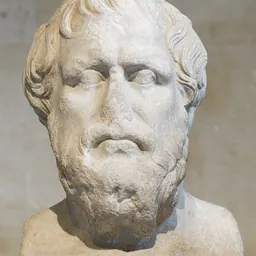
Aristotle advocated the view that Thales was the first natural philosopher (physiologoi), although this position was typically not adopted among other writers, even those within Aristotle's Peripatetic school, until the view became more prominent among eighteenth-century historians. Also, while the other Seven Sages were strictly law-givers and statesmen and not speculative philosophers, Plutarch noted "it would seem that Thales was the only wise man of the time who carried his speculations beyond the realm of the practical."
Water as the arche
Thales's most famous idea was his philosophical and cosmological thesis that all is water, which comes down to us through a passage from Aristotle's Metaphysics.
According to Aristotle: Feldman notes "The social significance of water in the time of Thales induced him to discern through hardware and dry-goods, through soil and sperm, blood, sweat and tears, one fundamental fluid stuff...water, the most commonplace and powerful material known to him."
Mathematics
Thales was known for introducing the theoretical and practical use of geometry to Greece, and has been described as the first person in the Western world to apply deductive reasoning to geometry, making him the West's "first mathematician". He is also credited with the West's oldest definition of number: a "collection of units", "following the Egyptian view".
The evidence for the primacy of Thales comes to us from a book by Proclus, who lived a thousand years afterward but is believed to have had a copy of Eudemus's lost book History of Geometry (4th century BC). According to Plutarch, it pleased the pharaoh Amasis. More practically, Thales was said to have the ability to measure the distances of ships at sea.
These stories indicate familiarity with the intercept theorem, and for this reason the 26th proposition in the first book of Euclid's Elements was attributed to Thales. They also indicate that he was familiar with the Egyptian seked, or seqed, the ratio of the run to the rise of a slope (cotangent). According to Kirk & Raven,
Astronomy
Thales was also a noted astronomer, acknowledged in antiquity for describing the position of Ursa Minor, and he thought the constellation might be useful as a guide for navigation at sea. He calculated the duration of the year and the timings of the equinoxes and solstices. He is additionally attributed with calculating the position of the Pleiades. While some say he left no writings, others say that he wrote On the Solstice and On the Equinox. The Nautical Star-guide has also been attributed to him, but this was disputed even in ancient times.
Cosmological model
Thales thought the Earth must be a flat disk or mound of land and dirt which is floating in an expanse of water. Heraclitus Homericus states that Thales drew his conclusion from seeing moist substance turn into air, slime and earth. It seems likely that Thales viewed the land as coming from the water on which it floated and the oceans that surround it, perhaps inspired by observing silt deposits.
He thought the stars were balls of earth on fire. He seemed to correctly gather that the moon reflects the Sun's light. A crater on the Moon is named in his honor.
Meteorology Rather than assuming that earthquakes were the result of supernatural whims, Thales explained them by theorizing that the Earth floats on water and that earthquakes occur when the Earth is rocked by waves. According to Seneca, Thales explained the flooding of the Nile as due to the river being beaten back by the etesian wind.
Olive presses
An olive mill and an olive press dating from Roman times in Capernaum, Israel.
A story from Aristotle recounts how Thales achieved riches from an olive harvest by prediction of the weather. One winter, Thales reserved all the olive presses in Miletus after predicting the weather and that there was a good harvest coming up. He was then able to rent them out at a high price when demand peaked in the subsequent bumper crop. This constitutes the first historically known creation and use of futures or options (on usage of olive press), depending on whether Thales's reservations obligated or allowed (respectively) him to rent the presses during harvesttime.
Aristotle explains that Thales's objective in doing this was not to enrich himself but to prove to his fellow Milesians that philosophy could be useful, contrary to what they thought, thus disproving the taunts that philosophy was useless. He had answered the proverbial charge "If you're so smart, why ain't you rich?". Aristotle also notes that cornering the market to achieve monopoly pricing is a general strategy for achieving wealth that does not rely on great wisdom or powers of prediction.
Prediction of solar eclipse
As mentioned above, according to Herodotus, Thales predicted a solar eclipse which occurred during a battle between the Lydians and the Medes.
Herodotus writes that in the sixth year of the war, the Lydians under King Alyattes and the Medes under Cyaxares were engaged in an indecisive battle when suddenly day turned into night, leading to both parties halting the fighting and negotiating a peace agreement. Herodotus also mentions that the loss of daylight had been predicted by Thales. He does not, however, mention the location of the battle.
However, based on the list of Median kings and the duration of their reign reported elsewhere by Herodotus, Cyaxares died 10 years before the eclipse.
D. R. Dicks joins other historians (F. Martini, J. L. E. Dreyer, O. Neugebauer) in rejecting the historicity of the eclipse story.
Falling into a well
Plato, Diogenes Laertius, and Hippolytus all relay the story that Thales was so intent upon watching the stars that he failed to watch where he was walking, and fell into a well.
"Thales was studying the stars and gazing into the sky, when he fell into a well, and a jolly and witty Thracian servant girl made fun of him, saying that he was crazy to know about what was up in the heavens while he could not see what was in front of him beneath his feet."
Engineering
In addition to astronomy, Thales involved himself in other practical applications of mathematics, including engineering. Another story by Herodotus is that Croesus sent his army to the Persian territory. He was stopped by the river Halys, then unbridged. Thales then got the army across the river by digging a diversion upstream so as to reduce the flow, making it possible to cross the river. While Herodotus reported that most of his fellow Greeks believe that Thales did divert the river Halys to assist King Croesus' military endeavors, he himself finds it doubtful.
Divinity
According to Aristotle, Thales thought "all things are full of gods", i.e. lodestones had souls because iron is attracted to them (by the force of magnetism). The same applied to amber for its capacity to generate static electricity. The reasoning for such hylozoism or organicism seems to be if something moved, then it was alive, and if it was alive, then it must have a soul.
As well as gods seen in the movement caused by what came to be known as magnetism and electricity, it seems Thales also had a supreme God which structured the universe:
According to Henry Fielding (1775), Diogenes Laërtius (1.35) affirmed that Thales posed "the independent pre-existence of God from all eternity, stating "that God was the oldest of all beings, for he existed without a previous cause even in the way of generation; that the world was the most beautiful of all things; for it was created by God."
Nicholas Molinari has recently argued that Thales was influenced by the archaic water deity Acheloios, who was equated with water and worshipped in Miletus during Thales's life. For evidence, he points to the fact that hydor meant specifically "fresh water", and also that Acheloios was seen as a shape-shifter in myth and art, so able to become anything. He also points out that the rivers of the world were seen as the "sinews of Acheloios" in antiquity, and this multiplicity of deities is reflected in Thales's idea that "all things are full of gods."
Death and legacy Diogenes Laërtius quotes Apollodorus as saying that Thales died at the age of 78 during the 58th Olympiad (548–545 BC) and attributes his death to heat stroke and thirst while watching the games.
Influence
Thales had a profound influence on other Greek thinkers and therefore on Western history. However, due to the scarcity of sources concerning Thales and the discrepancies between the accounts given in the sources that have survived, there is a scholarly debate over the extent of the influence Thales had and on which of the Greek philosophers and mathematicians that came after him.
The first three philosophers in the Western tradition were all cosmologists from Miletus, and Thales was the very first, followed by Anaximander, who was followed in turn by Anaximenes. They have been dubbed the Milesian school. According to the Suda, Thales had been the "teacher and kinsman" of Anaximander. Rather than water, Anaximander held all was made of apeiron or the unlimited; while Anaximenes, the successor of Anaximander, perhaps more like Thales with water, held that everything was composed of air.
John Burnet (1892) noted
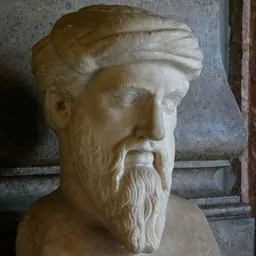
As two of the first Greek mathematicians, Thales is also considered an influence on Pythagoras. According to Iamblichus, Pythagoras "had benefited by the instruction of Thales in many respects, but his greatest lesson had been to learn the value of saving time." Early sources report that Pythagoras, in this story a pupil of Anaximander, visited Thales as a young man, and that Thales advised him to travel to Egypt to further his philosophical and mathematical studies.
Thales was also considered the teacher of the astronomer Mandrolytus of Priene. It is possible he was also the teacher of Cleostratus of Tenedos.
Don’t just read it —
keep it.
Full-length biographies made to live with: read them, listen on the way to work, watch them tonight.
- E-book
- Audio
- Video
Instant download · yours to keep · every purchase keeps this site free
Important facts
People in Thales's life
Named in this biography and alive at the same time


Related people
Same field, nearest in time




Contemporaries
People whose lives overlapped Thales's

Frequently asked questions
Who was Thales?
ancient Greek philosopher and mathematician
When was Thales born?
Thales was born in 650 BC in Miletus.
When did Thales die?
Thales died in 548 BC in Miletus.
What was Thales's occupation?
Thales was a mathematician, philosopher, astronomer, physicist, engineer and writer.
Sources & further reading
Cite this page
APA: Biography.guide. (2026). Thales. https://biography.guide/thales/
MLA: "Thales." Biography.guide, https://biography.guide/thales/.
Chicago: "Thales." Biography.guide. https://biography.guide/thales/.
Data last updated: 2026-09-26 · Spot an error? Report a correction.
Page generated 2026-09-27 05:15 UTC