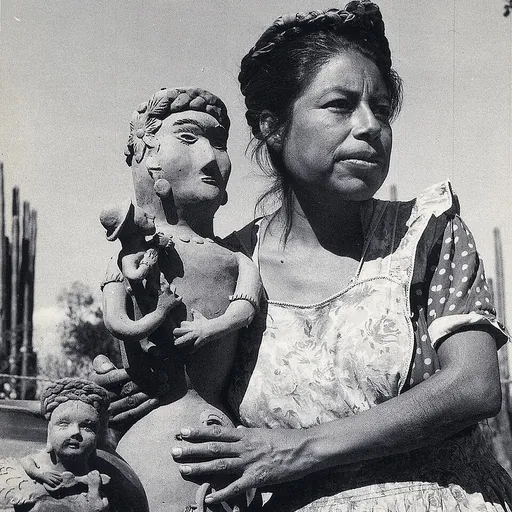
About Teodora Blanco Núñez
Lived 1928 – 1980 (aged 52). Teodora Blanco Núñez was a Mexican painter.
Teodora Blanco Núñez (February 28, 1928 – December 23, 1980) was an artisan in Santa María Atzompa, Oaxaca, Mexico who created her own style of decorative ceramics that influence the potters of her generation and those after in the region. The traditional ceramic of Atzompa has a green glaze, but that of Blanco Núñez is of natural beige and/or a reddish color from the clay. Instead, her work is distinguished by the creation of female and fantasy figures, profusely decorated with finely shaped bits of clay that are placed over the main body. It has since been imitated and reinterpreted by others in the region including various members of her own family, some of whom still work in the family compound that she lived and worked in.
Life and family
Blanco Núñez was born in Santa María Atzompa, a town where pottery-making is dominated by women. The town is known for its green glazed pottery (loza verde) as well as the making of Chia Pet animals, the most traditional being deer. These are traditionally made and the chia seed grown in come for Holy Week to be placed on altars. Her indigenous heritage is Mixtec, and worked with clay all her life, following the footsteps of her parents, who mostly made ashtrays, figures of monkeys called machines and small figures of musicians. She began when she was about six and soon her decorative elements on ashtrays stood out.
As she developed her ceramic work and it became known, she became relatively famous and wealthy for rural Oaxaca standards, able to send her sons to the city of Oaxaca for their education. However, she remained on the same land that she bought with her husband, Antonio Garcia Reyes, before she became famous but used the money she earned to build on the property and buy farm animals.
She has been described as having a “witty and forceful with charm and presence”
Teodora’s tradition of creating female figures and a decorative style called pastillaje has become traditional for the Blanco family, carried on also by her brother, sister and a number of her grandchildren. Her fantasy figures include humans with animal heads or horns and women nursing animals. This work reflects traditional beliefs, especially in nahuals which in her region have both a positive and negative relationship with humans. One such figure is a very large piece at the Casa de Cultura in Atzompa, a goddess of fertility figure, designated as such by eighteen breasts and the goddess’s many sons climb over her and an image of the moon is above the scene. Anthropomorphic figures and elements were almost always female, with exceptions such as archangels and king figures for nativity scenes.
Working in a windowless workshop, all of her pieces were created with rudimentary tools and materials: clay, water, a “turntable” consisting of a plate resting on an inverted bowl, a strip of newspaper or leather, a thorn (chaquixtle) and a flat piece of metal. The clay was brought from nearby Cacaotepec and was mixed with sand as a temper and strained through a fine mesh screen. As it is worked, it is black, but firing turns it beige with a red tinge.
She began her figures by making the body, which started out as a lump of clay formed into an elongated cup and further extended with coils of clay. The head was extended from the top of the body. Smoothing and detailing was done with her fingers constantly dipped in water and later by scraping with a piece of metal. After the main aspects of the piece were done, it generally sat for two days before she began to apply the pastillaje and extra elements. The reason for this is to let the body harden enough to support the weight of the new elements. The eyes were formed by very thinly rolled bits of clay, whose ends are placed together into an almond shape, giving them and Asian look. They were spaced far apart. These and other pastillaje elements were gently patted on by hand or if they were added using the thorn. The thorn was also use to inscribe even more delicate indentations into the work such as eyelashes. The large pieces with elaborate embellishments took her between two and three weeks to complete before firing. She signed her work with her initials and complained that others copied her work including her signature. She worked with two kilns, one larger than the other and heated them with ocote wood. The fire was lit in a separate space below, with pieces to be fired laid carefully in the upper chamber, using pieces of broken pottery to stabilize them. After firing the pieces are finished. Blanco rarely applied color to her pieces, and when she did, it was a red clay slip for contrast with the natural beige color.
Don’t just read it —
keep it.
Full-length biographies made to live with: read them, listen on the way to work, watch them tonight.
- E-book
- Audio
- Video
Instant download · yours to keep · every purchase keeps this site free
Important facts
Related people
Same field, nearest in time

Contemporaries
People whose lives overlapped Teodora Blanco Núñez's




Frequently asked questions
Who was Teodora Blanco Núñez?
Mexican artist
When was Teodora Blanco Núñez born?
Teodora Blanco Núñez was born on 28 February 1928 in Santa María Atzompa Municipality.
When did Teodora Blanco Núñez die?
Teodora Blanco Núñez died on 23 December 1980 in Mexico.
What was Teodora Blanco Núñez's occupation?
Teodora Blanco Núñez was a painter.
What nationality was Teodora Blanco Núñez?
Teodora Blanco Núñez was Mexican.
Sources & further reading
· Wikipedia: Teodora Blanco Núñez
· DBpedia: Teodora Blanco Núñez
Cite this page
APA: Biography.guide. (2026). Teodora Blanco Núñez. https://biography.guide/teodora-blanco-nunez/
MLA: "Teodora Blanco Núñez." Biography.guide, https://biography.guide/teodora-blanco-nunez/.
Chicago: "Teodora Blanco Núñez." Biography.guide. https://biography.guide/teodora-blanco-nunez/.
Data last updated: 2026-09-23 · Spot an error? Report a correction.
Portrait: Wikimedia Commons · author & licence
Page generated 2026-09-27 05:06 UTC