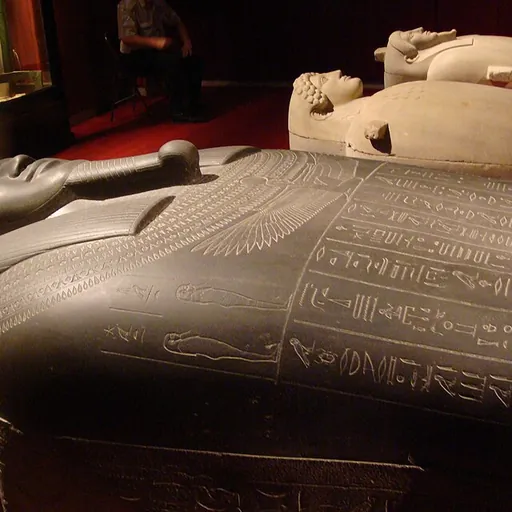
Tennes
4th-century BC Phoenician king of Sidon
About Tennes
Lived 400 BC – 345 BC.
Coin of Tennes. Tennes can be seen walking behind the Achaemenid king on his carriage. Tennes (; Tabnit II in the Phoenician language ) was a King of Sidon under the Achaemenid Empire, who ruled the Phoenician city-state of Sidon from , having been associated in power by his father since the 380s. It remains uncertain whether his known heir and successor, Tennes, was his son or some other close relative. His predecessor was Abdashtart I (in Greek, Straton I), the son of Baalshillem II
Rebellion of Sidon against the Achaemenid Empire Soon after the failure of the Egyptian campaign of the Achaemenid ruler Artaxerxes III, the Phoenicians declared their independence from Persian rule. This was also followed by rulers of Anatolia and Cyprus. Artaxerxes initiated a counter-offensive against Sidon by commanding the satrap of Syria Belesys and Mazaeus, the satrap of Cilicia, to invade the city and to keep the Phoenicians in check. Both satraps suffered crushing defeats at the hands of Tennes, who was aided by 4,000 Greek mercenaries sent to him by Nectanebo II and commanded by Mentor of Rhodes. As a result, the Persian forces were driven out of Phoenicia.
After this, Artaxerxes personally led an army of 330,000 men against Sidon. Artaxerxes' army comprised 300,000 foot soldiers, 30,000 cavalry, 300 triremes, and 500 transports or provision ships. After gathering this army, he sought assistance from the Greeks. Though refused aid by Athens and Sparta, he succeeded in obtaining a thousand Theban heavily armed hoplites under Lacrates, three thousand Argives under Nicostratus, and six thousand Æolians, Ionians, and Dorians from the Greek cities of Anatolia. This Greek support was numerically small, amounting to no more than 10,000 men, but it formed, together with the Greek mercenaries from Egypt who went over to him afterwards, the force on which he placed his chief reliance, and to which the ultimate success of his expedition was mainly due.
The approach of Artaxerxes sufficiently weakened the resolution of Tennes that he endeavoured to purchase his own pardon by delivering up 100 principal citizens of Sidon into the hands of the Persian king, and then admitting Artaxerxes within the defences of the town. Artaxerxes had the 100 citizens transfixed with javelins, and when 500 more came out as supplicants to seek his mercy, Artaxerxes consigned them to the same fate. Sidon was then burnt to the ground, either by Artaxerxes or by the Sidonian citizens. Forty thousand people died in the conflagration.
Tennes was put to death by Artaxerxes III in 346-345 BC. Artaxerxes later sent Jews who supported the revolt to Hyrcania, on the south coast of the Caspian Sea.
Don’t just read it —
keep it.
Full-length biographies made to live with: read them, listen on the way to work, watch them tonight.
- E-book
- Audio
- Video
Instant download · yours to keep · every purchase keeps this site free
Important facts
People in Tennes's life
Named in this biography and alive at the same time

Contemporaries
People whose lives overlapped Tennes's




Frequently asked questions
Who was Tennes?
4th-century BC Phoenician king of Sidon
When was Tennes born?
Tennes was born in 400 BC.
When did Tennes die?
Tennes died in 345 BC.
Sources & further reading
Cite this page
APA: Biography.guide. (2026). Tennes. https://biography.guide/tennes/
MLA: "Tennes." Biography.guide, https://biography.guide/tennes/.
Chicago: "Tennes." Biography.guide. https://biography.guide/tennes/.
Data last updated: 2026-09-23 · Spot an error? Report a correction.
Portrait: Wikimedia Commons · author & licence
Page generated 2026-09-27 05:04 UTC