About Teimuraz I of Kakheti
Lived 1589 – 1663 (aged 73–74). Teimuraz I of Kakheti was a Georgian poet.
Early life Teimuraz was the son of David I of Kakheti by his wife Ketevan (née Bagrationi-Mukhraneli). Kakheti, the easternmost Georgian polity that emerged after the fragmentation of the Kingdom of Georgia in the late 15th century, was within the sphere of influence of the Safavid dynasty of Iran. Until the early years of the 17th century, the kings of Kakheti had maintained peaceful relations with their Iranian suzerains, but their independent foreign policy and diplomacy with the Tsardom of Russia had long irked the shahs of Iran.
He returned home in 1606, after Christian Kakhetians, rallied by Teimuraz's mother Ketevan, revolted and overthrew their Muslim king, Constantine I, who had killed his own father, King Alexander II of Kakheti, in an Iranian-sponsored coup. The nobles of Kakheti requested that Shah Abbas I confirmed Teimuraz, who was Alexander II's grandson, on the throne. Abbas, frustrated by the rebellion and preoccupied with his new war with the Ottoman Empire, acceded to the Kakhetians' demand. Teimuraz was crowned King of Kakheti and began a long and difficult reign in conflict with his Safavid overlords.
Since the new monarch was still underage, Queen Ketevan temporarily assumed the function of a regent and arranged, in 1606, Teimuraz's marriage to Princess Ana Gurieli, daughter of Mamia II Gurieli, Prince of Guria on Georgia's Black Sea coast. In 1610, Ana died of a throat tumor and Teimuraz remarried, with Shah Abbas's encouragement, Khoreshan of Kartli, sister of Luarsab II, Kakheti's western neighbor, while the Shah himself married Teimuraz's sister Helene.
Iranian invasion
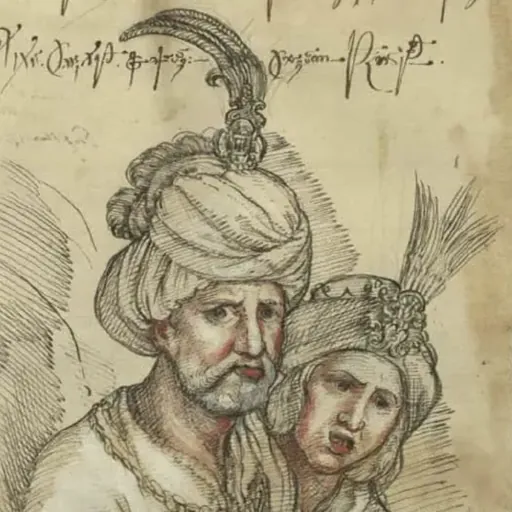
Teimuraz I, prepared for battle. A sketch from the album of the contemporaneous missionary Cristoforo Castelli. As the Safavid-Ottoman war drew to its close, Abbas I renewed efforts to bring Georgia more completely into his empire. His relations with Teimuraz I quickly deteriorated after the king of Kakheti turned down the shah's summons to Isfahan. Teimuraz, threatened with an Iranian invasion, attempted to buy peace by sending his two sons, Levan and Alexander, and his mother Ketevan as honorary hostages to the shah's court in 1613. This move, however, failed to relieve pressures on Kakheti.
Once the hostilities with the Ottomans had ceased momentarily in 1614 with the Iranian army at its acme, Abbas I sent in his troops against the Georgian kingdoms. This time he was aided by the Georgian nobleman, Giorgi Saakadze, an able fighter who had formerly enjoyed much influence in the service of Luarsab II of Kartli until a threat to his life had led him to defect to the shah. The Iranians drove both Teimuraz and Luarsab from their realms into the western Georgian Kingdom of Imereti, and Abbas I replaced them with Georgian converts to Islam. Bagrat VII was installed in Kartli, while Kakheti was given to Teimuraz's cousin Isa Khan. George III of Imereti, under the Ottoman protection, refused to give up the refugees and the shah retaliated by giving Kartli and Kakheti over to his troops for pillage. Then Luarsab chose to surrender, but rejected the shah's request to renounce Christianity. Abbas exiled him to Iran and had him strangled at Shiraz in 1622.
Rebel king
Teimuraz continued to seek and exploit Russian and Ottoman aid against Iran and remained a rallying point for opposition to the Safavids, encouraging his subjects to reject a Muslim replacement for him. Shah Abbas took revenge by torturing to death the king's mother, Ketevan, on September 13, 1624, and castrating his sons, Levan and Alexander.
The Georgian nobility, however, soon divided into two opposing camps. On one side stood Saakadze and his followers who objected to Teimuraz's control of Kartli and intended to invite the Imeretian prince Alexander (the future King Alexander III of Imereti) as a new king. On the other, Teimuraz and his loyal Kakhetian party who gained an influential supporter in Saakadze's brother-in-law and erstwhile associate Zurab, eristavi ("duke") of Aragvi. Shah Abbas I, suspicious of Saakadze's diplomacy with the Ottomans, also encouraged Teimuraz to deal a final blow to the ambitious general. Later in 1626, the rivalry among the Georgian leaders culminated in the Battle of Bazaleti in which the royal army won a decisive victory, driving Saakadze into exile to Constantinople where he was put to death in 1629 after serving a brief military career under Sultan Ibrahim I.
After the defeat of Saakadze and the death of Shah Abbas I in 1629, Teimuraz proceeded to strengthen his authority in eastern Georgia. He instigated Zurab of Aragvi to murder Semayun Khan, an Iranian-appointed rival king of Kartli in 1630, and then had Zurab assassinated, thereby getting rid of them both. By the early 1630s, Teimuraz I had gained more or less stable control of both Kartli and Kakheti. Determined to eliminate the Safavid hegemony over Georgia, Teimuraz sent his ambassador, Niciphores Irbachi, to Western Europe and requested the aid from Philip IV of Spain and Pope Urban VIII. However, the rulers of Europe were too involved in the Thirty Years' War (1618–1648) to be concerned about the fate of a small Caucasian kingdom, and nothing came of this mission, the publication of the first Georgian printed book Dittionario giorgiano e italiano ("Georgian-Italian Dictionary"; Rome, 1629) by Stefano Paolini and Niciphores Irbachi being the only result of this embassy.
End of reign Meanwhile, Teimuraz relations with the new Iranian shah, Safi, progressively deteriorated. In 1631, Teimuraz avenged the mountainous tribes of Dagestan for having joined Shah Abbas in the destruction of Kakheti, and devastated several of their settlements (auls). In 1633, he gave shelter to his brother-in-law Daud Khan, the Iranian governor (beglarbeg) of Ganja and Karabakh of Georgian extraction, who had fled Shah Safi's crackdown on the family of his brother Imam Quli Khan, the influential governor of Fars, Lar and Bahrain. Teimuraz refused to surrender the fugitive, and, fully appreciating the consequences of this refusal, gathered his forces in haste. Shah Safi retaliated by declaring Teimuraz deposed and replacing him with his favorite, a Muslim Georgian prince Khosro Mirza (Rostom), who had played an important role in consolidating Safi's hold of power after Shah Abbas's death.
Rostom and his fellow Georgian in the Safavid service, Rostam Khan, led the Iranian army into Georgia and took control of Kartli and Kakheti in 1633. Teimuraz escaped into yet another exile to Imereti, but re-established himself in Kakheti in 1634. In 1638, through Rostom's mediation, Teimuraz was pardoned and reconfirmed as king of Kakheti by the shah. He resumed his quest for alliance with Russia, however, and took an oath of allegiance to Tsar Michael on April 23, 1639, but the Russian protectorate never materialized in practice.
In 1641, Teimuraz, who was intent upon uniting all of eastern Georgia under his rule, backed a nobles' conspiracy against Rostom, which finally ruined his relations with the ruler of Kartli. The plot collapsed and the king of Kakheti, who had already advanced with his troops to the walls of Tbilisi, Rostom's capital, had to withdraw. In 1648, Rostom, joined by an Iranian force, marched against Kakheti and routed Teimuraz's army at Magharo. Having lost his last surviving son, David, on the battlefield, Teimuraz fled to Imereti whence he endeavored to regain the crown with the Russian aid. He sent his grandson, Heraclius, to Moscow in 1653, and personally visited Tsar Alexis of Russia in June 1658.
In the meantime, Rostom's willingness to cooperate with his Safavid suzerains won for Kartli a large measure of autonomy and relative peace and prosperity. However, the nobles and the populace of Kakheti continued to rally around the exiled Teimuraz in the hope of ending their subjection to Iran. In order to end resistance in Kakheti once and for all, Shah Abbas II revived a plan to populate the country with the Turkic nomads, a measure that incited a general uprising in 1659. The rebels succeeded in expelling the nomads but still had to grudgingly accept the shah's suzerainty.
Unable to garner the Russian support for his cause, Teimuraz concluded that the prospects for recovering the crown were nil and returned to Imereti to retire to a monastery in 1661, the same year when Rostom's successor to the throne of Kartli, Vakhtang V, crossed into western Georgia to enthrone his son, Archil II, as king of Imereti. Vakhtang V sent Teimuraz to Isfahan and the old Georgian ex-monarch was honorably received by Abbas II, but cast into prison when his grandson Heraclius returned from Russia and made a failed attempt at taking control of Kakheti. Teimuraz died in captivity at the fortress of Astarabad in 1663. His remains were transported to Georgia and interred at the Alaverdi Monastery.
The second period, 1649–56, was in exile at the court of his son-in-law, Alexander III of Imereti, when Teimuraz, in his own words, used poetry as therapy: "Tears flowed mercilessly like the Nile from my eyes. To overcome I wrote from time to time, I threw my heart into it." In his poems, Teimuraz laments the destruction of his kingdom, condemning the "transient and perfidious world", and mourns the fate of his family and friends, cursing the cause of his own and his people's misfortunes, the "bloodthirsty king of Persia."
Teimuraz's most elaborate and painful poem, however, was his first, The Book and Passion of Queen Ketevan (წიგნი და წამება ქეთევან დედოფლისა, ts'igni da ts'ameba ketevan dedoplisa) written in 1625, seven months after his mother, Ketevan, was martyred in Shiraz on September 13, 1624. The poem, which in the words of Professor Donald Rayfield proves that "whatever Georgia lost in the king, it gained in the poet", is influenced by the medieval Georgian hagiographic genre, vividly describing the tortures to which the queen mother is subjected after she refuses to follow Shah Abbas's order to renounce Christianity. Teimuraz quotes her prayer to the Holy Trinity and the Archangel Gabriel for the strength to endure and spares the reader nothing of the horrors of Ketevan's execution. Teimuraz's immediate source were the eyewitnesses of the event, the Augustinian missionaries from Iran, who brought the king his mother's remains. The same source is shared by another description of Ketevan's martyrdom, the classical tragedy Katharine von Georgien by the German author Andreas Gryphius (1657).
Family Teimuraz was first married to Ana, daughter of Mamia II Gurieli, Prince of Guria. She died of an ulcerated throat in 1610. They had two sons:
Prince Levan (1608–1620), who was taken hostage by Abbas I of Persia in 1614 and castrated in an act of revenge in 1620 (or 1618 ). He went mad and died shortly thereafter. Prince Alexander (1609–1620), who was also taken hostage by Abbas I of Persia in 1614 and castrated in 1620 (or 1618). He did not survive the mutilation and died soon afterward.
In 1612, Teimuraz married Khoreshan, daughter of George X and sister of Luarsab II. They had three children:
Prince David (1612–1648), who was appointed Prince of Mukhrani (1626–1628) by his father. He was killed at the Battle of Magharo fighting against the Iranians, leaving three sons, including Heraclius I of Kakheti, who later reigned as King of Kartli and Kakheti . Princess Darejan (died 1668), who was successively married to Zurab I, Duke of Aragvi in 1623, Alexander III of Imereti in 1629, and Vakhtang of Imereti in 1661. She became notorious for her controversial role in the politics of western Georgia. Princess Tinatin, who married Safi of Persia in 1637.
Don’t just read it —
keep it.
Full-length biographies made to live with: read them, listen on the way to work, watch them tonight.
- E-book
- Audio
- Video
Instant download · yours to keep · every purchase keeps this site free
Important facts
People in Teimuraz I of Kakheti's life
Named in this biography and alive at the same time




Related people
Same field, nearest in time


Contemporaries
People whose lives overlapped Teimuraz I of Kakheti's



Frequently asked questions
Who was Teimuraz I of Kakheti?
King of Kakheti (1589–1661) (r. 1605-1616 and 1625-1648)
When was Teimuraz I of Kakheti born?
Teimuraz I of Kakheti was born in 1589 in Tbilisi.
When did Teimuraz I of Kakheti die?
Teimuraz I of Kakheti died in 1663 in Gorgan.
What was Teimuraz I of Kakheti's occupation?
Teimuraz I of Kakheti was a poet.
What nationality was Teimuraz I of Kakheti?
Teimuraz I of Kakheti was Georgian.
Sources & further reading
· Wikipedia: Teimuraz I of Kakheti
Cite this page
APA: Biography.guide. (2026). Teimuraz I of Kakheti. https://biography.guide/teimuraz-i-of-kakheti/
MLA: "Teimuraz I of Kakheti." Biography.guide, https://biography.guide/teimuraz-i-of-kakheti/.
Chicago: "Teimuraz I of Kakheti." Biography.guide. https://biography.guide/teimuraz-i-of-kakheti/.
Data last updated: 2026-09-20 · Spot an error? Report a correction.
Page generated 2026-09-27 05:10 UTC