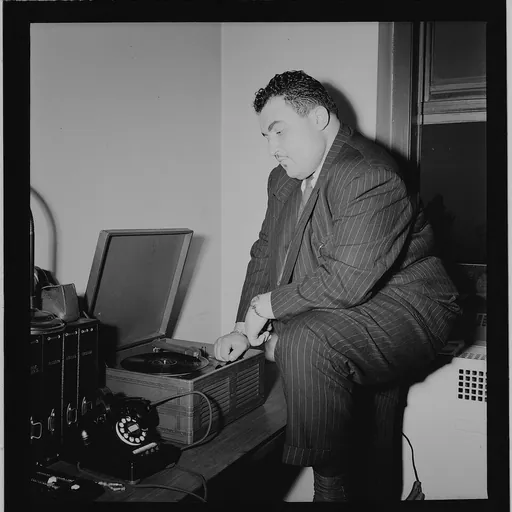
Teddy Reig
American record producer, A&R man, promoter, and artist manager
About Teddy Reig
Lived 1918 – 1984 (aged 65). Teddy Reig was an American record producer, composer, songwriter and artists & Repertoire.
Theodore Samuel Reig (November 23, 1918 – September 29, 1984) was a self-described "jazz hustler" who worked as a record producer, A&R man, promoter, and artist manager from the 1940s through the 1970s. As a record producer, he captured the work of dozens of jazz innovators. He also influenced rhythm and blues, rock and roll, and Latin music.
In 1945, Reig produced the first recordings led by the jazz saxophonist Charlie Parker. "Had he done nothing else," said Reig biographer Edward Berger, "this accomplishment alone would have ensured his place in history. But he continued to document the development of the new music through his work with a whole range of seminal artists."
Reig was born to a Jewish family on 110th Street, in Harlem, and attended New Utrecht High School, in Brooklyn. After leaving school without a diploma, he began hanging out at New York ballrooms, jazz clubs, and music hot spots, ingratiating himself with musicians, managers, and impresarios. In his early 20s he served nine months in a Kentucky jail for narcotics possession.
Jazz historian Patrick Burke wrote that Reig "initially earned his club-going money with schemes such as selling worn-out records that had been doctored with shoe polish to look brand new."
"Eventually, he was given small jobs, like placing signs announcing a gig," wrote jazz historian Richard Carlin. "Promoter Cy Shribman took him under his wing hiring him to work as a 'band boy' for Mal Hallett's band ... Band boys were responsible for managing the band's equipment and scores, and arranging the stands and chairs on stage before the band played. Reig's other 'duties' included keeping an eye on the band's stash of marijuana."
[Reig:] Down by the docks in Boston you could get all that crap that you wanted. The band always had a gang of shit [drugs] in the bus. We had a trunkful. I was in charge of the bag, and became everybody's buddy—blacks and whites.
Work as a record producer Savoy Records had been established in Newark, New Jersey, in 1942 by music entrepreneur Herman Lubinsky. In 1945, Reig, who was familiar with all the groundbreaking beboppers on the New York scene, made a deal with Lubinsky to produce jazz recordings for the label. Over the next four years, Reig recorded countless artists whose names became noted in jazz history.
Reig produced the first recordings by Miles Davis and Stan Getz. He also produced recordings by Dizzy Gillespie, Sarah Vaughan, Don Byas, Erroll Garner, Dexter Gordon, J.J. Johnson, Lester Young, Johnny Smith, Bud Powell, Quincy Jones, Redd Foxx, Sonny Stitt, Lee Morgan, Maynard Ferguson, and countless others.
"There is no question that much of this wonderful jazz would have gone unpreserved had not Reig interrupted his small-time 52nd Street hustles to become an artful bridge between musicians and the money men needed to seed a recording session," wrote jazz columnist Nels Nelson.
Recording Charlie Parker In November 1945, Reig produced Charlie Parker's first major recording session as a leader. Parker had been performing in New York for several years prior, and he'd done a handful of sessions as a sideman, but due to a recording ban that lasted from 1942 to 1944, his bebop stylings had largely gone unrecorded and were unknown outside the jazz club circuit.
Dave Gelly, at Jazz Journal, wrote that "Savoy's producer, Teddy Reig, had his work cut out assembling the musicians, paying them cash-in-hand, dealing with the union and turning out four masters per session. The material consisted entirely of originals, so there would be no publishers to pay."
About Parker, Reig later reminisced: "Bird's playing says it all. Listen to anybody: Ben [Webster], Hawk [Coleman Hawkins], Lester [Young], and you'll hear the personality of the artist come through. Bird always had a story to tell—and it was a beautiful story. Sometimes I take some of Bird's up-tempo things and play them at slower speeds. You can hear the beautiful melody line clearly. It's not just a gang of notes like some of the guys who think they're playing like Bird spew out."
When the jazz records market began to wane in the 1960s, Reig transitioned over to the Latin music market, recording its best practitioners and scouting emerging musicians arriving in the United States from Latin America.
He is credited with discovering and furthering the career of saxophonist Paul "Hucklebuck" Williams, all of whose Savoy sides Reig produced. Reig convinced Williams to switch his playing from alto to baritone sax, and insisted that Williams learn to aggressively "honk" with his instrument, a technique which led to the artist's commercial breakthrough and became one of his trademarks. In 1955 Reig was instrumental in helping sign an obscure St. Louis-based R&B singer named Chuck Berry to his first agency booking contract.
Reig's management roster included Count Basie, Erroll Garner, guitarist Johnny Smith, Paul Williams, the Solitaires, and others.
Legacy Reig was profiled in a posthumous 1995 as-told-to autobiography, Reminiscing in Tempo: The Life and Times of a Jazz Hustler, by Edward Berger of the Institute of Jazz Studies. The book was based on reminiscences recorded by Berger in the final years of Reig's life, and included additional reminiscences by musicians and record industry executives who knew and worked with Reig.
"Teddy's big secret of getting the best out of musicians was that he never paid any attention to what was going on in the studio," said Johnny Smith. "I always appreciated the fact that Teddy never came back to tell us what we should be doing. He would let the artists have complete freedom. Teddy knew enough to keep his nose out of the music." "Reig ... loved jazz as played by Basie and dollars any way they came," wrote Giddins. "That, at least, is the received wisdom about Vaughan's three years at the label, which she did nothing to dispel. At Basie's funeral service, she sat next to Billy Eckstine and giggled with mild embarrassment as [Eckstine] loudly encouraged Reig to rifle the coffin for any loot he might have overlooked."
Don’t just read it —
keep it.
Full-length biographies made to live with: read them, listen on the way to work, watch them tonight.
- E-book
- Audio
- Video
Instant download · yours to keep · every purchase keeps this site free
Important facts
People in Teddy Reig's life
Named in this biography and alive at the same time




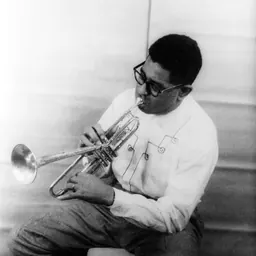
Related people
Same field, nearest in time



Contemporaries
People whose lives overlapped Teddy Reig's


Frequently asked questions
Who was Teddy Reig?
American record producer, A&R man, promoter, and artist manager
When was Teddy Reig born?
Teddy Reig was born on 23 November 1918 in New York.
When did Teddy Reig die?
Teddy Reig died on 29 September 1984 in Teaneck.
What was Teddy Reig's occupation?
Teddy Reig was a record producer, composer, songwriter and artists & Repertoire.
What nationality was Teddy Reig?
Teddy Reig was American.
Sources & further reading
Cite this page
APA: Biography.guide. (2026). Teddy Reig. https://biography.guide/teddy-reig/
MLA: "Teddy Reig." Biography.guide, https://biography.guide/teddy-reig/.
Chicago: "Teddy Reig." Biography.guide. https://biography.guide/teddy-reig/.
Data last updated: 2026-09-22 · Spot an error? Report a correction.
Portrait: Wikimedia Commons · author & licence
Page generated 2026-09-27 05:03 UTC