
Tarn Adams
American computer game programmer (born 1978)
About Tarn Adams
Born 1978. Tarn Adams is an American programmer, game programmer, computer scientist, information scientist and computer game programmer.
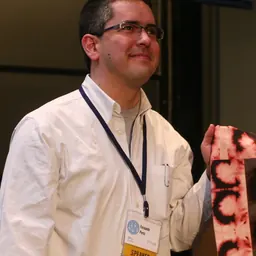
Tarn Adams (born April 17, 1978) is an American computer game programmer, best known for his work on Dwarf Fortress. He has been working on the game since 2002 together with his older brother Zach. He learned programming in his childhood, and took up designing computer games as a hobby. In 2006, he quit during his first year of a mathematics post doctorate at Texas A&M University to focus on game development.
Early life and education Tarn was born in Silverdale, in the U.S. state of Washington, in 1978. His father, Dan, worked at a waste water treatment plant and used to work in data management. He taught his sons the rudiments of coding at an early age and this shared interest allowed the brothers Tarn and Zach to remain close to each other despite their family's constant shifting due to their father's work. The brothers grew up playing computer games, drawing their own renditions of the randomly generated creatures they encountered, and logging their journeys in detail. In fifth grade, Tarn wrote his first animation game with Zach. Explaining his reluctance to socialize, he said, "I was a get-home-from-school, get-on-the-computer kind of kid." Tarn stated that the main reason they started writing games was to play them themselves, and they soon began introducing complicated and unpredictable behavior to achieve more replayability.
In sixth grade, they developed their first fantasy game, called Dragslay and written in BASIC. It consisted of single battles leading to a final encounter with a dragon. A few years later, Tarn rewrote it in the C programming language, and it featured minute details and kept track of populations of units in the generated world. In high school, Tarn and Zach created a spacecraft game that simulated sections of a rocket blowing off and released their first publicly available game on America Online.
After Dragslay, Tarn and Zach started working on another adventure game, focusing on procedural world generation. For this, they drew inspiration from the role-playing video game hit Ultima. After working on the project for four years and rendering it in 3D graphics, they released it under the title Slaves to Armok: God of Blood. "Armok" was the name of the game's deity from the variable "arm_ok", which was used in Dragslay to indicate how many arms were left on a particular unit. The addition of a random story generator was inspired by both of them being avid story writers. During his first year at Stanford, he said he was under heavy pressure, that the professional environment and competitiveness affected him negatively. He also cited a dilemma he was facing between studying mathematics and developing video games. This stressful situation drove him for a time into depression and he admitted to having had a brief stint with narcotics. Its development kept on until 8 August 2006, when the first alpha version was released. Donations reached $800–$1000 in the following months, this average increased gradually until Tarn and Zach were financially stable.
The game uses CP437 text-based graphics and is open-ended with no main objectives. It is a part construction and management simulation and part roguelike game due to its multiple game modes. Before playing, the player has to generate worlds with continents, oceans and histories documenting civilizations. The main game mode, Dwarf Fortress mode, consists of selecting a suitable site from the generated-world, establishing a successful colony or fortress, while fighting threats like goblin invasions, accumulating wealth, and taking care of the dwarves. Each dwarf is modeled down to its individual personality, has likes or dislikes, and specific trainable skills in various labors. The combat system is anatomically detailed with combat logs describing organs getting pierced, fat getting bruised, and limbs getting severed.
Continuing its development, Tarn calls it his life's work and said in 2011 that version 1.0 will not be ready for at least another 20 years, and even after that he would continue to work on it. The game influenced Minecraft, Terraria, and various other games. It was selected among other games to be featured in the Museum of Modern Art to show the history of video gaming in 2012. Fans have also made creative interpretations of the game. In the past, he and his brother sent crayon drawings or short stories to the donors, customized to their requests, and displayed the donors who have donated the most on their website.
Inspirations and preferences Tarn has cited books, movies, pen and paper role-playing games and other computer games, experienced during his childhood, as an inspiration for the various games he developed. however, this changed on Dwarf Fortress with the addition of another programmer.
Regarding his career, he said, "...but as far as design is concerned, I just think that I've happened to fall into a little sweet spot where I get a lot of freedom, but I guess the cost is my livelihood."
Don’t just read it —
keep it.
Full-length biographies made to live with: read them, listen on the way to work, watch them tonight.
- E-book
- Audio
- Video
Instant download · yours to keep · every purchase keeps this site free
Important facts
Related people
Same field, nearest in time





Contemporaries
People whose lives overlapped Tarn Adams's






Frequently asked questions
Who is Tarn Adams?
American computer game programmer (born 1978)
When was Tarn Adams born?
Tarn Adams was born on 17 April 1978 in Silverdale.
What is Tarn Adams's occupation?
Tarn Adams is a programmer, game programmer, computer scientist, information scientist and computer game programmer.
What nationality is Tarn Adams?
Tarn Adams is American.
Sources & further reading
Cite this page
APA: Biography.guide. (2026). Tarn Adams. https://biography.guide/tarn-adams/
MLA: "Tarn Adams." Biography.guide, https://biography.guide/tarn-adams/.
Chicago: "Tarn Adams." Biography.guide. https://biography.guide/tarn-adams/.
Data last updated: 2026-09-26 · Spot an error? Report a correction.
Page generated 2026-09-27 05:15 UTC