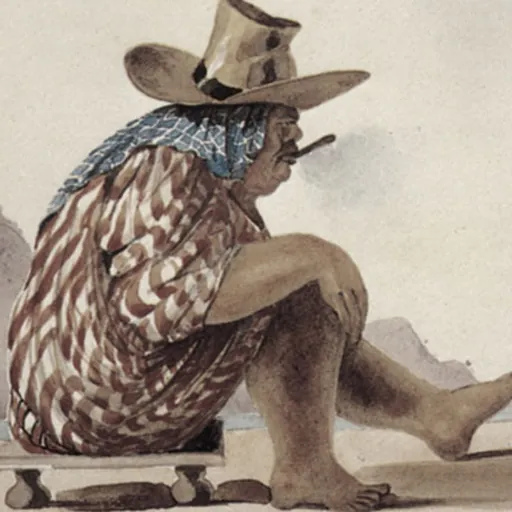
Tapoa II
King of Tahaʻa and Bora Bora
About Tapoa II
Lived 1806 – 1860 (aged 53–54).
Tapoa II (c. 1806–1860), also known as Teri'inohora'i, Pōmare, or Teari'imaevarua was a prominent figure in the political and dynastic history of the Leeward Islands during the nineteenth century. Through his marriage to Aimata, the future Queen Pōmare IV, he held the title of Royal consort of Tahiti from 1827 until December 1832. He became King of Bora Bora and Maupiti in 1840 and ruled until his death in 1860. His reign illustrates the complex interplay of indigenous leadership, missionary influence, and colonial pressures that shaped the political landscape of the Society Islands during this period.
Family Teri'inohora'i was born in 1806. His mother was Maevarua and his father was Teri'itaria. Teuira Henry pretended that he was the son of Tapoa I. Nevertheless, other sources clearly identify him as Tapoa I's grandson. He became an orphan in 1809. Davies recorded on 19 May 1809: "A canoe arrived from Raeatɛa with news that Maevarua, Tapoa's daughter, is very ill. This canoe was dispatched to fetch a man who lives in our neighbourhood named Totara. He is a priest and prophet, and supposed to have great power with the gods. He is to go to Raeatɛa to pray for Tapoa's daughter. He has been there lately on a like errand, and she got better, as was thought, by his prayers." Subsequently, on 14 July 1809, he noted: "Three canoes arrived from Raeatɛa; they come here to fetch the chiefs who are to go thither to lament the death of Maevarua, Tapoa's daughter and acknowledged chief of Tahaa and Bora Bora."
As Teri'inohora'i's mother held the rank of ari'i (chieftess) over both Bora Bora and Taha'a, traditional historical accounts and genealogies refer to her as Teari'imavarua or Teri'imaevarua, two variant forms of the same name. She should not be confused with Teri'imaevarua, a daughter of Puni, who in 1792 was reigning over Bora Bora, Maupiti, and Tupai, having lost control of Ra'iātea and Taha'a, according to George Vancouver. She was succeeded in the early 1800s by another Teri'imaevarua, known as Teri'imaevarua I, a great-granddaughter of Puni through her father Teau'e. On 7 November 1846, Henry Byam Martin, in command of , reported that Tapoa II had succeeded to the sovereignty of Bora Bora partly by right of his mother and partly by the voice of the people.
Pōmare II's visit to the Leeward Islands On 3 September 1814, Pōmare II made an unplanned visit to the Leeward Islands after adverse winds redirected the brig Mathilda, an Indian vessel commanded by Captain Fowler. He was accompanied by Charles Wilson; George Bicknell, nephew of Henry Bicknell; Samuel Pinder Henry, son of William Henry; Ta'aroaari'i, son of Mahine; and 23 individuals from the Society Islands. Compelled to remain in the Leeward Islands for three months, he visited Taha'a, Ra'iātea, and Huahine, where he was received with the highest honors. According to several testimonies dating from 1845, the chiefs of the Leeward Islands are said to have once again pledged allegiance and "ceded" their lands to Pōmare II, as they had previously done in 1810. During his stay in Taha'a, Pōmare II officially adopted Teri'inohora'i, grandson of Tapoa I, gave him his name Pōmare and betrothed him to his daughter Aimata. Fenuapeho, chief of Taha'a and a member of Tapoa I's family, was appointed regent to Teri'inohorai. Pōmare returned to Mo'orea on December 2, 1814.
Suzerainty over Taha'a Between late 1815 and early 1816, a coalition of worshippers of indigenous Tahitian deities allied with Fenuapeho in opposition to Tamatoa III and his faction of Pure Atua, or Christian converts. Although Fenuapeho was ultimately defeated, he retained his title as chief of Taha'a under Tamatoa's suzerainty.Tamatoa left the vanquished chief in possession of his lands, assuming control exclusively over the governance, which he exercised until his death.
Marriage with Aimata Teri'inohora'i married Aimata the future Queen Pōmare IV on 18 December 1822 in Huahine. The marriage was solemnized in the principal place of worship at Apo'otava. The spectacle was remarkably imposing and novel, both to Europeans and to the islanders. The relatives of the bride and groom, the chiefs from Tahiti and Huahine, together with Fenuapeho, king of Taha'a, and Tamatoa III, king of Ra'iātea, attended the ceremony.
Code of laws Tamatoa On 11 May 1820, under the guidance of English missionaries, the chiefs of the Leeward Islands, united in promulgating a formal legal code entitled E Ture, no Ra'iātea, e no Taha'a, e no Porapora, e no Maupiti, e no te fenua ri'i ato'a i pīha'i iho ("The Laws for Ra'iātea, Taha'a, Bora Bora, Maupiti, and all the small surrounding lands"). Modeled on the 1819 Tahitian code introduced by Pōmare II, this enactment marked a decisive transition from customary oral traditions to codified legislation within the Leeward Islands. Each island became independent, establishing its own government and appointing a chief justice. In the case of Taha‘a, Tamatoa III was appointed guardian of Tapoa I's young son, who was designated to succeed him. On 20 January 1825, the missionary Robert Bourne reported a contest for the governance of Taha'a. The two contenders were Pōmare or Teri'inohora'i, the grandson of Tapoa I, and the widow of Tapoa the biological son of Tapoa I, who had died a few months earlier. Pōmare received the support of the majority of Taha'a's inhabitants, while the widow of Tapoa I's son was backed by the minority on the island, along with all the chiefs and people of Ra'iātea. John Williams and Robert Bourne made every effort to mediate and resolve the conflict, but their attempts proved unsuccessful. These disruptions exerted a substantial impact on the local economy.
Second marriage and Coronation as King of Bora Bora and Maupiti Tapoa II later married Tainoa, who assumed the title Tapoa Vahine. In accordance with the peace agreement reached around mid-1832 among the chiefs regarding the division of the kingdoms of the Leeward Islands, Tapoa was crowned king of Bora Bora and Maupiti on 30 September 1840 under the title Teari‘imaevarua Third (sic), with the consent of Ma'i III and Tefa'aora II. His adopted daughter succeeded him and was formally crowned as Teriimaevarua II on 3 August 1860, in a ceremony officiated by missionary George Platt. Tapoa Vahine later died of illness on 11 April 1869 in Huahine. Her remains were repatriated to her native island of Bora Bora, accompanied by Queen Teha'apapa II, Ari'imate, and a large delegation from Huahine who paid tribute to her.
Ancestry
Don’t just read it —
keep it.
Full-length biographies made to live with: read them, listen on the way to work, watch them tonight.
- E-book
- Audio
- Video
Instant download · yours to keep · every purchase keeps this site free
Important facts
Family & relationships
People in Tapoa II's life
Named in this biography and alive at the same time






Contemporaries
People whose lives overlapped Tapoa II's






Frequently asked questions
Who was Tapoa II?
king of Tahaʻa and Bora Bora
When was Tapoa II born?
Tapoa II was born in 1806 in Bora Bora.
When did Tapoa II die?
Tapoa II died in 1860 in Bora Bora.
Sources & further reading
Cite this page
APA: Biography.guide. (2026). Tapoa II. https://biography.guide/tapoa-ii/
MLA: "Tapoa II." Biography.guide, https://biography.guide/tapoa-ii/.
Chicago: "Tapoa II." Biography.guide. https://biography.guide/tapoa-ii/.
Data last updated: 2026-09-21 · Spot an error? Report a correction.
Portrait: Wikimedia Commons · author & licence
Page generated 2026-09-27 04:58 UTC