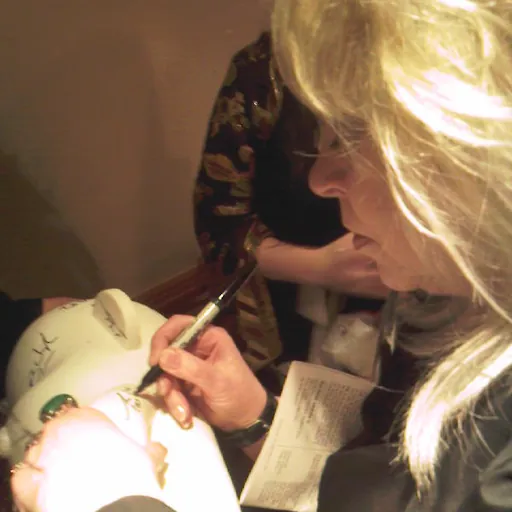
About Tanith Lee
Lived 1947 – 2015 (aged 67). Tanith Lee was a British writer, novelist, poet and science fiction writer.
Biography Early life Tanith Lee was born on 19 September 1947 in London, to professional dancers Bernard and Hylda Lee. Despite a persistent rumour, she was not the daughter of Bernard Lee (the actor who played "M" in the James Bond series films between 1962 and 1979). According to Lee, although her childhood was happy, she was the "traditional kid that got bullied," and had to move around frequently due to her parents' work. Although her family was poor, they maintained a large paperback collection, and Lee read weird fiction, including "Silken Swift" by Theodore Sturgeon and "Gabriel Ernest" by Saki, and discussed such literature as Hamlet and Dracula with her parents. Lee attended many different schools in childhood. She was at first "incapable" of reading due to a mild form of dyslexia, which was diagnosed later in life, but when she was aged 8, her father taught her to read in a few months, and she began to write at the age of 9.
Writing career She began publishing with The Betrothed (1968), a short story privately printed by a friend, but started serious writing with several children's fantasies. Of these, The Dragon Hoard (1971), her first novel, is a comic fantasy, in which an enchantress compels the quest-ridden protagonist to shapeshift into a raven at unpredictable moments. Princess Hynchatti & Some Other Surprises (collection of linked stories in 1972) puts its cast through various travails. In Companions on the Road (1975) the companions are the villains, a trio of hellish revenants who kill through their control of Dreams as they search for the holders of a magic chalice. The Winter Players (1976) – assembled with the previous book as Companions on the Road and The Winter Players: Two Novellas (1977) – dramatises the interaction between a young woman and the accursed wanderer whom she ultimately redeems. Even in these early works, several characteristic motifs dominate: the Rite of Passage whereby a young protagonist comes to terms – often via Metamorphosis – with his or her extraordinary nature, and strives for Balance in a riven world; vivid, but indeterminate, landscapes serving as almost interchangeable backdrops for psychic dramas; and a fine indifference to any moralistic settling of scores, her tales tending to close with Good and Evil characters settling into uneasy equipoise.
Her first professional sale came from "Eustace," a ninety-word vignette at the age of 21 in 1968. She continued to work in various jobs for almost another decade, due to rejection of her books. The Birthgrave allowed Lee to be a full-time writer and stop doing "stupid and soul-killing jobs."
During the nineties her "career went through the doldrums" because of trends in publishing. Major publishing companies were less accepting of Lee's later works. The companies which Lee worked with for years refused to look at her proposals. Smaller companies were publishing just a few of Lee's works. The refusals did not stop her from writing and she had numerous unpublished novels and short stories.
Works Lee often used the transitional character of the bildungsroman, or coming-of-age stories. For instance, the protagonist of Lee's The Birthgrave undertakes a journey to understanding her identity and culture.
Lee's two longest werewolf stories, "Wolfland" and Lycanthia, followed Lee's custom of reversing the images of popular culture icons. Lee approximated the werewolves' behaviours according to the social and hunting patterns of wild wolves. In altering this trope, she endowed werewolf stories with a new and more positive mythos.
Lee's 1971 debut was the children's book The Dragon Hoard; her first adult book was The Birthgrave in 1975. Lee's prolific output spans a host of different genres, including adult fantasy, children's fantasy, science fiction, horror, Gothic horror, Gothic romance, and historical fiction. Her series of interconnected tales called The Flat-Earth Cycle, beginning with Night's Master and Death's Master, is similar in scope and breadth to Jack Vance's The Dying Earth.
Night's Master contains allegorical tales involving Azhrarn, a demonic prince who kidnaps and raises a beautiful boy and separates him from the sorrow of the real world. Eventually, the boy wants to know more about the earth, and asks to be returned, setting off a series of encounters between Azhrarn and mankind, some horrific and some positive. Later tales are loosely based on Babylonian mythology. In the science fiction Four-BEE series, Lee explores youth culture and identity in a society which grants eternally young teenagers complete freedom. They are even killed and receive new bodies, gender and/or identity over and over again. Lee has also written a historical novel with The Gods are Thirsty, set during the French Revolution.
Lee was published by various imprints, particularly depending on whether she was offering adult fiction or children's fantasy. Her earlier children's fantasy novels were published in hardcover by Macmillan UK and subsequently printed as paperbacks in the US often by DAW, with occasional hardcovers by St. Martin's Press. Some of her work was only printed in paperback, mainly in the US by DAW in the 1970s to the early 1980s. She received some small press treatment, such as the Arkham House edition of short stories Dreams of Dark and Light: The Great Short Fiction of Tanith Lee in 1986, and in the first "Night Visions" instalment published by Dark Harvest. The technique she used is very descriptive and poetic to match the themes she used in her mythical stories. She was praised for her ability to balance her weird style with the challenges of writing a faraway world, but some critics counter that her style is not always easy on the reader; she sometimes leaves the reader with unanswered questions. She also wrote lesbian fiction under the pseudonym Esther Garber. Other than feminism and sexuality, Lee used a wide range of other themes in her stories. From 1975 to 1980, she began writing Gothic science fiction; her first Gothic novel "Sabella or the Bloodstone" features themes of loneliness and fear. These themes reoccur in her 1976 novel Don't Bite the Sun where the characters are involved in a very erotic lifestyle and the protagonist experiences despair. Eroticism shows up again in her novel "Death's Master" which examines the childhood origins of eroticism and the "later conflicts that arise from it". The sequel to Don't Bite the Sun, Drinking Sapphire Wine, is thematically similar to her other works, in that it features themes of death and renewal, sexuality, and love. The theme of recognition also appears in Drinking Sapphire Wine, where the characters are forced to recognize others and themselves in a world where physical form is so readily alterable. Her Flat Earth series was inspired by a game she played with her mother; some of her other works are influenced by fairy tales her mother told her. Much of her work comes from "small things" rather than major inspirations.
Authors Lee was inspired by writers and playwrights, including Graham Greene, Rebecca West, Elizabeth Bowen, Jack Vance, Fritz Leiber, Theodore Sturgeon, Angela Carter, Jane Gaskell, Charles Dickens, William Shakespeare, William Blake, Anton Chekhov, Harold Pinter, Tennessee Williams, Arthur Miller, Henrik Ibsen, August Strindberg, Ivan Turgenev, Ivan Bunin, Henry James, Rosemary Sutcliff, Mary Renault, Jean Rhys, John Fowles, John le Carré, the Brontë family, E. M. Forster, W. Somerset Maugham, Isabel Allende, Margaret Atwood, Ruth Rendell, Lawrence Durrell, Elroy Flecker, and Ted Hughes. Lee considered Virginia Woolf and C. S. Lewis to be influential on her from a young age.
Don’t just read it —
keep it.
Full-length biographies made to live with: read them, listen on the way to work, watch them tonight.
- E-book
- Audio
- Video
Instant download · yours to keep · every purchase keeps this site free
Important facts
People in Tanith Lee's life
Named in this biography and alive at the same time





Related people
Same field, nearest in time

Contemporaries
People whose lives overlapped Tanith Lee's




Frequently asked questions
Who was Tanith Lee?
British writer (1947-2015)
When was Tanith Lee born?
Tanith Lee was born on 19 September 1947 in London.
When did Tanith Lee die?
Tanith Lee died on 24 May 2015 in East Sussex.
What was Tanith Lee's occupation?
Tanith Lee was a writer, novelist, poet and science fiction writer.
What nationality was Tanith Lee?
Tanith Lee was British.
Sources & further reading
Cite this page
APA: Biography.guide. (2026). Tanith Lee. https://biography.guide/tanith-lee/
MLA: "Tanith Lee." Biography.guide, https://biography.guide/tanith-lee/.
Chicago: "Tanith Lee." Biography.guide. https://biography.guide/tanith-lee/.
Data last updated: 2026-09-21 · Spot an error? Report a correction.
Portrait: Wikimedia Commons · author & licence
Page generated 2026-09-27 04:59 UTC