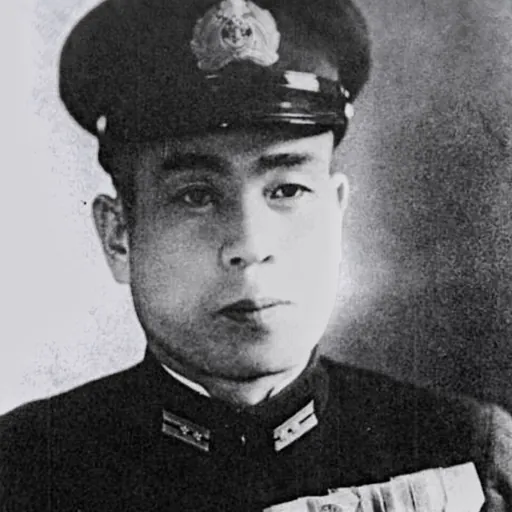
About Tameichi Hara
Lived 1900 – 1980. Tameichi Hara was a Japanese military personnel.
was an Imperial Japanese naval commander during the Pacific War and the author of the IJN manual on torpedo attack techniques, notable for his skill in torpedo warfare and night fighting. Hara was the only IJN destroyer captain at the start of World War II to survive the entire war and his memoirs serve as an important source for historians.
Early life Hara was born on October 16, 1900, in a suburb of Takamatsu City on the island of Shikoku. A native of Kagawa Prefecture and of samurai descent, Hara graduated with the 49th class from the Imperial Japanese Naval Academy at Etajima in 1921. In 1932 Hara was assigned as a surface warfare instructor and wrote a torpedo attack manual that was accepted as official doctrine. He began the war as the captain of destroyer .
Military career Amatsukaze (center bottom), under Hara's command, maneuvers at high speed to evade a high-level bomb attack by B-17 bombers on the disabled Japanese aircraft carrier (center right) during the Battle of the Eastern Solomons. Hara commanded a Japanese destroyer or destroyer division in many significant Pacific sea battles. As captain of the Commander Hara participated in the Battle of the Java Sea, the capturing of the hospital ship and the sinking of the submarines and , and the occupation of Christmas Island. He wrote in his memoirs of having spotted Perch in the darkness of the night after detecting it when he saw a sailor topside on the vessel light a cigarette an estimated away. Under his command, Amatsukaze also took part in the Battle of Midway in June 1942 and the Battle of the Eastern Solomons in August 1942. On 13 November 1942 Hara's Amatsukaze sank the destroyer and helped to sink the light cruiser during the Naval Battle of Guadalcanal but was severely damaged in turn after Hara left his searchlights on too long and drew intense fire from the light cruiser .
After Amatsukaze returned to Japan for repairs, Hara was promoted to captain and given the command of Destroyer Division 27, flying his flag aboard . While this was technically a four-ship formation the demands on the Imperial navy were such that Hara's ships rarely operated together. While serving aboard Shigure, Hara was involved in several fierce naval engagements during the latter part of the Solomon Islands Campaign. While on a re-supply mission through Blackett Strait on 2 August 1943, Hara noticed a fireball exploding near leading destroyer and ordered s crew to shoot at the burning wreckage of Lt. John F. Kennedy's . During the Battle of Vella Gulf on 6–7 August Shigure was the only one of four Japanese destroyers to escape, though she was later found to have been hit by a torpedo, passing through the rudder, that failed to explode.
Although undamaged in the Bombing of Rabaul (November 1943), Shigure was ordered back to Sasebo for a long overdue refit. Hara was relieved of his command and reassigned as senior torpedo instructor at the Naval Torpedo School at Oppama near Yokosuka to teach students in the Imperial Japanese Navy's belated Motor Torpedo Boat program. Hara was quickly frustrated with the lack of effective equipment as well as the lack of leadership in the navy and army. He hastily wrote a letter intended for emperor Hirohito, urging him to fire the heads of the army and navy and seek peace as the war was lost, and hand-delivered it to Hirohito's younger brother Nobuhito, Prince Takamatsu, at the Navy Ministry. Despite the potentially grave consequences of this action Hara did not hear anything further on the matter.
Hara's last sortie was as captain of the light cruiser as flagship of the destroyer screen accompanying on her fateful last mission as part of Operation Ten-Go. Hara survived the sinking of Yahagi, which also saw the loss of Yamato and four escorting destroyers.
Hara ended the war at Kawatana training Japanese sailors to operate Shinyo suicide boats, where he witnessed firsthand the effects of the second atomic bombing.
Major wartime actions During the war Captain Hara participated in 14 major actions: Air raid against American naval base at Davao on Mindanao (Philippines), 8 December 1941, escorting aircraft carrier ; a complete fiasco, as no American ships were found (on Amatsukaze) Invasion of Davao on 20 December 1941, an easy Japanese victory, as the base was already almost completely evacuated (on Amatsukaze) Invasion of Ambon Island, 30 January – 3 February 1942, a Japanese victory (on Amatsukaze) Battle of the Java Sea, 27–28 February 1942, a great Japanese victory (on Amatsukaze) Invasion of Christmas Island, 31 March 1942, an easy Japanese victory as British garrison surrendered without resistance (on Amatsukaze) Battle of Midway, 4–7 June 1942, a decisive Japanese defeat (on Amatsukaze) Battle of the Eastern Solomons, 24–25 August 1942, a serious Japanese defeat (on Amatsukaze) Battle of the Santa Cruz Islands, 26 October 1942, a costly Japanese victory (on Amatsukaze) Naval Battle of Guadalcanal, 13 November 1942, a costly Japanese defeat (on Amatsukaze) Battle of Vella Gulf, 6–7 August 1943, a crushing Japanese defeat (on Shigure) Battle off Horaniu, 17 August 1943, inconclusive (on Shigure) Battle of Vella Lavella, 6 October 1943, the last Japanese naval victory of the war (on Shigure) Battle of Empress Augusta Bay, 1–2 November 1943, a heavy Japanese defeat (on Shigure) Operation Ten-Go, 7 April 1945, a crushing Japanese defeat (on Yahagi)
List of victories Source: British oil tanker, destroyed by Amatsukazes guns during the successful capture of the port of Davao , a Dutch hospital ship that Amatsukaze helped to capture on 28 February 1942. She escorted Op Ten Noort to Singapore where she was converted into a prisoner of war ship. , a Dutch submarine fatally damaged by Amatsukaze and the destroyer on 1 March 1942. K X was scuttled the next day in harbor due to being damaged too badly to escape the increasingly hostile port of Surabaya. , an already crippled US submarine finished off by Amatsukaze and the destroyer , 3 March 1942. were translated into English and French and became an important reference for the Japanese perspective for historians writing about the Pacific Campaign of World War II. In his memoir, Hara objects to compulsory suicide as official doctrine, which he saw as a violation of bushido values. His personal doctrines demonstrate why he survived the war and the Japanese lost it – they were inflexible, and he was not. His doctrines were "Never ever do the same thing twice" and "If he hits you high, then hit him low; if he hits you low, then hit him high", the latter being also a maxim of Douglas MacArthur's. Hara criticizes his superiors for using cavalry tactics to fight naval battles; never understanding the implications of air power; dividing their forces in the face of enemy forces of unknown strength; basing tactics on what they thought their enemy would do; failing to appreciate the speed with which the enemy could develop new weapons and accepting a war of attrition with a foe more capable of maintaining it.
Hara does make some mistakes in this memoir, the most egregious of which would be his claim that the destroyer torpedoed and sank the light cruiser at the naval battle of Guadalcanal, (Helena actually survived the battle without significant damage, and was only later sunk at the battle of Kula Gulf by the destroyers and , 6 June 1943), and that there were three Japanese battleships at the 2nd naval battle of Guadalcanal (there was in fact only one, the ).
Personal life Hara had three children with his wife Chizu: two daughters Keiko and Yoko, and a son, Mikito, who was born shortly before the start of hostilities.
Don’t just read it —
keep it.
Full-length biographies made to live with: read them, listen on the way to work, watch them tonight.
- E-book
- Audio
- Video
Instant download · yours to keep · every purchase keeps this site free
Important facts
People in Tameichi Hara's life
Named in this biography and alive at the same time





Related people
Same field, nearest in time




Contemporaries
People whose lives overlapped Tameichi Hara's



Frequently asked questions
Who was Tameichi Hara?
Japanese Naval officer (1900–1980)
When was Tameichi Hara born?
Tameichi Hara was born in 1900 in Kagawa Prefecture.
When did Tameichi Hara die?
Tameichi Hara died in 1980 in Japan.
What was Tameichi Hara's occupation?
Tameichi Hara was a military personnel.
What nationality was Tameichi Hara?
Tameichi Hara was Japanese.
Sources & further reading
Cite this page
APA: Biography.guide. (2026). Tameichi Hara. https://biography.guide/tameichi-hara/
MLA: "Tameichi Hara." Biography.guide, https://biography.guide/tameichi-hara/.
Chicago: "Tameichi Hara." Biography.guide. https://biography.guide/tameichi-hara/.
Data last updated: 2026-09-22 · Spot an error? Report a correction.
Portrait: Wikimedia Commons · author & licence
Page generated 2026-09-27 05:02 UTC