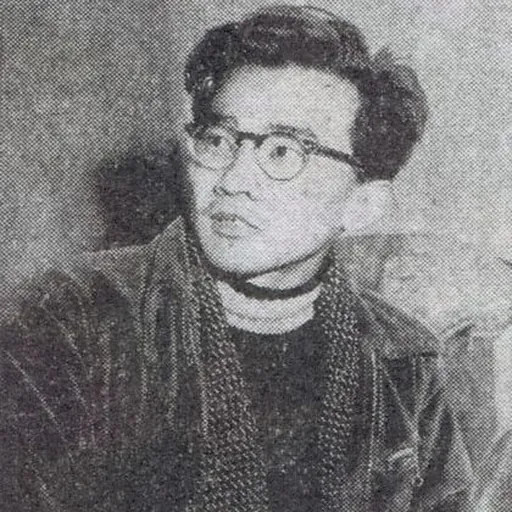
About Takeshi Kaikō
Lived 1930 – 1989 (aged 58). Takeshi Kaikō was a Japanese prose writer, journalist, writer, editing staff, peace activist and screenwriter.
, also known as Ken Kaikō, was a Japanese novelist, short-story writer, essayist, literary critic, and television documentary writer. He was distinguished by his knowledge, intellect, sense of humor and conversational skills, and although his style has been criticized as wordy and obtuse, he was one of the more popular Japanese writers in the late Shōwa period.
Early life Kaikō was born in the Tennoji Ward of Osaka as the son of an elementary school teacher. In 1948, he enrolled in the Law Department of Osaka City University, but was often absent from class, as he had to take a variety of part-time jobs in order to pay for his tuition. While in school, rather than study law he was sidetracked by the works of Motojirō Kajii, Mitsuharu Kaneko and Atsushi Nakajima. He also translated the works of Sherwood Anderson and Louis Aragon into Japanese. He graduated in 1953 and moved to Tokyo, where he took a job with Kotobukiya (the present Suntory), where he worked in the public-relations department.
He married Yōko Maki, a poet.
Literary career Kaikō published his first work, Na no nai machi (Nameless City, 1953) in the literary magazine Kindai Bungaku soon after his move to Tokyo. It was largely ignored by critics. However, his second work, a short story titled Panniku (Panic, 1957) published in the Shin Nippon Bunkaku, caused a sensation for its unusual concept and style. It was a story about a dedicated forester in a rural prefecture of Japan, who struggles against government incompetence and corruption. Kaikō wrote the story as a satirical allegory comparing human beings to mice.
Kaikō won the prestigious Akutagawa Prize in 1957 with his Hadaka no ōsama (The Naked King), a story critical of the pressures placed on school children by Japan's educational system.
Kaikō is considered a leftist activist, respected in many Indochinese countries, in particular, for his vocal opposition to Japan's support of the United States' policies in Indochina in the 1960s. He was one of the founders of the Beheiren (Betonamu ni heiwa wo! Shimin rengo), or the Citizen's League for Peace in Vietnam. This activity was related to his experience as a war correspondent in Vietnam with the Asahi Shimbun; he was briefly imprisoned by the Viet Cong. These experiences translated into his novel, Kagayakeru yami (Into a Black Sun, 1968), an account of a Japanese journalist experiencing first-hand the life of the Americans and South Vietnamese troops in Vietnam. The novel won the prestigious Mainichi Book Award.
However, Kaikō had a wide range of topics in his repertory. Natsu no yami (Darkness in Summer, 1971) was essentially a romance between a reporter and an expatriate Japanese woman living in Europe.
Kaikō enriched the Japanese language with the word "apache", to denote scavengers of recyclables, described in his novel, Japan's Threepenny Opera.
Considered a gourmet and an avid angler, in his later years Kaikō wrote numerous essays on food and drink, as well as appearing on food-related or fishing-related TV shows and in TV commercials. His 1984 expedition to Alaska in search of king salmon was documented in the video Kawa wa Nemuranai (, "The River Doesn't Sleep"), which the photographer Yoichi Aoyagi planned, directed and published through Bungeishunjū; his still photographs of the trip were issued by Bungeishunjū in February 2009 as a photo essay of the same title, which also revived Kaikō's recorded commentary on the expedition.
He died of esophageal cancer. His grave is at the Shorei-in sub-temple of the Engaku-ji Temple complex, Kamakura, Kanagawa.
Legacy His former house in Chigasaki, Kanagawa has been preserved as a memorial museum.
Don’t just read it —
keep it.
Full-length biographies made to live with: read them, listen on the way to work, watch them tonight.
- E-book
- Audio
- Video
Instant download · yours to keep · every purchase keeps this site free
Important facts
People in Takeshi Kaikō's life
Named in this biography and alive at the same time






Related people
Same field, nearest in time

Contemporaries
People whose lives overlapped Takeshi Kaikō's


Frequently asked questions
Who was Takeshi Kaikō?
Japanese writer and activist (1930–1989)
When was Takeshi Kaikō born?
Takeshi Kaikō was born on 30 December 1930 in Osaka.
When did Takeshi Kaikō die?
Takeshi Kaikō died on 9 December 1989 in Chigasaki.
What was Takeshi Kaikō's occupation?
Takeshi Kaikō was a prose writer, journalist, writer, editing staff, peace activist and screenwriter.
What nationality was Takeshi Kaikō?
Takeshi Kaikō was Japanese.
Sources & further reading
Cite this page
APA: Biography.guide. (2026). Takeshi Kaikō. https://biography.guide/takeshi-kaiko/
MLA: "Takeshi Kaikō." Biography.guide, https://biography.guide/takeshi-kaiko/.
Chicago: "Takeshi Kaikō." Biography.guide. https://biography.guide/takeshi-kaiko/.
Data last updated: 2026-09-20 · Spot an error? Report a correction.
Portrait: Wikimedia Commons · author & licence
Page generated 2026-09-27 04:57 UTC