
About Takeo Hirose
Lived 1868 – 1904 (aged 35). Takeo Hirose was a Japanese military personnel.
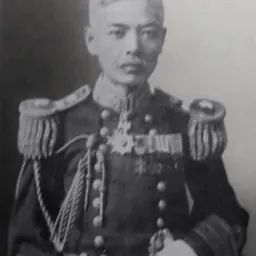
was a career officer in the Imperial Japanese Navy. He commanded the cargo vessel Fukui Maru during the Battle of Port Arthur in the Russo-Japanese War. The ship was hit by coastal artillery, and despite being wounded, he was killed while looking for other survivors of the sinking, going down with his ship. His selfless sacrifice elevated him to the status of a deified national hero.
Biography
Born in what is now Taketa, Ōita, his father Hirose Shigetake was a judge, while his elder brother Hirose Katsuhiko was a rear admiral. He studied at the Imperial Japanese Naval Academy in Etajima, graduating from the 15th class in 1889. He served aboard the ironclad warship during the First Sino-Japanese War and saw action at the Battle of Yalu River on September 17, 1894. From 1897 to 1899 Hirose was sent to study in Russia and stayed on as the resident military attaché in St. Petersburg until 1902. During his time as attaché he went on a tour of Germany, France and Great Britain. He was promoted to lieutenant commander in 1900.
When Japan went to war against Russia in the Russo-Japanese War in 1904, Hirose was assigned to the battleship as torpedo officer. However, during the Battle of Port Arthur he volunteered to command the Fukui Maru, an old cargo vessel which was used as a blockship during the second unsuccessful attempt to blockade the entrance to Port Arthur on the night of March 26. As the ship was about to reach the channel, it was hit by Russian artillery and a torpedo fired by a destroyer Silnyi and sunk. Hirose was fatally wounded while searching for survivors and went down with the ship.
Because of his heroism, he was posthumously promoted to commander, and deified as a "martial spirit" (軍神 gunshin), and a Shinto shrine was built in his honor in Taketa, Oita. A statue of him was also erected outside the Manseibashi Railway Station in Tokyo until 1947.
Cultural references Song of Commander Hirose was a Monbusho Shoka, or a song authorized by the Ministry of Education, a predecessor of the current Ministry of Education, Culture, Sports, Science and Technology.
Hirose was the subject of the epic historical novel Saka no Ue no Kumo, by author Ryōtarō Shiba. The novel became the basis for the NHK television drama Saka no Ue no Kumo, in which Hirose portrayed by ex-Olympic swimmer and actor Takahiro Fujimoto.
Don’t just read it —
keep it.
Full-length biographies made to live with: read them, listen on the way to work, watch them tonight.
- E-book
- Audio
- Video
Instant download · yours to keep · every purchase keeps this site free
Important facts
People in Takeo Hirose's life
Named in this biography and alive at the same time
Related people
Same field, nearest in time





Contemporaries
People whose lives overlapped Takeo Hirose's




Frequently asked questions
Who was Takeo Hirose?
Japanese Naval officer (1868–1904)
When was Takeo Hirose born?
Takeo Hirose was born on 27 May 1868 in Taketa.
When did Takeo Hirose die?
Takeo Hirose died on 27 March 1904 in Lüshunkou District.
What was Takeo Hirose's occupation?
Takeo Hirose was a military personnel.
What nationality was Takeo Hirose?
Takeo Hirose was Japanese.
Sources & further reading
Cite this page
APA: Biography.guide. (2026). Takeo Hirose. https://biography.guide/takeo-hirose/
MLA: "Takeo Hirose." Biography.guide, https://biography.guide/takeo-hirose/.
Chicago: "Takeo Hirose." Biography.guide. https://biography.guide/takeo-hirose/.
Data last updated: 2026-09-25 · Spot an error? Report a correction.
Page generated 2026-09-27 05:13 UTC